


Pensions in 2030: 40,000 or 46,000 lekë?
From nominal growth to real purchasing power, the cost for the working generation, and the problem the new figure does not solve.
In Albania, the pension debate has increasingly focused on a government-set target for the average full urban pension to reach ALL 40,000 per month by 2030. The target for the partial urban pension is ALL 22,000, while the rural pension is targeted at ALL 18,000. According to the Ministry of Finance framework, the full urban pension would increase from approximately ALL 27,350 today to ALL 40,000, representing a nominal increase of around 46%.
But here we need to distinguish between two issues that are often confused.
The first issue addresses the question of whether a pensioner in 2030 will be better off than a pensioner in 2026.
For this purpose, the appropriate benchmark is the current pension of approximately ALL 27,350. If average inflation is 3% per year, ALL 40,000 in 2030 would have the purchasing power of approximately ALL 34,500 today. The real increase would remain positive, but would be significantly smaller than the 46% nominal increase.
The second issue is different: how high would the nominal pension need to be in 2030 for today’s ALL 40,000 to retain the same purchasing power?
In this case, with average inflation of 3%, the figure would rise to approximately ALL 46,300. At 2.5% inflation, it would be around ALL 45,000, while at 4% it would reach approximately ALL 48,700. The difference between ALL 40,000 and ALL 46,000 is not a cosmetic debate. It represents the cost of preserving purchasing power over the four-year period.
If the policy objective is simply “ALL 40,000”, then this level is a stated minimum. If the objective is for pensioners to live no worse than they do today, then ALL 40,000 is the starting point, not the endpoint.
How much can a pension actually buy in 2030?
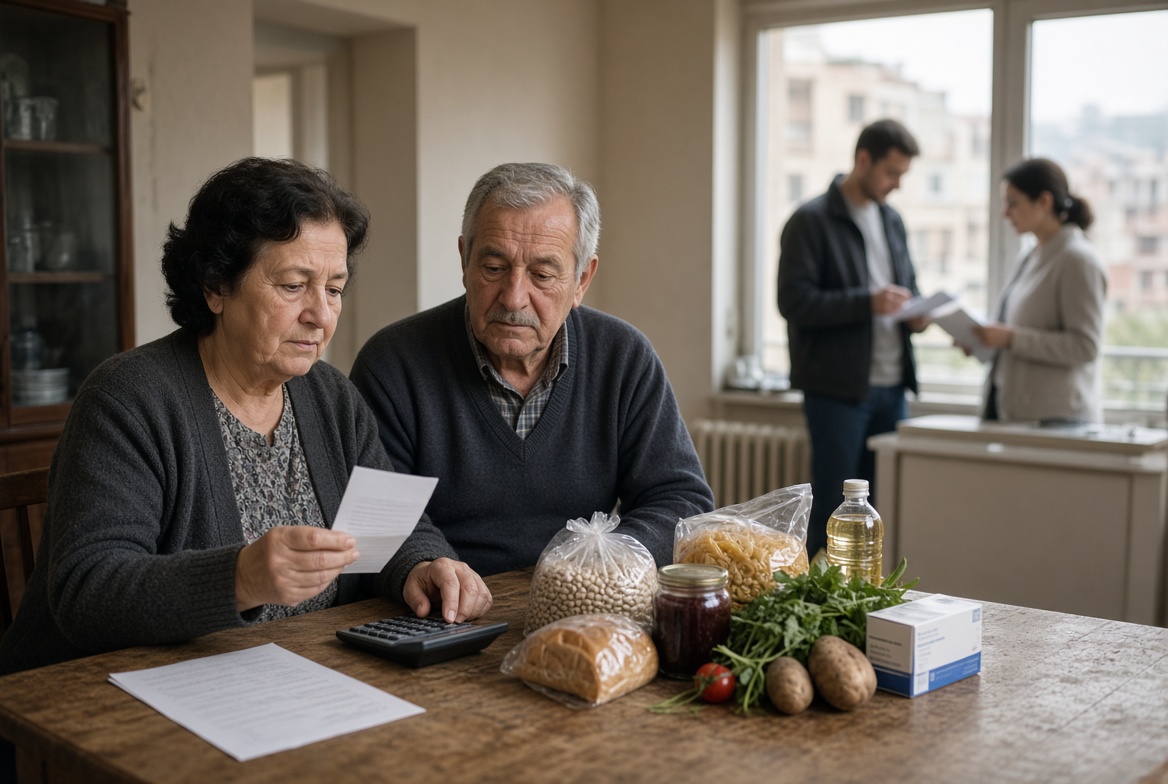
A pensioner does not consume the average consumption basket of the entire population. Food, energy, medicines and healthcare account for a larger share of their household budget.
As an illustrative scenario, a pensioner today might spend around ALL 15,000–16,000 on basic food, ALL 4,000–5,000 on energy and water, ALL 3,000–4,000 on medicines, and ALL 2,000–3,000 on transport or other services. If these categories increase faster than overall inflation, as has often happened, then even a pension that rises in nominal terms may purchase less than it appears to.
Therefore, pension adequacy should be measured against at least three thresholds:
- protection against inflation, meaning preservation of current purchasing power;
- coverage of the pensioner’s basic consumption basket without pushing them toward complete dependence on family support;
- the relationship between pensions and the wages of those who work and contribute.
The pension–wage link: what happens to the ratio in 2030?
Today, according to ISSH reports, the average pension is approximately 32% of the contributory wage. The average gross wage in the second quarter of 2026 was ALL 92,150. Comparisons with the region, where figures in the 35–45% range are often cited, should be treated with caution because the replacement rate varies depending on the methodology: average pension relative to average wage, new pension relative to the final wage, gross versus net. Where there is no clear methodological specification, international comparisons remain inaccurate.
But the pension-to-wage ratio is not static. It depends on how quickly wages rise and how quickly pensions increase. If the pension is analyzed only against inflation, an essential dimension is lost: the pensioner’s relative position compared with those who are working.
Under an illustrative scenario:
- If the full urban pension reaches ALL 40,000 and the average wage rises to ALL 100,000, the ratio would be 40%.
- If the pension reaches ALL 46,000—the level required to preserve the purchasing power of today’s ALL 40,000 at 3% inflation—and the average wage rises to ALL 110,000, the ratio would be approximately 41.8%.
These figures are not a forecast. They illustrate that pensions should not be measured only against prices, but also against wage dynamics. If wages rise faster than pensions, pensioners lose ground relative to the living standards of the wider society even when their pensions increase in nominal terms. If pensions rise faster than wages, the burden on contributors becomes heavier.
Therefore, a sustainable target cannot be simply “ALL 40,000”, but rather a pension-to-wage ratio that remains reasonable while purchasing power is preserved.
Who pays for the increase?
Pension increases represent a transfer of public resources across generations. They are financed partly through the contributions of the working generation and, when the pension scheme is not fully covered by contributions, through the state budget.
The International Monetary Fund estimates that the planned increases could add approximately ALL 10 billion per year to the cost of the scheme, with a cumulative effect of around ALL 50 billion by 2030. This does not mean that ALL 50 billion must be found every year. It refers to a cumulative effect. However, over time, part of this additional cost becomes a permanent expenditure of the scheme and requires a sustainable source of financing, including contributions, tax revenues and economic growth.
In 2026, the social insurance scheme absorbs approximately ALL 204.1 billion, equivalent to 7.3% of GDP. The budget provides for monthly increases with an estimated annual effect of around ALL 10.4 billion, in addition to indexation and the bonus. These substantial budgetary allocations show that the reform is also being supported by budget transfers, not solely by contributions.
The problem that ALL 40,000 does not solve is demographics
The greatest pressure does not come from the monthly figure of ALL 40,000, but from the structure of the population.
As of 1 January 2026, Albania’s population stood at 2,335,930, down 1.16% from a year earlier. People aged 65 and over accounted for around 20% of the population, compared with 11% in 2011. The old-age dependency ratio has reached 30.4%, up from 16.7% in 2011. The World Bank estimates that only around 46% of the working-age population currently contributes to the system and that by 2060, as much as 34% of Albanians could be above retirement age.
The more intuitive question is not simply how many pensioners there will be, but how many working-age people will finance each pensioner. If this ratio deteriorates, every nominal increase in pensions will place a greater financial burden on those who remain active in the labor market.
What would a sustainable pension look like?
The problem cannot be solved by establishing a new pension amount every year. It requires defining in advance the rule governing how pensions evolve in relation to prices, wages and individuals’ contribution histories.
A more sustainable formula would combine inflation indexation, a share of real wage growth, the individual’s contribution history and the financial capacity of the scheme. This would avoid two opposite risks: first, pensions falling behind inflation; and second, politically driven increases creating fiscal obligations without a clearly identified source of financing.
Pensioners need higher incomes. The budget needs those increases to be financially sustainable. But today’s contributors have another, longer-term question: will the system they are financing still exist when it is their turn to retire?
By 2030, the real test of pension reform will not be whether the pension slip shows ALL 40,000. The test will be whether those ALL 40,000 can buy more, whether the scheme can be financed without placing an uncontrolled burden on contributors, and whether today’s working generation will have the same security when its turn comes.
Pensions should be measured not only in lek, but in purchasing power, relative to wages, and over time.

Leave a Reply
You must be logged in to post a comment.