


Research analysis on the taxation of freelance professionals in the Western Balkans
Taxation, Social Contributions, and the Competitiveness of Freelancers in the Western Balkans (WB6) – 2026
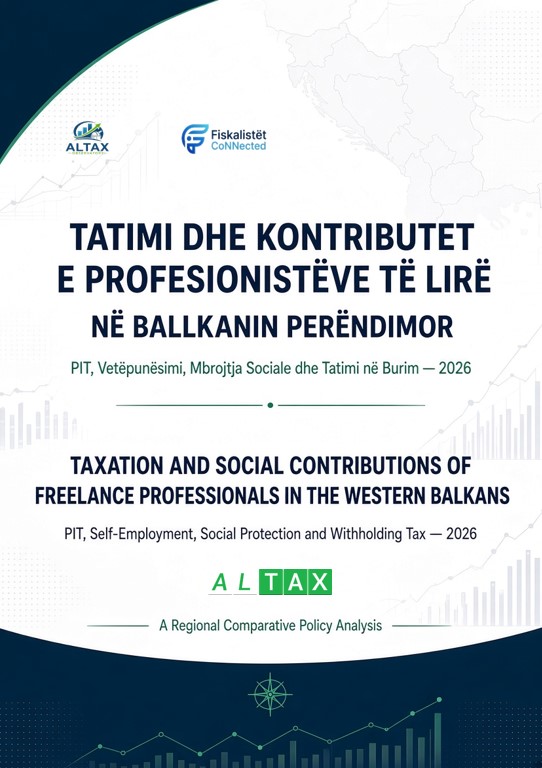
ALTAX has published a new report titled “Taxation and Contributions of Freelancers in the Western Balkans – PIT, Self-Employment, Social Protection, and Withholding Tax – 2026,” a comparative analysis of six Western Balkan countries: Albania, Kosovo, Montenegro, North Macedonia, Serbia, and Bosnia and Herzegovina.
The ALTAX Observatory study goes beyond the traditional comparison of tax rates. Using a three-level Fiscal Burden Model, the analysis evaluates not only the statutory personal income tax (PIT) rate but also the burden on the taxable base after deductions and the total mandatory burden, including social contributions. The model is tested across four annual gross income levels: €10,000, €25,000, €50,000, and €100,000.
The key finding is that the tax rate does not reflect the full burden.
The report highlights that the taxable base, deduction regimes, and mandatory contributions have a greater impact on the actual burden than the PIT rate itself. Therefore, comparing tax systems cannot rely solely on nominal rates. A 10% rate applied to €100,000 with minimal deductions does not impose the same burden as a 10% rate applied to the same income after significant deductions. This is precisely where what the report identifies as regional “tax-base arbitrage” emerges.
One of the study’s key findings concerns the differing treatment of freelancers and employees within social security schemes.
In Albania, North Macedonia, Montenegro, and Bosnia and Herzegovina, freelancers are not required to pay social security contributions—or such contributions are voluntary—whereas employees face a substantial contribution burden. In Albania, this gap amounts to approximately 28 percentage points.
According to the analysis, this disparity creates a significant channel for arbitrage between employment and self-employment, potentially impacting labor market formalization, the contribution base, and the long-term sustainability of the social protection system.
The ALTAX model places Albania’s total fiscal burden on freelancers at around 12% of gross income across the analyzed scenarios—a rate that remains relatively stable regardless of income levels. This places Albania in a competitive position for middle- and high-income freelancers. However, the report highlights that the significant disparity in social security contribution burdens between employees and freelancers remains a key issue regarding tax system neutrality and labor market formalization.
Another important factor is the VAT threshold. In Albania, it stands at approximately €100,000, whereas in other Western Balkan 6 (WB6) countries, it ranges from around €16,250 in North Macedonia to about €68,085 in Serbia.
The region is diverging into distinct fiscal models.
The analysis identifies a clear fragmentation in taxation systems for freelancers.
On one hand, there are countries with relatively low burdens and no mandatory contributions; on the other, there are countries applying a model characterized by a heavier fiscal burden and broader social protection.
In the ALTAX model scenarios, Serbia emerges as having the system with the highest and most progressive burden, while Bosnia and Herzegovina shows the lowest. Kosovo sits at an intermediate level, with a relatively stable burden. The cross-border dimension is becoming increasingly important.
For professionals providing IT, consulting, design, and other professional services abroad, the report also analyzes VAT, the reverse charge mechanism, withholding tax (WHT), double taxation treaties (DTTs), and the risk of creating a Permanent Establishment (PE).
In B2B services, the reverse charge mechanism remains a key element of cross-border treatment. Meanwhile, exposure to WHT and protection under DTTs can significantly alter the actual cost of operations, depending on the jurisdiction and the client relationship.
What does the analysis imply for policymaking?
The report does not aim to declare a “winning country.” Instead, it frames the discussion around four key dimensions:
tax neutrality between employment and self-employment;
social protection for independent professionals;
administrative simplicity and compliance costs;
cross-border competitiveness regarding talent and digital services.
In this context, the report suggests that a more neutral system requires addressing not only Personal Income Tax (PIT) rates but also social security contributions, the tax base, deductions, VAT, and the treatment of cross-border income. A new debate regarding the freelance economy represents another dimension of the analysis.
The rise of remote work, digital platforms, and cross-border B2B services is transforming the freelancer into an increasingly important component of the Western Balkans’ labor market.
For this reason, the way countries in the region tax freelancers is no longer merely a technical tax issue. It is directly linked to the formalization of labor, social protection, fiscal competitiveness, and the ability of these countries to attract and retain digital talent.
The full bilingual report (Albanian/English) is part of the ALTAX Observatory’s research publications and aims to contribute to the professional debate regarding the development of fiscal and labor market policies in the Western Balkans.

Leave a Reply
You must be logged in to post a comment.