


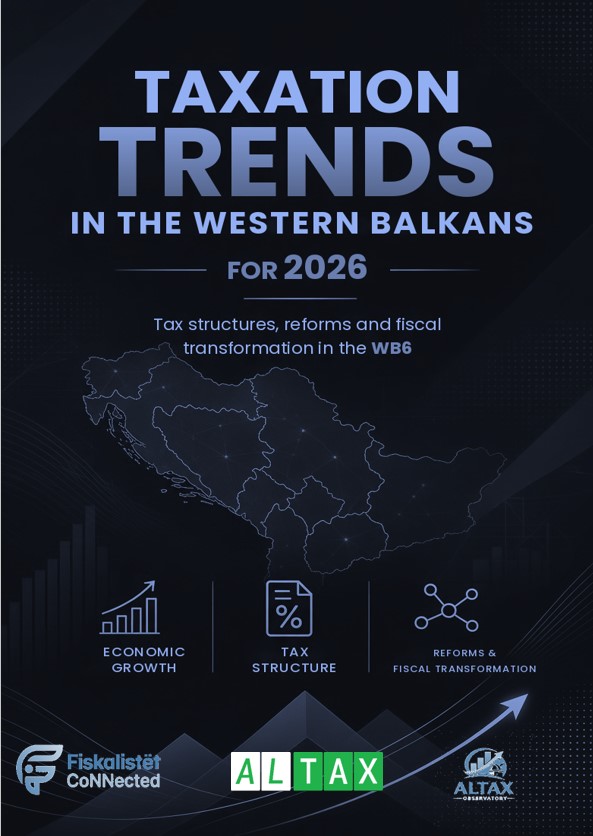
Taxation Trends in the Western Balkans 2026
How are tax systems across the Western Balkans changing, and what do these changes mean for competitiveness, employment, investment and European convergence?
The new ALTAX report examines tax developments across the six Western Balkan economies – Albania, Bosnia and Herzegovina, Kosovo, Montenegro, North Macedonia and Serbia combining fiscal data for 2020–2025 with legal and institutional developments in 2026.
The report finds that the region continues to have a lower overall tax burden than the European Union, but its tax structure remains strongly dependent on consumption and labour taxation. In 2025, the average WB6 tax burden reached 32.3% of GDP, compared with 41% in the EU, while VAT accounted for approximately 36.6% of total regional tax revenues.
But the key topic is no longer simply how much the region taxes, but it is also how the structure of taxation is changing, and whether tax systems are becoming more efficient, competitive and fair.
The report identifies five major transformations:
▪️ a shift from raising tax rates towards broadening the tax base;
▪️ the continued dominance of VAT;
▪️ labour taxation becoming a competitiveness issue;
▪️ regional competition for investment through tax rates and incentives;
▪️ the digital transformation of tax administration.
Against this background, the next phase of fiscal reform in the Western Balkans is increasingly about the quality of the tax mix rather than the size of the overall tax burden.
Broadening the tax base, formalisation, restructuring the tax mix, measuring the fiscal cost and effectiveness of incentives, strengthening the taxation of capital and property, and advancing digitalisation and data exchange are emerging as central dimensions of fiscal transformation and European convergence.
“Taxation Trends in the Western Balkans 2026” is the fourth edition of ALTAX’s series on taxation trends in the Western Balkans. It moves towards a more fundamental dilemma about in which direction are the tax systems of the Western Balkans transforming?
The report provides a common comparative framework for the WB6 and an analytical basis for understanding the relationship between taxation, competitiveness, employment, investment, informality and European integration.


Leave a Reply
You must be logged in to post a comment.