


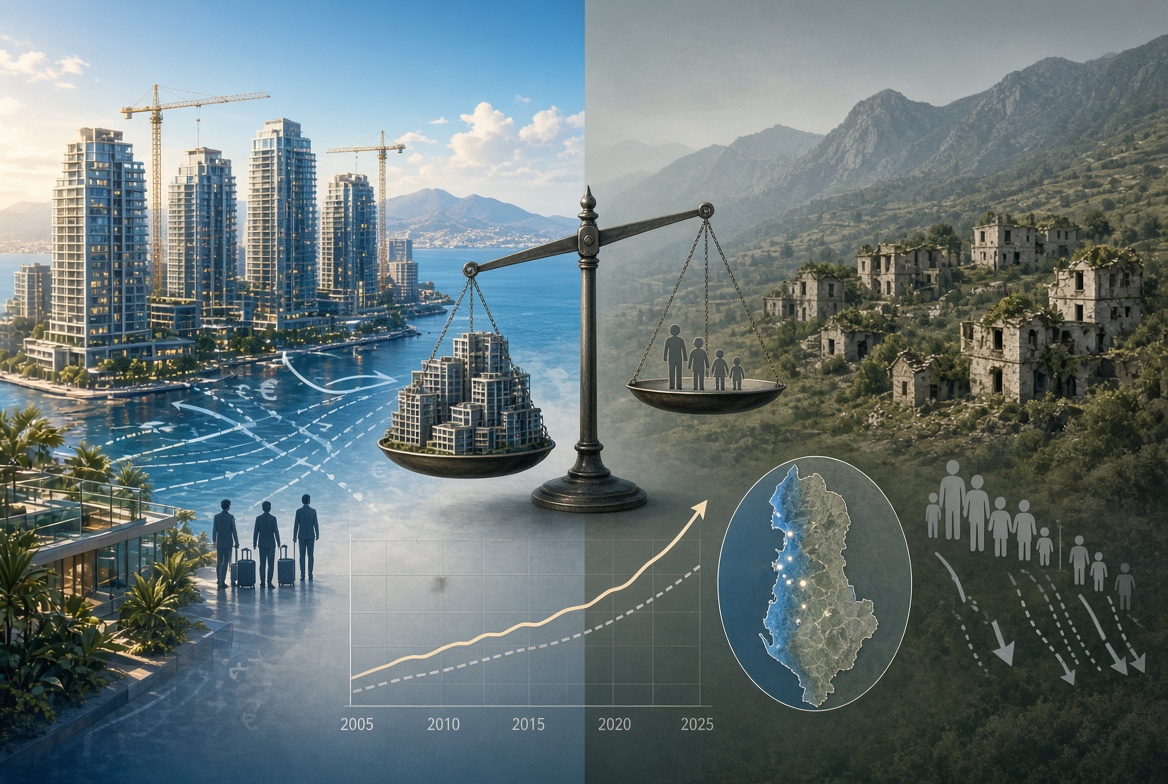
Why is so much being built, but not for everyone?
Over the past two decades, Albania’s construction sector has produced a deeply divided landscape. On the one hand, the formal housing supply, as measured by official permits, has remained limited at the national level. On the other hand, the reality measured by the Census shows a much larger increase in the housing stock, while the number of households has declined by tens of thousands. This mismatch is not accidental: it reveals a model in which construction follows the logic of capital—remittances, deposits, foreign investment, and informal flows—rather than domestic demographic needs.
The Demographic Mismatch Index shows that market supply is taking place where the number of households is declining.
By combining the change in the number of households (2005–2025) with the exact cumulative number of new dwellings according to official permits, the Demographic Mismatch Index is derived. The higher the index, the greater the mismatch, meaning excessive construction relative to household dynamics.
At the national level, the decline in households is estimated at between –45,000 and –55,000, while formal new dwellings reach 16,845. The national index stands at around 0.34. This means that formal supply is relatively high compared with demographic contraction, but is geographically concentrated.
- Tirana is the only case with an increase in households (+40,000), but its low index (≈0.10) indicates that formal permits remain below the pace of actual household growth.
- Durrës, Vlora, and Fier show higher indices (0.11–0.25) despite declining household numbers. This is linked to tourism and external demand.
- Shkodër, Kukës, and Dibër have very low indices (0.07–0.11), reflecting minimal construction activity.
The index table reveals “two Albanias” in terms of construction: one urban and coastal, driven by investment and tourism; the other peripheral, characterized by deep demographic decline and limited activity. Formal permits explain only around 11.5% of the actual increase in the housing stock measured by the Census. The large difference—around 88.5%—is attributable to construction outside the formal registry.
Who Creates Demand and Who Finances It?
Demand for new construction does not primarily come from household growth, which is negative in most counties. It is shaped by internal migration, income, credit conditions, profit expectations, tourism, and the replacement of the existing housing stock. The three main groups of actors are households, businesses, and investors.
A decisive factor is external demand: non-resident buyers, including members of the Albanian diaspora and foreign nationals. They purchase for second homes, investment, short-term rental, or capital preservation. The impact is strongest along the coast—Durrës, Vlora, Sarandë, and Himarë—where mismatch indices are higher. In Tirana, concentrated domestic demand dominates, supplemented by emigrants. In inland counties, construction remains more household-oriented and financed by remittances.
The financing structure of purchases (indicative estimates for 2020–2025) shows that regular wages are the weakest source:
- Bank deposits and credit: 35–45%
- Remittances: 25–35%
- Employment income: 15–22%
- Informal flows: 10–18% (higher in coastal areas)
- Foreign investment and existing capital account for the remainder
Bank deposits are concentrated approximately 54% in Tirana and Durrës, creating strong leverage in these counties. Informal flows create an “informal premium” in prices and pose a challenge to transparency.
Affordability Ranges between 11 and 26 Years of Income
The affordability ratio—the price of a 65 m² dwelling divided by annual income—reveals the depth of the gap:
- Based on wages alone, it reaches 22–26 years in Tirana and 20–24 years in coastal areas.
- Wages plus deposits/credit reach 16–19 years in Tirana.
- Wages plus remittances reach 13–16 years.
- All sources combined, including informal sources, reach 11–14 years in Tirana.
Even with the full combination of available sources, affordability remains low for ordinary households. The Social Beneficiary Index indicates that in Tirana and coastal areas, 65–78% of purchases are made by the upper-middle class, investors, and non-residents. Only 22–35% of the market remains accessible primarily through regular wages.
The average apartment price in Tirana doubled from approximately €916/m² in 2016 to €1,833/m² in 2025, while wage growth was much slower. The indicative affordability index by county (60 m² apartment, 2025) places Tirana and Vlora in the “critical” category (16–17+ years), Durrës in the “high” category (14 years), while peripheral counties show lower nominal figures but have substantially lower absolute incomes.
Who is left out?
Four groups face structural barriers:
- Young people (18–35 years old) – low wages, limited credit history, and a need for 15–17+ years of income.
- Households without existing property – no accumulated capital with which to enter the market.
- Employees with average wages – formally employed, but with insufficient income to support mortgages in urban centres without a substantial initial contribution.
- Returning emigrants with modest capital – facing prices that no longer correspond to their expectations.
The overlap of these groups produces the segments most exposed to exclusion from home ownership.
Risks and Scenarios to 2030
The current model carries clear risks: high municipal dependence on revenues from construction permits, oversupply risk in premium segments, widening regional inequalities, and continued dependence on remittances and informal flows.
Three main scenarios emerge:
- Pessimistic: declining remittances, 2,500–3,500 formal dwellings, high informality, and budgetary pressure on municipalities.
- Baseline (most likely): continuation of the current model, 4,500–6,000 formal dwellings, informality at 85–90%, and further deterioration in affordability.
- Optimistic: implementation of reforms, a decline in informality toward 60–70%, and gradual improvement in access for broader segments of the population.
The key factor is not only the mismatch index, which is sensitive to its denominator, but the degree of fiscal transparency and traceability.
To change the trajectory, structured measures are required:
- A national affordable housing programme—public land, partnerships, and interest subsidies—with a target of 3,000 units within five years.
- A national local fiscal diversification fund to reduce municipalities’ dependence on construction-permit revenues.
- A conditional investment package for peripheral counties to develop infrastructure and create employment.
- Enhanced financial transparency—digital payments, beneficial ownership registers, and cross-checking with tax declarations.
- Diaspora instruments to channel remittances toward productive investment rather than solely into real estate.
Albania’s market is experiencing high levels of construction because it is financed by concentrated capital—banking, diaspora, foreign, and informal capital—rather than by declining domestic demographic needs. This construction is not “for everyone,” because the same ecosystem allocates 65–78% of the market in Tirana and coastal areas to those with access to multiple sources of capital, while the majority of households relying on wages remain limited to 22–35% of the market.
Without coordinated intervention in transparency, fiscal diversification, affordable housing, and the channeling of remittances, territorial and social polarization will deepen.
The baseline scenario to 2030 is a continuation of the current model: high construction relative to demographic dynamics, but inaccessible to the majority. Correcting this trajectory requires political commitment and concrete implementation of measures that connect construction with the real needs of the population, rather than solely with capital flows.
Excerpts from the in-depth study “Increasing Housing Supply Does Not Guarantee Improved Access to Housing”.



Leave a Reply
You must be logged in to post a comment.