Bashkohuni me ekipin tonë. A jeni gati të rrisni biznesin tuaj? Mëso më shumë


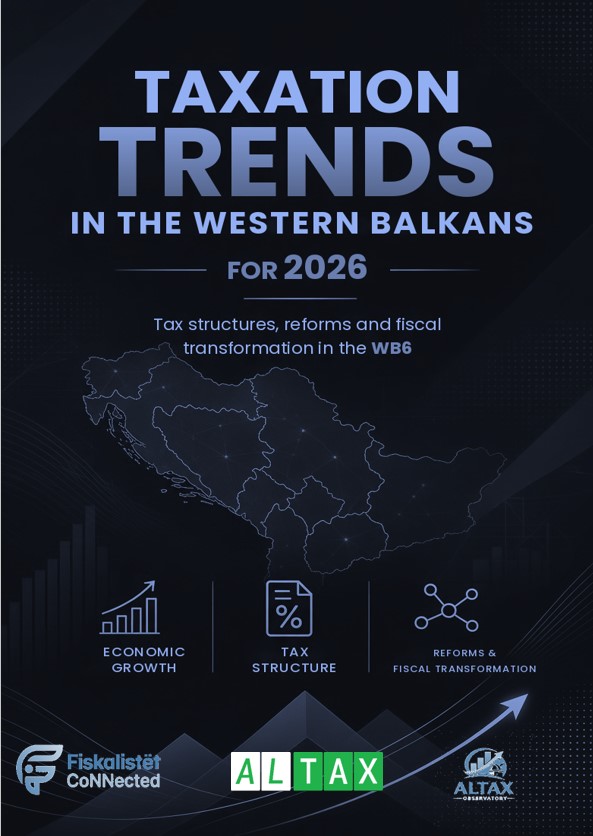
TAX TRENDS IN THE WESTERN BALKANS, 2026
0 €
This report analyses the transformation of tax systems in the six Western Balkan countries (WB6) – Albania, Bosnia and Herzegovina, Kosovo, Montenegro, North Macedonia and Serbia – focusing on the structure of the tax burden, changes in fiscal policies, competitiveness, tax administration and convergence with the European Union. The analysis combines fiscal data for the period 2020–2025 with the legal and institutional developments of 2026, using national and international sources, including Eurostat, the European Commission, the OECD, the IMF, the World Bank and PwC, as well as the ALTAX database.
The findings show that the WB6 remains a region with a tax burden lower than the EU average, but with a fiscal structure that relies heavily on consumption and labour. In 2025, the average regional tax burden reached 32.3% of GDP, compared with 41% in the EU, while VAT accounts for around 36.6% of regional tax revenues. At the same time, labour taxation remains an important factor in the cost of formal employment, while capital, property and wealth continue to carry a relatively limited weight in the tax structure.
The report identifies five main transformations: the shift from raising rates towards broadening the tax base; the continued dominance of VAT; the growing importance of labour taxation for competitiveness; regional competition for investment through tax rates and incentives; and the digitalisation of tax administration. These developments intertwine with high informality, emigration, the shrinking of the working-age population and the need to preserve public revenue capacity without weakening employment and investment.
In this context, the report argues that the next phase of fiscal reforms in the WB6 is not only about the size of the tax burden, but increasingly about the quality of its structure. Broadening the tax base, formalisation, reviewing the composition of the tax mix, measuring the cost and effectiveness of incentives, strengthening the taxation of capital and property, and digitalisation and data exchange emerge as central dimensions of fiscal transformation and of the region’s convergence with European standards.
Keywords: Western Balkans, tax policy, tax burden, VAT, labour taxation, informality, tax digitalisation, European convergence
JEL Codes: H20, H21, H26, H30, E62, J38, O23, F15
- Description
Description
This fourth report, a direct continuation of the ALTAX series on tax trends in the Western Balkans in 2016, 2020 and 2023, examines in this edition not simply how much the region taxes, but how the WB6 tax systems are changing, why they are changing and in which direction they are converging with the European Union. The main theme seeks to clarify whether the tax systems of the Western Balkans are becoming more efficient, more competitive and fairer, or simply better at collecting revenue.
1.1. The regional tax landscape in 2026
The WB6 (Albania, Bosnia and Herzegovina, Kosovo, Montenegro, North Macedonia, Serbia) remains a region with a total tax burden below the EU average (32.3% regional average in 2025, compared with 41% in the EU), but with a tax structure that relies markedly more on consumption and labour than on capital and property. VAT alone accounts for 34–37% of regional tax revenues, social contributions add considerable pressure on the cost of formal labour, and no WB6 country applies any general form of net wealth tax. This structural asymmetry is not merely a matter of the level of the burden, but the thread running through the entire report.
Statutory rates (§4) show a region that is relatively competitive on paper, with corporate income tax (CIT) of 9–15%, personal income tax (PIT) mostly flat or with limited progressivity (0–23%), and VAT with standard rates of 17–21%. But nominal rates hide very different realities when viewed alongside contributions (from 0.5% in Montenegro to 31% in BiH/FBiH), tax expenditures (5.4% of GDP in Albania alone) and informality (30–35% of GDP in most countries).
1.2. Ten key findings — 2026
1. VAT remains the dominant fiscal instrument
VAT accounts for 34–37% of total tax revenues in the WB6, as the main revenue instrument in every country of the region, with direct consequences for the regressivity of the system (§5).
2. Labour taxation is becoming a competitiveness issue, not just a budget one
Demographic contraction (-2.1% of population, 2021–2023) and emigration are transforming the tax burden from a purely fiscal matter into a direct factor of economic competitiveness (§6).
3. Base broadening is replacing rate increases as the central challenge
With informality at 30–35% of GDP in most countries, formalisation rather than rate increases is the main route to additional revenue (§6, §13).
4. Capital and property remain structurally under-taxed
No WB6 country applies a general net wealth tax, while property taxation is still based on outdated valuations (§8).
5. Digitalisation is changing administration faster than legislation
From Albania’s full fiscalisation (2021–22) and Serbia’s advanced system, to North Macedonia’s e-Invoice reform, still under implementation with deadlines postponed to September 2026 (§9).
6. EU integration is shaping reforms, but at very different paces
From Montenegro (18 of 33 chapters closed), Albania (3 of 33 chapters closed) and up to Kosovo (still without candidate status), a wide spectrum of readiness for the acquis on taxation emerges (§10).
7. Fiscal incentives require stronger measurement of their return
Over 350 investment incentives and 40 free economic zones are identified across the region, but only Albania regularly publishes their real cost, amounting to 5.4% of GDP (§7, §12).
8. Demographic decline is becoming a direct tax policy issue
Demographic decline is not only a social matter, as the future labour tax base narrows with every year of population contraction (§6.5).
9. Informality remains the main structural constraint on revenue
With Kosovo at the top of the region (up to 83% of the employed with some form of informality, according to SELDI) (§13).
10. The next phase of reforms is about the quality of the tax mix, not its size
The gradual shift from labour and consumption towards capital, property and more transparent administration — this is the axis of the 2026 reform agenda (§20–§22).
1.3. Five key tax trends in 2026
Trend 1 — From revenue mobilisation towards broadening the tax base
Systems cannot rely indefinitely on rate increases or on consumption. More and more countries are seeking to broaden the tax base (formalisation, limiting deviations/exemptions, fighting informality) instead of raising rates.
Trend 2 — VAT remains the fiscal pillar
All six WB6 countries have VAT rates between 17% (Bosnia and Herzegovina) and 21% (Montenegro), with a tension between revenue-collection efficiency, the regressive nature of indirect taxes and formalisation.
Trend 3 — Labour taxation is becoming a competitiveness issue
Labour shortages and emigration are turning the fiscal cost of labour (tax wedge) into a competitiveness issue, not merely a budget revenue one.
Trend 4 — Taxation of capital and property is gaining political attention
Corporate income tax, dividends, real estate and capital gains remain structurally under-developed compared with the taxation of labour and consumption.
Trend 5 — Tax administration is becoming digital infrastructure
E-invoicing, fiscalisation, data matching, risk-based auditing and cross-border information exchange are changing tax administration faster than tax legislation itself, in line with the EU’s “VAT in the Digital Age” (ViDA) reform.
Related products
-
ALTAX LIBRARY
VAT EU Court decisions and comments
Original price was: 14 €.11 €Current price is: 11 €. -

-
-
ALTAX LIBRARY
Investment Volume 3: Lifting the burden
Original price was: 36 €.2 €Current price is: 2 €. -

-
ALTAX PRODUCTS, PUBLICATIONS
Tax Burden in the Western Balkans – Albania, Kosovo…Tax Freedom Day 2024
Original price was: 45 €.35 €Current price is: 35 €.