Bashkohuni me ekipin tonë. A jeni gati të rrisni biznesin tuaj? Mëso më shumë


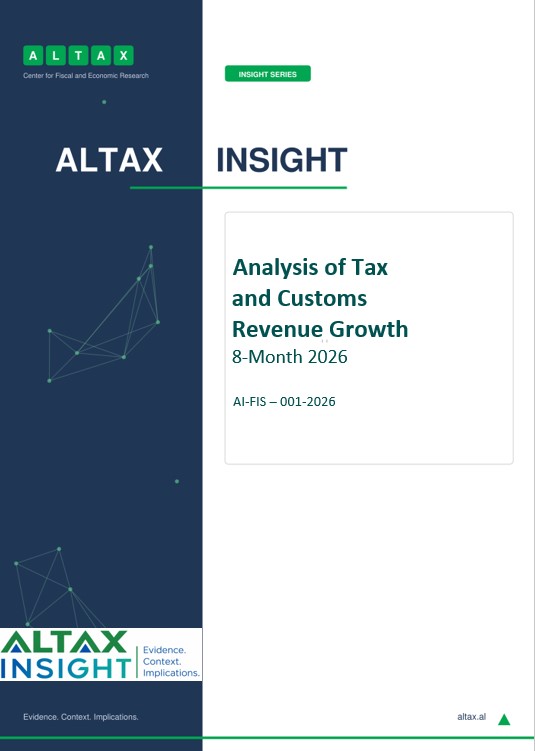
Analysis of the growth in tax and customs revenues in 8 months of 2026
0 €
An ALTAX analysis for the first eight months of 2026 shows that approximately 86–90% of the growth in tax and customs revenues is explained by the nominal expansion of the economy.
Tax and customs revenues increased by ALL 25.1 billion (+7.6%) during the first eight months of 2026. However, this increase accounts for only 41.7% of the total growth across the three main revenue categories analyzed (ALL 60.2 billion).
According to the new ALTAX Insight analysis, the dominant share of the growth in tax and customs revenues is linked to the nominal expansion of the economic base. With real GDP growth of approximately 3.6–3.7% and average inflation of 2.9%, the indicative nominal growth rate is 6.5–6.6%. This accounts for approximately ALL 21.6–21.8 billion of the increase. The remaining difference of ALL 3.3–3.5 billion (13–14%) cannot be automatically equated to a reduction in tax evasion. It encompasses formalization, administration, base expansion, structural changes, and other factors.
The growth is real but mixed. Tax and Customs revenues account for 41.7% of the total increase, while Local Government (+19.2 billion, +75.7%) and Special Funds (+15.9 billion, +13.4%) make up the remainder.
The strongest indicators of formalization are evident in:
Net domestic VAT collected (+24.2%)
Personal Income Tax – TAP (+15.5%)
Special Funds (+13.4%)
The improvement is not uniform. Corporate Income Tax fell by 5.1%, indicating that the rise in total collections does not automatically translate into increased tax revenue from business profits.
Local government figures require a separate interpretation. The sharp increase (+75.7%) is primarily linked to local taxes and local administration, rather than organic economic growth.
How should the rise in collections be interpreted?
ALTAX emphasizes that an increase in revenue does not automatically equate to a reduction in tax evasion. The dominant factor is the nominal expansion of economic bases (consumption, wages, imports). The component attributable to factors beyond this expansion is more limited (approximately 1.5–3.5 billion ALL for Tax and Customs). To track this dynamic in a structured manner, ALTAX proposes two indicators:
Tax Revenue Elasticity (TRE) = 1.09–1.17 (indicates that revenues are growing faster than the nominal economy).
Revenue Performance Gap (RPG) +3.5 billion ALL (the difference between actual growth and the growth explained by the nominal base).
These indicators will be tracked on a monthly basis as part of the ALTAX Observatory’s regular monitoring.
Read the full analysis Insight Note – Revenues are growing faster than the economy, but not all of the difference is due to formalization
8-Month Analytical Report | January–August 2026
- Description
Description
This Insight Note analyses the growth of tax and customs revenues during the first eight months of 2026 (January–August) and assesses how much of this growth is explained by the nominal expansion of the economy and how much remains as formalization, administration or other factors. Revenues from Taxes and Customs increased by +25.1 billion lek (+7.6%), but account for only 41.7% of the total growth of the three main blocks (+60.2 billion lek). Approximately 86–90% of the increase in Taxes and Customs is linked to the nominal expansion of the economic base (real GDP around 3.6–3.7% and average inflation of 2.9%), leaving a residual of 3.3–3.5 billion lek (13–14%) that cannot automatically be equated with a reduction in tax evasion. The strongest signals of formalizations and administrative improvement appear in net domestic VAT (+24.2%), personal income tax (+15.5%) and special funds (+13.4%). In contrast, corporate income tax declined by 5.1%, indicating that the improvement is not uniform. The strong growth in local government revenues (+75.7%) is mainly linked to local taxes and should not be interpreted as organic economic growth. The analysis emphasizes the need for careful decomposition of the economic base effect from formalizations and administration, and proposes two indicators for continuous monitoring: Tax Revenue Elasticity (TRE) and Revenue Performance Gap (RPG).
Keywords: tax revenues; formalization; tax administration; VAT; personal income tax; growth decomposition; 8-month 2026
JEL Classification: H20; H26; H71; E62; O17
Related products
-
ALTAX PRODUCTS
Investment climate and tax system in Albania 2013
Original price was: 11 €.10 €Current price is: 10 €. -
ALTAX LIBRARY
VAT EU Court decisions and comments
Original price was: 14 €.11 €Current price is: 11 €. -
ALTAX PRODUCTS
Tax notes for construction industry in Albania
Original price was: 15 €.14 €Current price is: 14 €. -

-

-
ALTAX PRODUCTS
Tax system and incentives for investments in Albania
Original price was: 12 €.8 €Current price is: 8 €. -
-
ALTAX PRODUCTS
Investment climate and tax system in Albania 2015
Original price was: 12 €.10 €Current price is: 10 €.