


Strategic Analysis of Business Demography in Albania 2022–2024
In 2024, the Albanian economy records 127,634 active enterprises, with 15,521 new enterprises and 975 closures. Although the number of enterprises is gradually increasing, the economy remains dominated by micro-enterprises (50.9% without paid employees), low value-added trade, and services.
This structure reflects a “broad but shallow” economy, with vitality in market entry but difficulties in scaling, innovation, and quality job creation.
From the perspective of ALTAX Observatory, the Albanian economy must transition from a model based on thousands of small commercial and low-productivity service businesses (“House of Small Shops & Services”) toward a structure where enterprises create brands, scale, innovation, and export capacity (“House of Impact Brands”). This means less economic fragmentation and more companies generating added value, quality employment, and long-term economic impact.
- The foundation of the economy shows numerical stability
The increase in the number of active enterprises in Albania, from 120,587 in 2022 to 127,634 in 2024, indicates a gradual expansion of the entrepreneurial base and a revival of economic activity.
Table 1: Evolution of enterprises by status (2022–2024)
| Enterprise Status | 2022 | 2023 | 2024 | Change 2023–2024 |
| Active enterprise | 120.587 | 125.736 | 127.634 | +1.51% |
| New enterprises | 15.261 | 13.346 | 15.521 | +16.3% |
| Closed enterprises | 565 | 810 | 975 | +20.4% |
This development is also supported by the increase in the number of new enterprises, which reached 15,521 in 2024, compared to 13,346 in 2023, signaling a return of private initiative after the previous slowdown. At first glance, these indicators create the perception of an economy gaining density and dynamism in its productive and commercial structure.
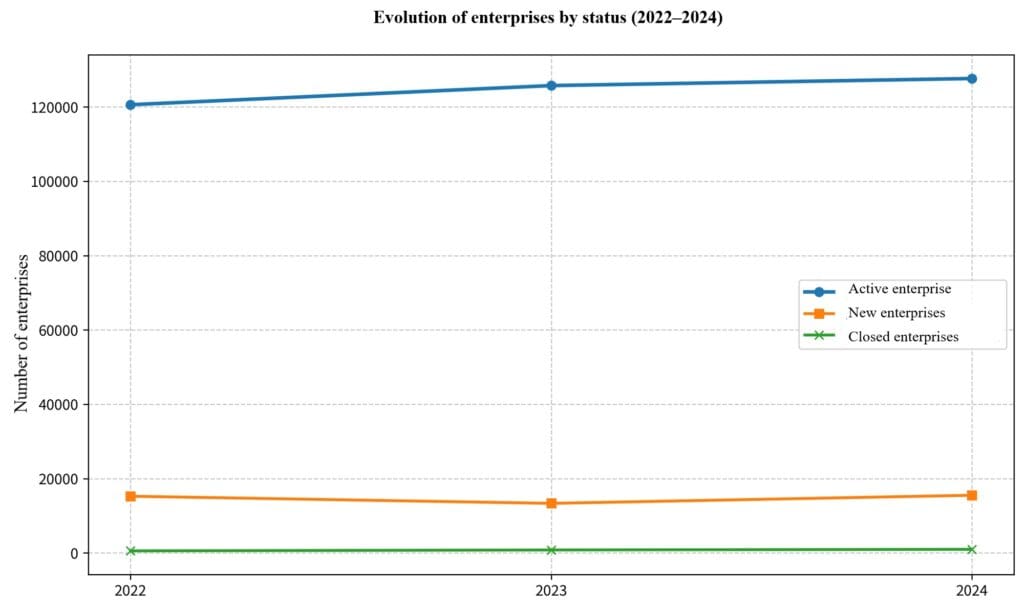
However, alongside the expansion of the base, the number of enterprises closing down is also increasing. In 2024, 975 closures were recorded, compared to 565 in 2022, indicating a noticeable rise in competitive pressure and operational difficulties for market survival.
This phenomenon suggests that part of the new enterprises fail to consolidate beyond the initial phase, reflecting weaknesses in access to finance, managerial capacities, the competitive environment, or institutional support.
In this sense, the Albanian economic base remains positive in terms of numerical expansion, but still fragile in terms of sustainability.
The challenge is no longer only related to encouraging new registrations, but to creating an ecosystem that guarantees the survival, growth, and long-term formalization of enterprises. The increasing pace of market entry and exit signals the need for smarter support policies focused on productivity, market access, innovation, and reducing operational costs, so that the expansion of the entrepreneurial base does not remain merely a statistical figure, but translates into real economic stability.
- Sectoral structure – Which “brands” dominate the House?
The current structure of enterprises in Albania reflects an economy dominated by commercial activities and services with easy market entry, but with relatively limited capacity to generate productivity and long-term added value.
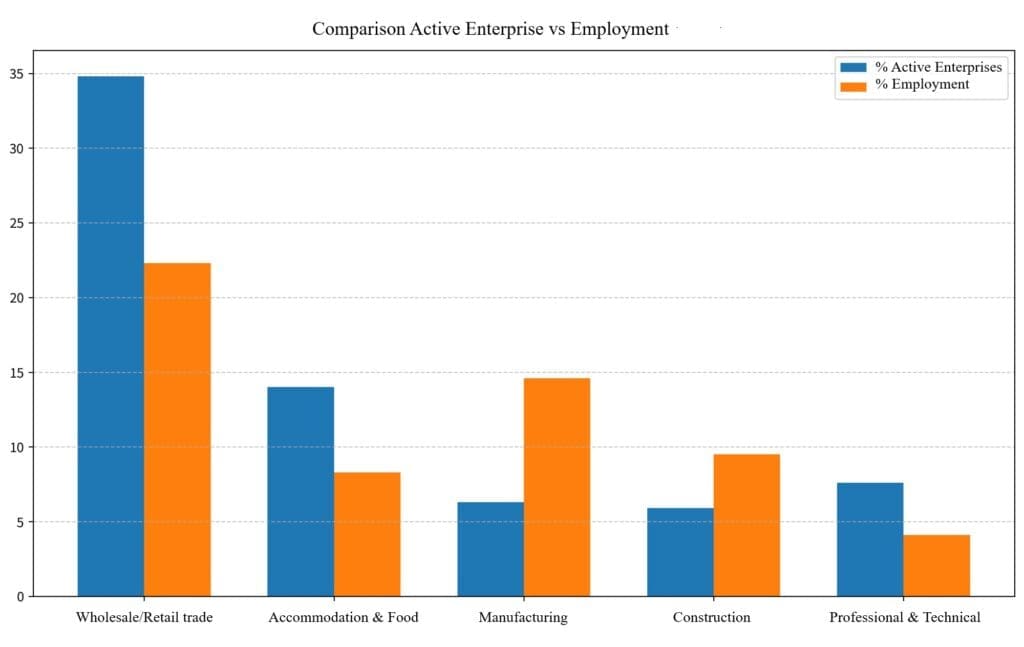
Trade represents 34.8% of active enterprises in 2024, making it the largest sector numerically, but it contributes only 22.3% of total employment. This disproportion signals an economic model based on low profit margins, fragmented activity, and limited productivity, where most businesses operate in distribution and consumption functions rather than value creation.
In contrast, manufacturing industry, although representing only 6.3% of active enterprises, has a much higher weight in employment, with 14.6% of jobs.
This shows that productive sectors have a much stronger multiplier effect on the economy, as they create more employment, supply chains, and export potential.
Construction, with 9.5% of employment, also demonstrates that sectors requiring capital, organization, and structured labor generate broader economic impact than fragmented commercial activities.
Meanwhile, the tourism and food sector represents 14% of active enterprises and remains one of the most visible drivers of new entrepreneurship.
Professional and scientific activities account for 7.6%, representing a segment with high potential for qualitative economic transformation.
However, the pace of new enterprise creation shows that the economy continues to orient itself toward sectors with low entry barriers and quick returns.
Table 2: Structure of active enterprises and employment (2024)
| Economic Activity (NACE) | % Active Enterprises | % Employment | Difference (Employment – Enterprises) |
| G – Wholesale/Retail Trade | 34,8% | 22,3% | –12,5 pikë |
| I – Accommodation & Food Services | 14,0% | 8,3% | –5,7 pikë |
| C – Manufacturing Industry | 6,3% | 14,6% | +8,3 pikë |
| F – Construction | 5,9% | 9,5% | +3,6 pikë |
| M – Professional & Technical Activities | 7,6% | 4,1% | –3,5 pikë |
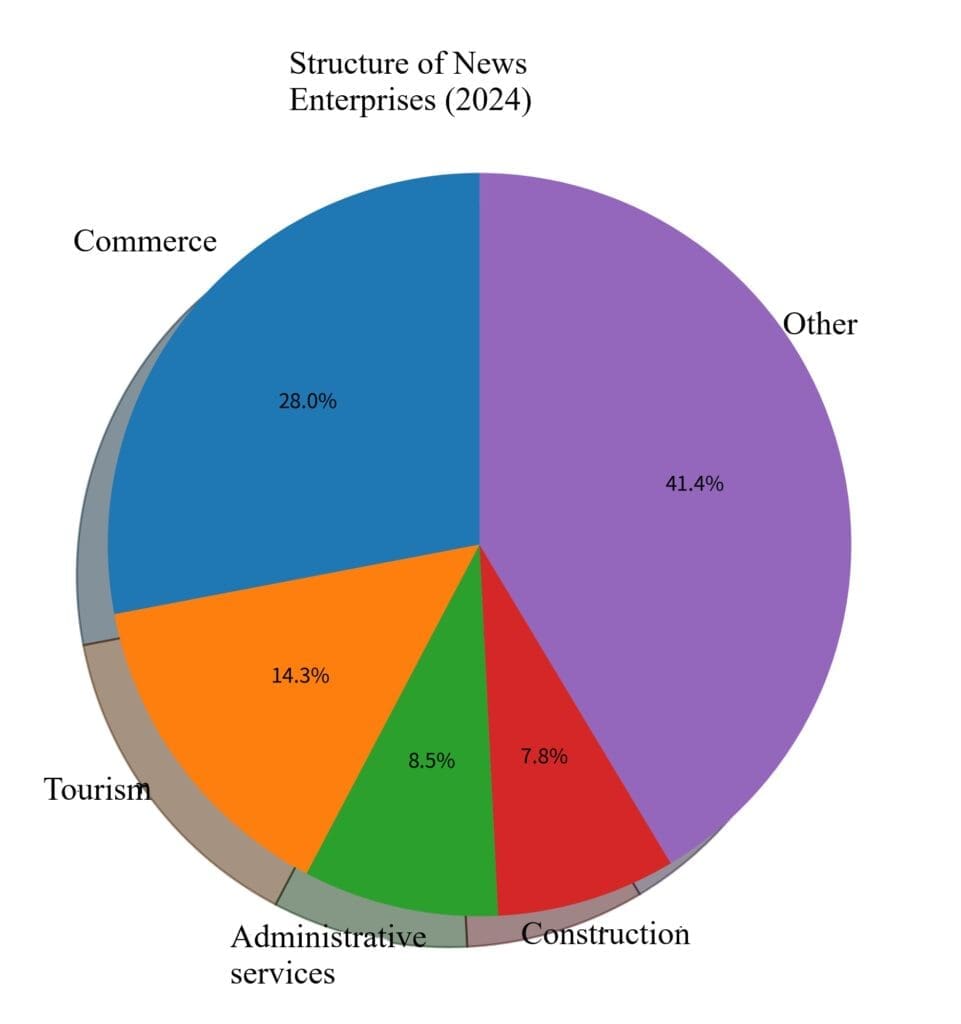
Trade accounts for 28% of new businesses, tourism 14.3%, and administrative services 8.5%. This suggests that entrepreneurship is being channeled more toward consumption and intermediary activities rather than innovation, technology, or production.
Table 3: New enterprises by activity (2024)
| Economic Activity | % New Enterprises | % Employment in New Enterprises |
| G – Trade | 28,0% | 22,4% |
| I – Tourism & Food | 14,3% | 14,8% |
| N – Administrative Services | 8,5% | 8,4% |
| F – Construction | 7,8% | 11,4% |
From the perspective of the “House of Impact Brands” ecosystem, this structure represents an economic portfolio overloaded with consumer and commercial brands, but underdeveloped in manufacturing industries, technology, and high value-added services.
As a result, the Albanian economy remains oriented more toward consumption and imports than toward production and exports.
This creates greater dependence on domestic demand, remittances, and external flows, limiting the country’s ability for sustainable growth and regional competitiveness. To change this trajectory, a strategic shift is needed toward policies that favor production, innovation, technology, and the development of brands with export capacity and long-term economic impact.
- Size and sustainability
The structure of enterprises in Albania highlights an economy with a broad numerical base, but limited capacity to generate scale, sustainability, and long-term impact.
In 2024, more than half of active enterprises (50.9%) operate without any paid employees, while 37.1% have only 1 to 4 employees.
Only 6.3% of businesses manage to employ more than 10 workers, demonstrating the absence of a broad layer of medium and large enterprises that could serve as engines of productivity, innovation, and sustainable employment.
In economic terms, this structure represents an ecosystem filled with small commercial activities, shops, and restaurants, but with few “large houses” (consolidated companies) that create quality employment, long-term investment, and innovative capacities.
The situation becomes even more concerning among new businesses, where 56.9% are created without any paid employees and only 1.8% immediately achieve a structure with more than 10 employees.
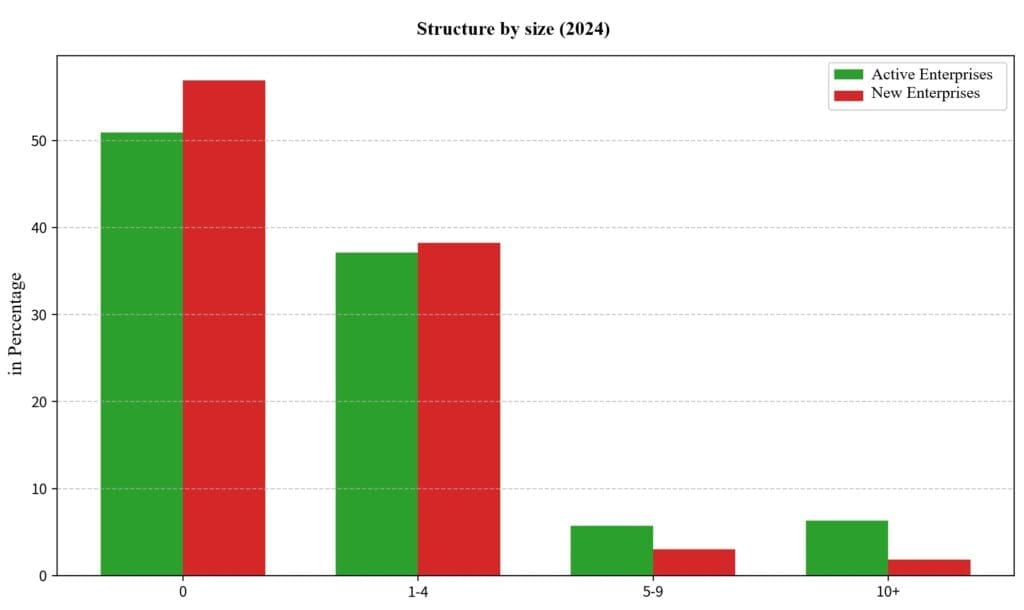
This shows that most enterprises enter the market as micro-family activities and have a high probability of remaining small permanently.
As a consequence, although the number of enterprises continuously increases, the real impact on employment and productivity remains relatively limited. The dominance of micro-businesses creates an economy with low resilience to crises, weak export capacities, and a fragmented fiscal base.
Table 4: Structure by size (2024)
| Size (paid employees) | % Active Enterprises | % New Enterprises |
| 0 employees | 50,9% | 56,9% |
| 1–4 employees | 37,1% | 38,2% |
| 5–9 employees | 5,7% | 3,0% |
| 10+ employees | 6,3% | 1,8% |
- Sectors with impact potential
Nevertheless, within this structure there are sectors with high potential for impact and economic transformation.
Tourism, construction, and professional services are showing natural growth and can serve as a basis for more qualitative economic expansion. Manufacturing industry, although declining relatively in number, remains one of the sectors with the greatest effect on employment and value-chain creation. Likewise, knowledge-based sectors such as technology, professional services, and renewable energy present high potential for productivity growth, exports, and economic modernization.
The economy continues to be characterized by the dominance of import-based trade, which limits domestic production and value creation. The main challenge for the Albanian economy is no longer the creation of new businesses, but transforming them into enterprises that grow, employ, and export. For this reason, economic policy must shift from the logic of a “start-up economy” toward a “scale-up economy” model.
This requires fiscal and financial incentives directly linked to the creation of paid jobs, productive investments, and export orientation. A national strategy for sectoral diversification should favor manufacturing industry, agro-processing, technology, green energy, and knowledge-intensive services, so that the economy gradually moves away from dependence on import trade and consumption.
At the same time, there is a need to create more flexible mechanisms for the closure or restructuring of inefficient businesses, facilitating the reallocation of capital and human resources toward more productive activities.
Equally important is the development of new instruments for measuring economic impact, such as a “Business Impact Score,” which would focus not only on the number of enterprises, but on their real contribution to quality employment, innovation, exports, and regional development.
From the perspective of the “House of Impact Brands” model, the country needs to transition from an economy with many fragmented small brands toward a more integrated and collaborative structure.
ALTAX Observatory assesses that this can be achieved through the creation of networks or clusters of small businesses under shared umbrellas for branding, exports, marketing, and innovation, following models similar to international “house of brands” structures.

Leave a Reply
You must be logged in to post a comment.