


Are Albanian capital outflows abroad a signal of economic maturity or a symptom of structural weaknesses?
Albania has recorded a notable acceleration in capital outflows in recent years, combining the legitimate diversification of private wealth with the possible integration of funds of questionable origin into international assets.
According to Eurostat, the stock of real estate owned by Albanian residents abroad reached €766.5 million at the end of 2023, or about 2.5% of GDP, a dramatic increase from just €6.5 million one year earlier. This trend has further strengthened, with outward foreign direct investment flows reaching approximately €1.34 billion in 2024 and €1.33 billion in 2025, according to balance of payments data.
These developments demonstrate a significant accumulation of private wealth and a deeper financial integration with European markets. However, they raise serious concerns regarding the interaction between domestic money laundering, primarily through the construction and real estate sectors, and subsequent outflows that serve to legitimize and relocate these funds, whether by residents or non-residents.
Compared to other Western Balkan countries, Albania presents a particularly pronounced pattern in outflows linked to real estate. Without deep structural reforms and rigorous enforcement of anti-money laundering measures, these flows risk weakening domestic capital formation, productive investment, and the country’s long-term convergence toward European Union standards.
Scale and Trajectory of Outflows
The increase in outward investment became more visible following methodological improvements by the Bank of Albania and the strengthening of data exchange with key partners such as Italy, Greece, and Spain. The surge in 2023 largely reflects better capture of historically underreported assets, but the absolute size of flows, nearly €760 million in that year alone, also indicates real new activity.
Quarterly balance of payments data provide a precise picture of outward direct investment. The “Assets” category consistently records high negative values, indicating net capital placement abroad.
| Quarter | Flow (Assets) | Annual total |
| Q1 2024 | -283 | |
| Q2 2024 | -227 | |
| Q3 2024 | -349 | |
| Q4 2024 | -382 | -1,341 |
| Q1 2025 | -293 | |
| Q2 2025 | -307 | |
| Q3 2025 | -377 | |
| Q4 2025 | -356 | -1,333 |
This steady trend, with pronounced peaks in the final quarters of the year, coexists with strong inward FDI flows (around €1.6–1.7 billion annually), concentrated mainly in real estate, energy, and tourism. This dual flow highlights Albania’s financial openness but also reveals a structural asymmetry in capital allocation.
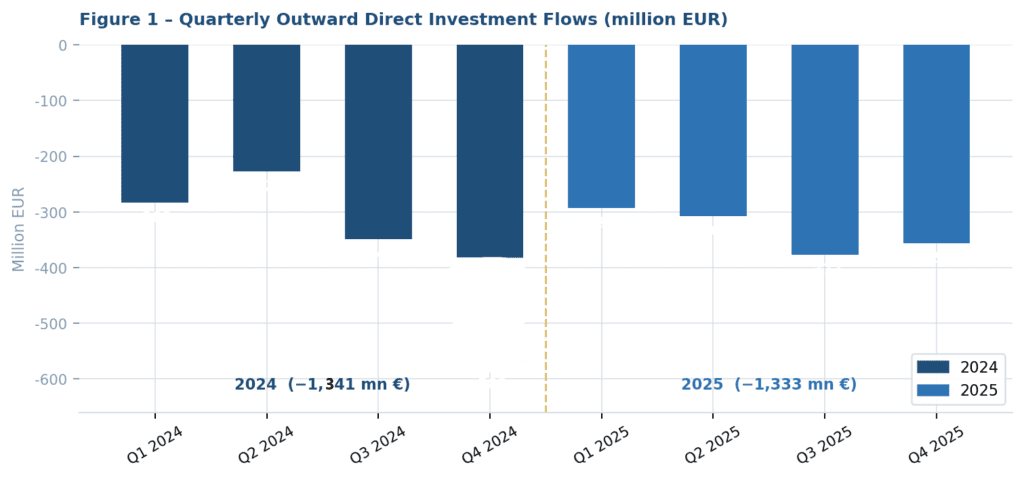
Figure 1: Quarterly Outward Foreign Direct Investment Flows (million euros), 2024–2025. Negative values represent net capital outflows abroad.
Drivers include both legitimate incentives and illicit channels
Several legitimate factors explain much of this phenomenon. Property prices in Tirana and coastal areas have reached levels comparable to or higher than those in parts of Southern Europe, making investments in more mature European markets (Italy, Greece, Spain) more attractive in terms of rental returns and asset security. The search for greater legal certainty, political stability, and protection from local macroeconomic risks is another important driver.
Liquidity generated by the tourism boom, remittances, and the construction sector has grown faster than opportunities for productive investment within the country, which are constrained by weak infrastructure, regulatory unpredictability, and a narrow industrial base.
A particularly concerning dimension remains the role of money laundering. The construction and real estate sector has for years functioned as a primary channel for integrating proceeds from drug trafficking, organized crime, and corruption. Illicit funds enter through cash-intensive businesses, shell companies, and overvalued transactions, then are layered and legitimized domestically before being transferred abroad as investments.
This “park and exit” strategy enables criminal networks to launder capital in Albania and secure it in jurisdictions with stronger property rights and rule of law. Improved statistical reporting has increased transparency, but the scale of recorded outflows continues to raise important questions about the origin of part of these funds.
Regional Comparison
The phenomenon is not unique to Albania, but its intensity in certain segments appears more pronounced. Across the Western Balkans, real estate and construction remain preferred channels for money laundering due to high cash usage, low transparency of beneficial ownership, and weak enforcement. Montenegro faces high risks in coastal properties, Serbia has experienced a construction boom with many unoccupied luxury units, while North Macedonia has investigated political links to laundering schemes.
Albania stands out for the dramatic increase in the stock of assets abroad (Eurostat) and the high concentration of inward FDI in non-tradable sectors. While Serbia has attempted a more industrial orientation, the Albanian model generates rapid liquidity that easily flows outward. Reports by the Global Initiative against Transnational Organized Crime and MONEYVAL identify similar regional typologies. Albania’s exit from the FATF grey list in 2023 is an important formal step, but implementation gaps, especially in the real estate sector, remain comparable to those of neighboring countries.
Macroeconomic and Development Impacts
Capital outflows bring real benefits, like risk diversification, future income opportunities (rents, dividends, capital gains), and demonstration of international entrepreneurial capacity. However, the net impact on domestic capital formation is largely negative. Capital that leaves does not finance infrastructure, human capital, or export industries, perpetuating dependence on tourism, construction, and remittances.
Inflated property prices reduce housing affordability, contribute to property vacancies due to emigration, and crowd out productive investment. The parallel outflow of capital and skilled labor reinforces a low-productivity trap. Flows linked to money laundering erode public trust, distort competition, and complicate the path to EU accession.
Policy Implications and Outlook
The current dynamics reflect a dual reality: extraordinary accumulation of private wealth alongside deep structural weaknesses. Effective responses must be comprehensive: strengthening beneficial ownership registries, strict due diligence in real estate, intensified financial intelligence, improved business climate, judicial efficiency, and targeted public investment in vocational education, renewable energy, and digital connectivity.
EU accession negotiations represent a historic opportunity to rebalance capital flows toward value creation within the country.
Albanian capital outflows abroad represent an important moment of economic maturity and European integration. They demonstrate the growing capacity of private actors to operate across borders and to safeguard accumulated wealth. At the same time, the scale and channels of these flows expose the structural weaknesses of the current growth model, particularly the challenge of integrating illicit finance.
Countries in the region face similar issues, but Albania’s profile highlights the urgency of transforming private wealth accumulation into sustainable and productive national development. The coming years, with intensified engagement with the European Union, will be decisive in determining whether this phenomenon becomes a catalyst for transformation or a symptom of an unfinished structural transition.


Leave a Reply
You must be logged in to post a comment.