


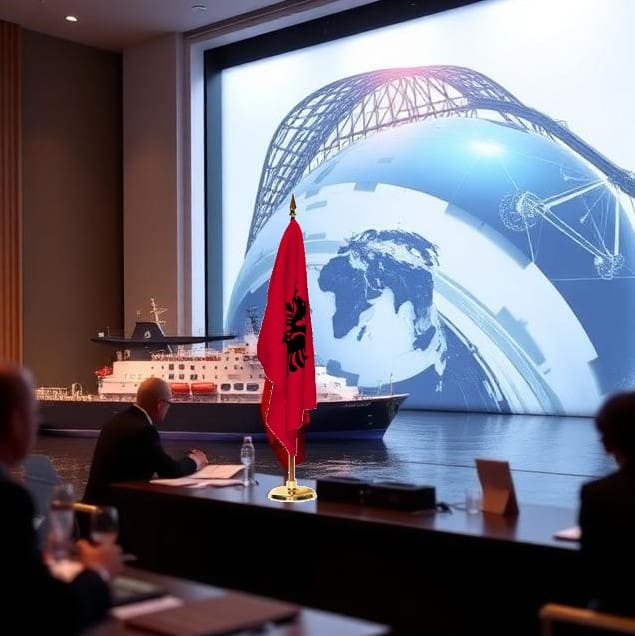
Six billion dollar energy Agreement between Albania, the US and Greece and the feasibility
On April 28, 2026, in Tirana, a major energy agreement worth approximately $6 billion was signed, involving the Albanian company ALBGAZ, the American company Venture Global (specialized in LNG, liquefied natural gas), and the Greek partner Aktor LNG. The agreement is a 20-year long-term contract for the supply of liquefied natural gas from the United States to Albania, with the primary goal of strengthening energy security in the Western Balkans region and Southern Europe.
The U.S. Ambassador in Athens, Kimberly Guilfoyle, who attended the signing ceremony together with Prime Minister Edi Rama, described the agreement as “historic.” She emphasized that “when the U.S., Albania, and Greece work together, this region becomes more connected, more secure, and more prosperous.” According to her, the $6 billion commitment strengthens not only energy security but also national security across the region, advancing the energy agenda of President Donald Trump.
What does the agreement specifically provide?
Public information so far remains largely declarative. The agreement focuses on the import of U.S. LNG, with the potential development of infrastructure such as terminals (including the possibility of a floating terminal in the Vlora or Devoll area, according to some sources). The objective is to diversify gas supply sources, reduce dependence on traditional suppliers (such as Russia historically), and position Albania as part of a regional network linking the U.S., Greece, and the Balkans.
This is built around three core ideas highlighted in official statements:
Energy security – the creation of a shared architecture for independence from unstable external sources and increased resilience of the regional system.
Albania as a net energy exporter – Prime Minister Edi Rama has long stated the goal of turning Albania into a net energy exporter within the current mandate, leveraging hydropower potential, renewables, and now gas as a “back-up” for stability.
Immediate implementation – concrete steps toward grid modernization, increased generation capacity, and market integration, although full project details are still not publicly available.
Possible structure of measures (based on similar regional agreements)
Large energy agreements are often communicated as historic turning points, but their real substance becomes clear only when analyzed at the level of concrete measures. In this case as well, the cooperation between Albania, Greece, and the United States follows a familiar logic seen in regional and European practice: a combination of physical investments, market reforms, and institutional interventions.
At its core, the transformation is expected to be built on a strong infrastructure base. Expanding interconnection capacities with Greece and deeper integration with the European energy network (ENTSO-E) are among the main pillars. At the same time, modernizing the transmission grid through 400 kV lines, new substations, and digital management (smart grids) is essential to handle a more complex and decentralized system.
On the generation side, the focus shifts toward a more balanced energy mix. Photovoltaic parks and wind potential are expected to complement traditional hydropower, while optimizing existing cascades remains critical. However, the defining element for system functionality is energy storage through batteries and especially pumped-storage projects, without which the integration of renewable sources remains limited.
Beyond infrastructure, market integration is equally important. This implies not only physical connectivity but also the joint functioning of pricing and trading mechanisms. Coupling the Albanian market with the Greek and regional markets and strengthening the ALPEX exchange aim to create a more efficient and transparent environment. Gradual market liberalization and increased transparency in cross-border trading are necessary steps to move from a regulated system to a truly competitive market.
This transformation cannot occur without deep institutional reforms. Alignment with the European Union energy acquis, including unbundling and competition rules, is a prerequisite for market functionality. At the same time, establishing joint planning mechanisms among the three countries and improving the investment climate through faster procedures and guarantees for private capital via PPP or IPP schemes are key elements for attracting financing.
At a broader level, the agreement also addresses the strategic dimension of energy security. Diversifying sources by balancing hydropower with solar, wind, and gas as a reserve aims to reduce risks from climate variability. Meanwhile, regional mechanisms for emergency management and energy exchange strengthen system resilience during crises. Financing is expected to rely on a combination of private capital, international financial institutions, and U.S. guarantees.
What is still missing or critical?
Despite this structured vision, important gaps remain.
There is still no detailed public list of projects with clear timelines, allocated budgets, and finalized contracts. In this sense, the agreement appears more as a strategic framework than a fully operational plan.
Transparency is also lacking regarding how the $6 billion investment is distributed across components such as gas infrastructure, interconnections, or new generation capacities. Some observers express skepticism that a significant portion of the value may be tied to long-term LNG purchase contracts, potentially more expensive than existing regional alternatives.
How achievable is the transformation by 2030?
In practical terms, the agreement aims to:
- Build infrastructure for gas import and use
- Open the Albanian energy market in real terms
- Position Albania as an active regional exporter by combining hydropower, renewables, and gas for stability
However, timelines suggest a more complex reality.
Interconnection projects and grid modernization typically take 4–7 years, including design, permitting, and construction.
Solar and wind projects are faster, requiring 2–4 years.
Energy storage, especially pumped-storage, may take 5–8 years and represents the main technical bottleneck.
At the same time, market reforms and institutional changes require 2–5 years and often face delays due to political or administrative factors.
This means that a full transformation of the energy system is neither linear nor immediate. The 2030 target can serve as a milestone for intermediate progress, but the full realization of the vision requires a longer time horizon and, above all, a sustained capacity to move from strategic declarations to concrete, financed, and implemented projects.
Realistically, full transformation may extend into 2032–2035.
Success will depend on rapid decision-making within the next 12 months, zero delays in procurement, strong trilateral coordination, and political stability—factors that have proven difficult to maintain in similar cases in the past. In conclusion, the April 28, 2026 agreement represents a concrete step toward diversification of energy sources and regional cooperation with the United States and Greece. It supports the vision of Edi Rama for a more energy-independent and export-oriented Albania, but it remains largely a strategic framework. To become a true success, it must quickly move from declarations to concrete contracts, financed projects, and measurable results.


Leave a Reply
You must be logged in to post a comment.