


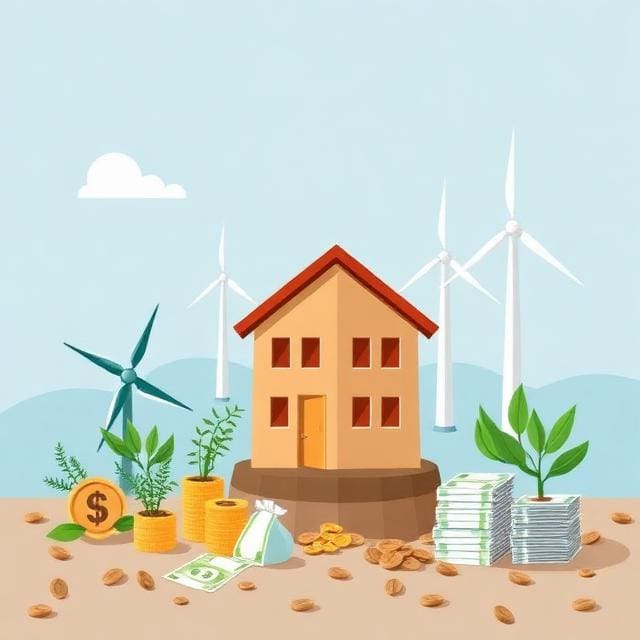
What should we do with Cash in Albania?
This analytical information is dedicated to those who hold cash and are not clear about where to invest it in Albania. It is not merely financial advice, but an economic, fiscal, and developmental approach.
The question “What can we do in Albania with all this cash?” is directly linked to the functioning of the real economy.
We will analyze why there is so much cash, what is happening today, the strategic directions for 2026, the risks if we do not act, and a core message. Then, we integrate an investment map for 2026, tailored to different profiles.
Why is there so much cash in Albania?
In Albania, a large part of money circulates outside the banking system. According to the latest data from the Bank of Albania and reports for 2025, around €4.6 billion in cash is outside banks. This figure has increased significantly compared to previous years and is much higher than the European average, where cash outside banks accounts for only 10–15% of total money in circulation. Why does this happen? There are several deep structural reasons linked to history, the real economy, and the daily habits of Albanians.
First, high informality in the economy plays a major role. Many small businesses, seasonal employment, and family trade operate without official registration, without invoices, and without bank payments. Estimates show that informality accounts for around 28–35% of Gross Domestic Product (GDP), making cash the simplest and fastest way to pay suppliers, workers, or services. In rural areas or local markets, electronic payments are still not widespread, and people prefer physical money to avoid complications.
Second, there is historical distrust toward the banking system. After the pyramid scheme crisis of the 1990s, which destroyed the savings of many families, and the difficult transition from communism, many Albanians still view banks as not entirely safe. Even though banks today are more stable and supervised, this mindset has remained: “better money in hand than in an account.” This is particularly common among families living on remittances from emigrants, where large sums enter in cash form and remain outside the system.
Third, the fragmented household economy favors “under-the-pillow” saving. Many families save for weddings, housing, or emergencies by keeping money at home, because they do not trust financial alternatives or want immediate access. The financial market in Albania is still shallow, as there are few attractive investment options, such as funds or bonds accessible to the average citizen, and deposit interest rates often do not cover real inflation.
Finally, cash serves as protection against fiscal and legal uncertainty. Frequent tax changes, fiscal inspections, or fear of income declaration lead many to prefer keeping money off the state’s radar. This creates a vicious circle. The more cash stays outside, the fewer revenues for the budget and the greater the uncertainty.
The main problem is not the existence of so much cash itself, which in the end shows that there is liquidity in the economy, but its failure to be channeled into productive investments. This money could be turned into business loans, funds for renewable energy, or development projects, but instead it often remains idle or goes into speculation such as real estate. This is why, despite abundant cash, economic development remains slow and inequality increases.
What is happening today with this physical money?
In Albania today, a large part of cash circulating outside banks among the highest in Europe, with the ratio of cash to broader monetary aggregates such as M2 exceeding 20–25% (much higher than the European average of 10–15%) is not being used optimally to stimulate economic development. Instead, it follows several paths that create long-term negative effects.
Much of this money remains unused at home or is used only for short-term daily consumption, such as food purchases, informal payments, or family emergencies. This happens because investment alternatives are limited and distrust of the financial system leads people to prefer keeping money “under their control.” Another part, especially remittances from emigrants, which in the first half of 2025 reached around €532 million, with a 4.7% increase compared to the previous year, enters mainly in cash form and is quickly spent on basic family needs.
A main channel where this cash flows is real estate, often in a speculative manner. In recent years, housing prices are known to have risen significantly. By the end of 2024, they increased by over 40% compared to the previous year, especially in Tirana and coastal areas, where prices per square meter range from €1,500 to €5,000. This boom is fueled precisely by informal cash and remittances, where people buy apartments not to use them (for rent or living), but as a “safe place” to preserve the value of money. The result? High inflation in housing prices, making them unaffordable for young people and middle-income families, without increasing real economic productivity, as no new jobs or industries are created.
Moreover, a large part of cash circulates in the informal economy, which is estimated to account for 28–35% of GDP. Here, payments are made without invoices, without taxes, and without legal protection. Workers without contracts, businesses avoiding VAT, or informal trade. This means the state loses significant budget revenues, while individuals risk lacking social security or protection in case of disputes.
The main paradox is that Albania has high liquidity. That is, there is a lot of money circulating or hidden, but economic development remains low. Despite GDP growth of around 3–4% in recent years, productive investments (in factories, technology, or modern agriculture) remain low, inequality increases, and the economy depends heavily on remittances and seasonal tourism. This abundant cash is not being transformed into loans for real businesses or projects that create long-term value, leaving the economy fragile to external crises.
What can individuals and businesses do?
Now that the fiscal amnesty law was approved in December 2025, there is a real window of opportunity to bring cash into the system without fear of severe penalties. This is a state policy, and also a concrete opportunity for you who have cash at home or in business, to move from “keeping it hidden” to “putting it to work” in a safe and profitable way.
Here is what you can do yourself, step by step.
First, take advantage of the amnesty moment to formalize cash without feeling threatened. The new law offers conditional amnesty and incentives for voluntary declaration, where if you declare the money and deposit it in a bank or invest it through official channels, you pay a low tax or zero in some cases, without deep investigations into origin. For small businesses, registration and reporting costs have been significantly reduced. This means that you, as an individual or small business owner, can deposit cash into a bank account without the previous risk. When you feel safe, you move money more easily, and this is the key to starting.
Second, turn your cash into capital that works for you. With declared money, you can invest in new instruments that are being created or becoming more accessible, such as national development bonds that provide guaranteed and safe returns, or investment funds dedicated to high-potential sectors such as processed agriculture (e.g., small olive oil or fruit processing plants), year-round tourism (agritourism or mountain-area facilities), renewable energy (solar panels for self-consumption or sale), and the processing industry. Instead of money sitting at home losing value due to inflation, it starts generating income for you and your family.
Third, use the expanding financial market to have more choices. A more functional stock exchange means you can buy shares or bonds easily, without expensive intermediaries. For families, long-term savings-investment schemes are being created that offer higher returns than simple deposits. And real private pensions, not the formal ones we have had so far, allow you to save for old age by investing in diversified funds. If until today your cash “had nowhere to go,” now there are more and more open doors.
Fourth, benefit from fiscal policies that reward real investment and not speculation. If you reinvest profits in your productive business, you will pay lower taxes. In contrast, unused real estate (empty apartments) will be taxed more heavily, pushing you to think twice before “parking” cash in concrete. For productive investments, banks will offer guaranteed loans with better conditions. Thus, your cash is rewarded when it creates real value with jobs, products, and services.
Fifth, gradually move to digital payments while gaining concrete benefits. This is not about obligation, but about tax reductions when you pay electronically, reimbursements or tax credits for bank transactions, and minimal costs for accounts and cards. As a business, you will save time and money, while as an individual, you will have more security and convenience.
Ultimately, with the new amnesty law, you have the choice: to continue keeping cash outside and losing opportunities, or to put it into play while feeling safe and benefiting from it. It is time to move from “money that sits” to “money that works” for you and your future.
What happens if we do nothing?
When an economy holds large amounts of money outside the formal system, it creates an illusion of stability. On the surface, it seems there is liquidity, consumption, and circulation. In reality, what is missing is organized capital, money that works, multiplies, and creates long-term security. This is the fundamental risk of an economy based on informal cash: it functions, but it does not build.
In Albania, cash outside the system is not simply a consequence of informality, but a sign of a fragile relationship between citizens, businesses, and institutions. When money does not enter banks, is not invested through financial instruments, and is not channeled into productive projects, the economy loses the ability to create buffers. Growth becomes dependent on seasonality, remittances, and short-term consumption. In good times, it moves forward. At the first moment of uncertainty, it falters.
Money that stays outside the system is fragmented money. It is not pooled in volume, not structured into long-term credit, and not transformed into investments that raise productivity. For this reason, real investments stagnate. A lot is built, but little is produced. Capital does not flow into industry, technology, or processing, but concentrates in assets that do not create new value. The economy appears active, but remains superficial. It circulates, but does not advance.
In this environment, inequality does not appear loudly, but grows silently. Those with access to informal cash, assets, or informal networks benefit. Those who are formal, who pay taxes and depend on wages, bear the greatest burden. Businesses that operate honestly lose ground to those that evade obligations. A two-speed economy is created, where not work and productivity, but informal position, determines benefit. This inequality is not only of income, but of opportunity and future security.
The state, in such an economy, remains chronically financially weak. When the tax base is narrow and unstable, public revenues increasingly depend on indirect taxes and debt. Fiscal policies lose their strategic character and turn into emergency management. Public investments are postponed, service quality deteriorates, and the fiscal burden concentrates on the few actors who are formal. A state without stable revenues cannot plan development; it simply tries to survive from one budget year to the next.
The most severe consequences are felt in times of crisis. When the financial system is shallow and cash is kept outside it, there are no protective mechanisms. Families face the shock themselves. Savings are unprotected, credit freezes quickly, and public support is limited. Instead of crises being absorbed by institutions and markets, they are transferred directly to citizens. Every economic shock becomes more painful, more unequal, and longer-lasting in its social effects.
In the end, the problem is not the lack of money. Albania does not suffer from monetary poverty, but from a lack of trust and reliable channels to turn money into capital. An economy that keeps cash outside the system can survive for a while, but cannot develop. It can consume, but it cannot build the future. Formalizing money, in this sense, is not a technical or banking issue, but a condition for economic stability, social cohesion, and long-term security for families and businesses.
The Investment Map for 2026: from orientation to decision
The year 2026 is not expected to be a year of “easy opportunities.” The normalization of interest rates will limit speculation with cheap credit. Fiscal pressure will increase costs for those operating without structure. Meanwhile, the Albanian economy will continue to be characterized by a familiar paradox: a lot of cash and little productive investment. In this context, the winner is not the one who follows market noise, but the one who correctly reads structural demand.
Structural demand in 2026 will come from three main sources: energy, food, and basic services. These are sectors that do not depend on fashion cycles or speculative flows, but on the real needs of the economy and society. Rational investment should be built around them, with a clear division of risk.
Investments by level of risk
What do these instruments below actually do?
Low risk with value preservation and stability
Albanian government bonds in 2026 remain the clearest instrument for preserving value. They are not a means of enrichment, but a means of capital discipline, keeping funds declared, traceable, and available. Relatively good liquidity makes them suitable for individuals and businesses that want flexibility.
Medium-term deposits make sense only if real rates are positive. Otherwise, they simply serve as temporary parking of money. In 2026, deposits should not be seen as investments, but as risk management instruments.
Medium risk with sustainable and functional returns
Renewable energy is probably the most rational sector for investment in Albania in 2026. Demand is guaranteed, pressure for decarbonization is increasing, and European support makes the sector less exposed to local fluctuations. Investments in solar and wind are no longer “visionary” projects, but basic economic infrastructure.
Agro-processing and the food chain represent one of the largest structural gaps in the Albanian economy. The country exports raw materials and imports processed products. Investment in storage, processing, and export standards not only creates profit, but stabilizes the domestic market and reduces dependence on imports.
Year-round tourism, if treated as a service rather than construction, remains a sector with potential. Agritourism, health tourism, and cultural tourism generate more distributed income and less seasonality, unlike the overloaded coastal model.
High risk with growth potential, but only with a filter
Real estate is no longer an automatic investment. In 2026, it only makes sense if it has real use and stable cash flow (rent, service, economic activity). Buying for price appreciation without use is pure speculation and increasingly risky in a more constrained fiscal environment.
Technology and exportable services, such as IT outsourcing and digital platforms, represent higher-risk investments, but with real growth potential. The main advantage is relatively low-cost human capital and access to global markets. The main limitation remains management and scaling.
What should be avoided as typical mistakes for 2026
In 2026, the main mistake will be following investments considered “safe because everyone does them.” Speculation in real estate without usage analysis, projects without fiscal transparency, investments without cash-flow plans, and following the “next trend” are recipes for capital loss, not for preservation or growth.
Indicative formula for capital allocation: how to build the portfolio
A rational capital allocation in 2026 should reflect environmental uncertainty:
- 30–40% in safety and liquidity instruments, for stability and flexibility.
- 40–50% in productive sectors that generate real cash flows (energy, agro, year-round tourism).
- 10–20% in high-risk investments with growth potential, mainly in technology.
This structure does not aim for maximum profit, but for survival and sustainable capital growth.
Adaptation by profiles: from theory to practice
For individuals and families, the focus in 2026 should be security. Government bonds, real estate with real rental income, functional family businesses, and private pension schemes create a protective base. Speculation and unsecured loans are the main risks.
For small and medium-sized businesses, investment should move toward efficiency. Automation, solar energy for self-consumption, expansion of processing capacities, and export orientation are concrete ways to cope with cost pressure and competition. Investments for prestige or artificial turnover growth are classic traps.
Institutional investors should focus on scaling and long-term contracts. Renewable energy, logistics infrastructure, and sectoral funds offer volume and predictability. The main risk remains involvement in political projects or those without an exit strategy.
In the Albania–Region/EU relationship, the optimal strategy remains combination. Albania offers higher returns but higher risk. The EU offers stability, liquidity, and institutional protection. A balanced portfolio leverages both.
In 2026, investment is not an act of boldness, but an act of discipline. The winner is the one who understands that real demand is worth more than any promised return, and that capital must be placed where the economy needs it, not where the market makes noise.
Leave a Reply
You must be logged in to post a comment.