


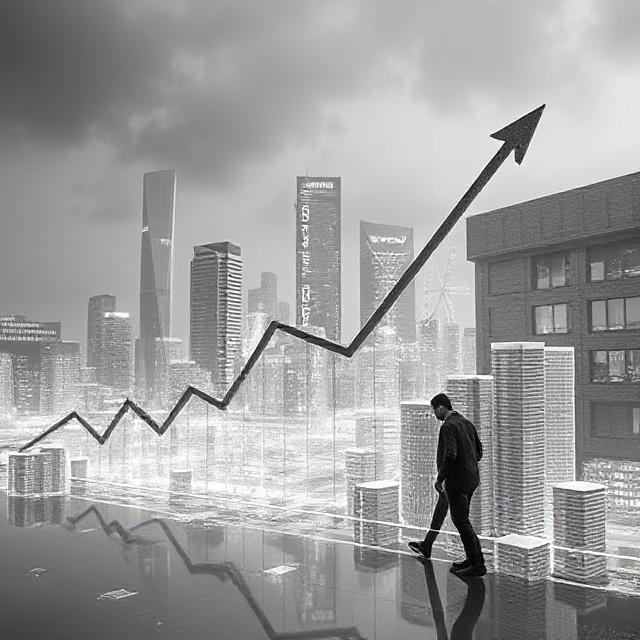
The invisible decline in GDP
In Albania’s economic horizon, the year 2024 represents a silent turning point, where after a period of moderate expansion and hope for export diversification, the figures reversed. Statistical data show that exports fell by 15.4%, while imports increased by 2.5%.
This asymmetric development is, fundamentally, more than a sign of weak external demand. It reflects an economy dependent on few export sectors, with low value-added content, and with a deep, cyclical, and concentrated import profile.
This imbalance is not merely statistical but deeply structural, and understanding it requires interpretation beyond usual trade accounting.
Disconnect between economic growth and trade performance and the paradox phenomenon
In 2024, the Albanian economy did not register a general decline in economic activity, at least not in the formal sense. GDP remained positive, thanks to a combination of factors that sustained domestic demand, such as: public investments driven by infrastructure projects, steady remittances, and soft bank credit supporting private consumption.
This macroeconomic picture would suggest a suitable environment for export growth, but the opposite happened.
Goods exports fell by 15.4%, a dramatic drop unjustified by aggregate demand dynamics. At the same time, imports increased by 2.5%, further deepening the trade deficit and unbalancing the external accounts structure. This incoherence between trade and domestic economic activity challenges classic macroeconomic models, which typically predict exports and imports to closely follow the same direction as real GDP.
This leads to what international literature calls the “missing trade puzzle,” an abrupt and unexplained disconnect between developments in foreign trade and domestic activity.
But this “puzzle” is not accidental.
The answer lies in the internal structure of aggregate demand and the sectoral composition of the Albanian economy.
Instead of analyzing only the level of aggregate demand, attention must shift to its composition.
Which components of demand grew?
Which declined?
What are their trade characteristics?
For example, an increase in government spending on wages or social welfare does not have the same impact on import demand as would an increase in industrial investments or export input purchases. Likewise, a shift from machinery investments toward intellectual property or services has different effects on goods trade.
In Albania’s case, exports are highly concentrated in a few product groups (textiles, minerals, energy, agricultural products), which are sensitive to external demand, partner monetary policies, and global price changes, but are also exposed to internal structural factors such as lack of technology, high production costs, and absence of value chain networks.
On the other hand, imports are dominated by consumer goods, production inputs, and capital goods, supporting the current production and consumption structure. When domestic demand is oriented more toward consumption than export production, imports continue rising while exports fall.
At its core, the 2024 trade deficit is not the result of economic weakness, but the consequence of an economic model favoring foreign consumption and lacking competitive production for foreign markets. The fall in exports in this context is not a general economic downturn, but a symptom of structural inability to translate economic growth into sustainable export increases.
An economy vulnerable to external factors and lacking structural protection
In 2024, over 72% of Albanian exports went to the EU, with 44% directed to just one country — Italy. This high territorial dependence was accompanied by a 15.5% decline in exports to the EU, with Italy contributing a contraction of -13.9%.
Meanwhile, imports from the EU increased by 3.6%, deepening the imbalance. In this context, the country’s main partnership turns out more a source of exposure than strategic advantage.
The export structure is concentrated in products with high cycle volatility and low technological content (textiles, footwear, minerals, metals, and energy). These sectors are sensitive to international price fluctuations, supply chain changes, and foreign monetary and fiscal policies.
Thus, if the EU enters a monetary tightening cycle or a demand shift from goods to services or IP (as occurred in 2023), demand for Albanian exports is hit directly without alternative cushions.
In the first five months of 2025, exports rose by 2.1% and imports fell by 2.4%. The trade deficit narrowed by 6.1%. At first glance, this is good news, but behind the numbers lie sectoral shifts indicating a more complex dynamic:
- Export growth was led by mineral products, energy, and fuels — sensitive to price cycles but not necessarily sustainable.
- Construction materials and metals continued to decline, reflecting stagnant investment demand.
- Imports reduced mainly in the same cyclical categories, not due to increased local production, but because of slower domestic demand in construction and energy.
Export growth in this context looks more like a seasonal or price effect than a sign of structural recovery.
Demand composition channels and the role of enterprises
An aspect reinforcing this interpretation is the structure of exporting and importing enterprises:
- 55% of exports are realized by 50 large enterprises.
- 97% of exporting companies are micro or small, with limited access to international markets, capital, technology, and product diversification.
- Firms exporting to only one country account for 29% of exports, a high geographic dependency.
- Imports are more widespread but still dominated by 100 large companies. This shows Albania’s supply chains are more connected to foreign supply than domestic capacity.
At the macroeconomic level, this means any external demand shock (or EU monetary policy) impacts exports heavily, while imports remain more stable due to domestic consumption and production structure.
Is there an internal channel for monetary policy transmission?
Unlike the Eurozone, Albania lacks strong monetary policy influence on trade. But indirect effects via partner policies and on domestic investment structure exist.
Imports of capital goods, construction materials, and industrial inputs respond to investment pace, which depends on fiscal climate, credit availability, and exchange rates.
A slowdown in public or private investments, as signaled by declining construction material imports, translates into reduced import demand, as seen in early 2025.
Hence, the composition of internal demand between consumption, investment, or export production represents a silent but real channel of trade impact.
The 15.4% drop in Albanian exports in 2024, followed by a modest 2.1% recovery in early 2025, cannot be considered simply cyclical or isolated events. Rather, they clearly signal internal structural weaknesses in Albania’s trade model, which is sensitive to external shocks and lacks the ability to respond symmetrically through exports.
This asymmetry — where exports fall sharply while imports continue expanding — indicates not only structural lack of competitiveness but also excessive exposure to a narrow range of products and markets.
Albania’s economy needs to break dependence on unbalanced trade and low value-added sectors, orienting itself toward building a new trade architecture that combines diversification, smart industrialization, and regional integration.
Each leading market enterprise should serve as a model in coordination with government and market actors both domestically and abroad.
Finally, as the most advanced Eurozone studies show, trade balance is explained not only by GDP changes but also by the internal composition of demand and sectoral economic structure. For a country like Albania, striving to emerge from the periphery, this structural perspective is essential.

Leave a Reply
You must be logged in to post a comment.