


Structural distortions in Agriculture, Migration, and Productivity
When observing Albania through the lens of the latest analysis by the International Monetary Fund (IMF), the picture of its economic development is described by a series of structural distortions that have simultaneously affected agriculture, the labor market, and migration dynamics.
These distortions are not merely technical; they are institutional, historical, and territorial in nature. They have shaped the way the Albanian economy produces, employs, and distributes welfare.
The IMF emphasizes that countries with limited fiscal capacity, weak administration, and a fragmented agricultural sector face a clear risk: low productivity, increased emigration, and long-term economic instability. Albania is a clear example of this model.
Structural distortions in agriculture, an unresolved legacy
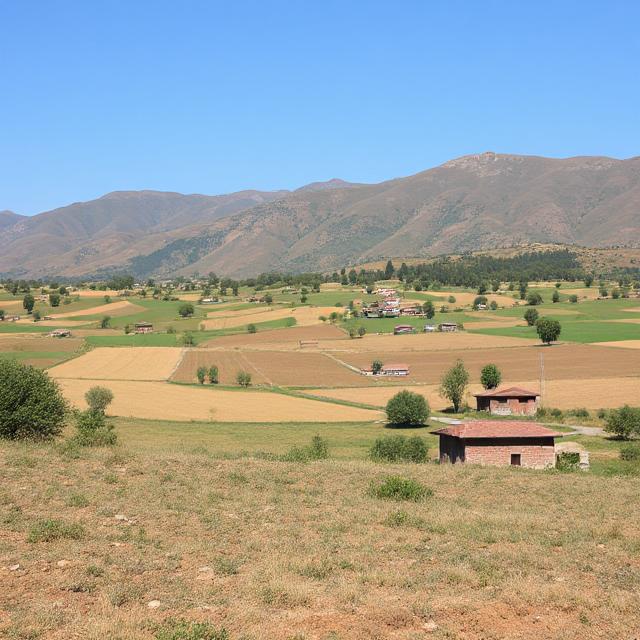
The agricultural sector in Albania, while still accounting for a significant share of employment (around 35–37% of the labor force), contributes only about 15–17% of the Gross Domestic Product (GDP). This pronounced mismatch shows that human and land resources are not being used efficiently.
Extreme land fragmentation is one of the main sources of this distortion. According to World Bank data, there are around 359,000 farms in Albania, with an average size of only 1.1 hectares each, often divided into several non-adjacent plots. This situation makes it impossible to create economies of scale, use modern machinery, or access market supply chains.
At the same time, land ownership insecurity remains an open wound. Only 10% of agricultural properties have been digitally registered, while about 80% exist only in old paper registries and 10% lack documentation entirely. This lack of legal formality has for decades excluded farmers from access to credit, development funds, and subsidies.
A farmer without ownership documentation is practically excluded from any form of formal financing. This is why only 1.5–2% of bank loans in the country go to the agricultural sector, even though it employs nearly one-third of the national workforce.
In this sense, Albanian agriculture is not underdeveloped due to a lack of willingness, but because of a web of legal, economic, and institutional distortions that have blocked its progress.
Migration as both a consequence and reflection of distortions
One of the most evident effects of agricultural distortions is massive and selective emigration. Albania is among the countries with the highest emigration rates relative to its active population in Europe.
According to the International Organization for Migration (IOM), about 40% of the Albanian labor force has emigrated or is living abroad.
In rural areas, this figure is even more dramatic. For instance, Kukës County has lost over 20% of its population in just one decade, while in some southern municipalities, the population has halved.
This shift is not random, nor has it happened in a few years. It is closely tied to the lack of economic perspective. Young people, who are potentially the most innovative and productive group face a narrow labor market with low income opportunities.
The IMF notes that in countries like Albania, where agriculture remains the main source of self-employment, structural distortions push abroad precisely the most capable layer of the rural population.
This produces a double effect:
- on one hand, it reduces the potential for agricultural development within the country;
- on the other, it creates dependency on remittances, which make up 8–9% of GDP but are not used productively due to the absence of a clear rural investment channel.
Thus, Albania experiences a self-reinforcing cycle of distortions, inefficient agriculture fuels emigration (especially of young people), which in turn lowers agricultural productivity, and declining productivity increases dependency on external markets and imports.
Misallocation of resources and the cost of low productivity
According to the IMF’s analysis, an economy faces resource misallocation when capital, land, and labor are not used where they generate the highest returns. Albania is a typical illustration of this phenomenon.
Based on data from the Institute of Statistics, the average yield per hectare in many agricultural crops is 2–3 times lower than in neighboring EU countries such as Greece or Croatia.
This is not due to a lack of land or climate, Albania has favorable agro-climatic conditions, but rather due to a lack of mechanization, financial inclusion, and technology.
Moreover, subsidy policies have been scattered and often not results-oriented. Instead of supporting innovation or processing, a significant portion of funds goes to covering routine costs or compensations, with little real impact on productivity.
In 2024–2025, for instance, public funds for agriculture accounted for only about 2% of total budget expenditures, while the EU average stands at 5–6%.
This financial gap, translated into reality, means that farmers remain at a level of subsistence rather than development.
Macroeconomic and territorial consequences
The combination of agricultural distortions and emigration has produced visible consequences in the overall economic structure:
- The food deficit has deepened, statistics show that Albania imports over 60% of the food products it consumes.
- The economic structure has shifted toward construction and non-productive services, generating fragile growth dependent on seasonal consumption.
- Territorial inequalities have widened, rural areas are depopulating, while urbanization is concentrated in a few centers, such as Tirana and Durrës, increasing pressure on urban infrastructure.
- The labor market suffers from a shortage of skilled workers in productive sectors and a surplus of low-wage jobs.
The IMF defines this as a two-dimensional economic trap, an urban economy growing on non-productive bases and a rural economy stuck in low productivity.
This divide is deepening and threatens to make the country lose its agrarian and food potential in the coming decade.
Central and Eastern European countries have gone through similar phases but have demonstrated that solutions are possible when interventions are sustainable and coordinated.
- Poland, after 1990, faced the same problem of extreme fragmentation. It created programs for voluntary farm consolidation, state-guaranteed loans, and support for cooperative enterprises. Within ten years, agricultural productivity tripled.
- Croatia completed the land registration process before joining the EU and linked it directly to access to IPARD funds. The result: a 50% increase in rural investments within five years.
- Slovenia and Lithuania implemented fiscal policies encouraging farmers to formalize in exchange for benefits (tax reductions, technology grants, energy support).
These countries turned the agricultural sector from a weak link into a sustainable source of exports and local development.
For Albania, these examples are highly relevant, they show that the problem does not lie in market size or natural wealth, but in institutional efficiency and the direction of public policy.
Paths toward solutions
If Albania wants to escape this structural trap, it must act simultaneously on several fronts:
- Completion of agricultural land reform
Accelerate land registration, consolidate property, and create a unified digital cadastre as prerequisites for any development reform. - Formalization and financial inclusion
Establish simplified tax schemes and state-backed guarantees for small farmers to integrate them into the banking system and enable investments in mechanization and technology. - Rebuilding modern cooperatives
Instead of traditional fragmentation, new cooperatives should function as joint business units for storage, marketing, and processing, reducing costs and strengthening farmers’ bargaining power. - Policies for diaspora return and inclusion
The Albanian diaspora is a major source of capital and experience. Developing co-financed investment programs in rural areas could transform emigration from loss into opportunity. - Development of integrated markets and digital agriculture
Online agricultural trade platforms, transparency in subsidies, and digital training for farmers could boost productivity and accountability.
Albania stands at a point where agriculture, migration, and economic development can no longer be treated as separate spheres.
Structural distortions in agriculture mirror the broader economy, fragile institutions, fragmented policies, and a lack of coordination between reforms.
Examples from Central Europe show that change is possible, but it requires long-term vision, policy integration, and courage to confront short-term interests.
If the country manages to break this cycle, it can transform agriculture from a survival sector into a source of sustainable growth and social stability. Ultimately, this means restoring the balance between land, people, and markets, three pillars that today remain distorted, but tomorrow could become the foundation of a more productive and equitable Albania.



Leave a Reply
You must be logged in to post a comment.