


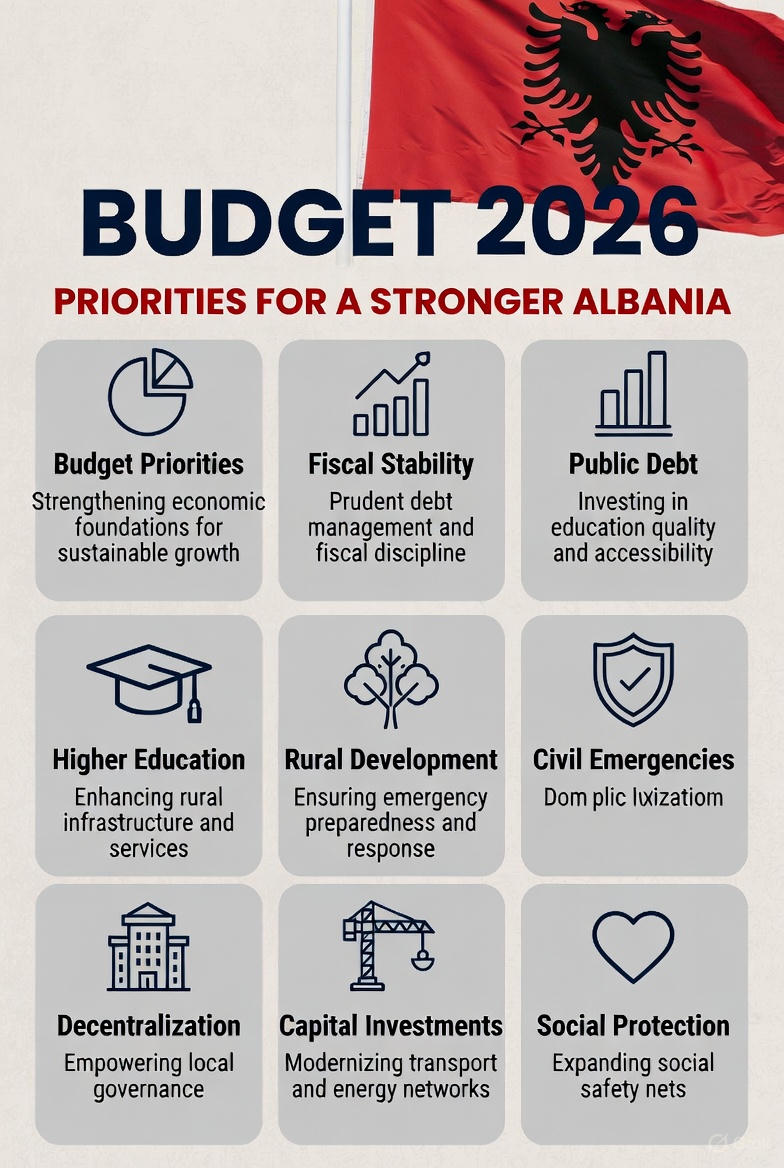
Overview of the Priorities of the Draft Budget for 2026
The 2026 Draft State Budget reflects a careful fiscal approach aimed at maintaining the stability of the deficit and public debt, while directing expenditures toward social and developmental priorities.
Compared to previous years, when the government’s focus was primarily on managing external economic crises, inflation, and energy prices, the 2026 budget shows a clear shift toward supporting social groups, strengthening education and scientific research, rural development, and the decentralization of investments.
The financing of the deficit is carefully structured: net domestic borrowing is capped at 45 billion ALL, while the remaining deficit is financed through external borrowing and adjustments in the government’s single treasury account at the Bank of Albania.
This reflects a clear priority of keeping public debt under control while maintaining flexibility for external financing when needed—illustrating a conservative yet adaptive fiscal stance responsive to international conditions.
Regarding external borrowing, the indicative value of 10.27 billion ALL represents a combination of long-term project loans (28.26 billion ALL), budget support from international financial institutions (17.70 billion ALL), and principal repayments (-36.69 billion ALL). This structure demonstrates a balance between developmental investment and debt management, ensuring that capital expenditures and externally financed projects remain sustainable.
The use of accumulated funds in the single treasury account, with an indicative value of 8.43 billion ALL, provides a powerful instrument for liquidity management and financial stability.
A particularly important element is the allocation of privatization revenues, where less than 50% is used to reduce the limit of net domestic borrowing, while the remaining portion can be directed toward increasing the ceiling of capital expenditures—reflecting a strategy of converting one-off revenues into productive investments to support economic development.
On the expenditure side, the 2026 budget is characterized by a clear focus on central government spending (636.07 billion ALL), a reserve fund (2.5 billion ALL), and contingencies for debt-related risks (6.3 billion ALL).
This indicates a dual priority: preserving fiscal stability while ensuring readiness to respond to unforeseen emergencies. Compared to previous years, when emergency funds were more limited, this represents a heightened focus on fiscal and financial risk management.
A critical feature of the 2026 budget is its orientation toward decentralization of investments and support for local governance. Unconditional transfers to local self-governing units, civil emergency funds, and support for school and sports infrastructure underline an effort to strengthen local efficiency and municipal capacities, bringing governance closer to citizens.
However, this approach requires strong monitoring and transparency mechanisms to avoid disparities between wealthier and poorer municipalities.
In higher education and scientific research, funds are distributed into three main categories: development policy grants, teaching grants, and research and creative activity grants. This focus on innovation and academic capacity building aligns with EU standards, but the lack of measurable performance indicators and weak links with the labor market remain challenges that could reduce investment effectiveness.
In the agriculture and rural development sector, expenditures include support for agricultural fuel, irrigation and drainage infrastructure, and rural infrastructure management projects. This reflects a priority for sustainable rural development and productivity growth, though the dispersion of funds across many small projects could fragment impact and limit macroeconomic benefits.
Another key element is the focus on civil protection and emergencies, with dedicated funds for disaster prevention, dams, and reservoirs. This demonstrates a proactive approach to natural risk management, consistent with international sustainability standards.
From a debt and borrowing perspective, the budget maintains a conservative profile, with annual net borrowing for 2026 limited to 55.27 billion ALL, while growth in guaranteed debt and public debt stock remains under strict control. This approach reduces the risk of borrowing dependency and ensures fiscal stability, though it may constrain the scale of new capital investments—particularly in large infrastructure projects.
Another important feature is the flexibility in the use of residual or reallocated funds from international creditors, which allows the government to address emerging needs and unplanned investments. However, this requires transparency and rigorous reporting to prevent misuse.
Overall, the 2026 budget demonstrates a strong prioritization of social spending, education and research, civil protection, and decentralization, while maintaining fiscal stability and public debt limits.
However, the main challenge remains the lack of a direct link between expenditures and measurable economic outcomes, as well as the need for effective monitoring of decentralized funds and capital investments.
Thus, while the budget is oriented toward well-being and sustainability, it will achieve full success only if implemented with transparency, performance indicators, and control mechanisms that ensure efficient and equitable use of public funds.



Leave a Reply
You must be logged in to post a comment.