


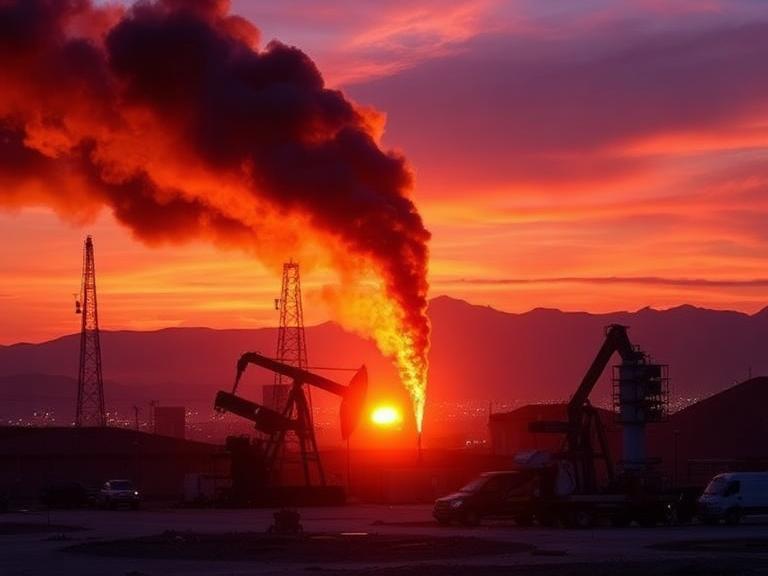
Middle East Tensions raise inflation risk in Albania
Recent geopolitical tensions in the Middle East, including US and Israeli attacks on Iran and Tehran’s retaliatory responses, are causing major concerns in global energy markets.
These developments have led to a sudden increase in oil prices, fueling a “cost-push” inflation, where the increase in input costs such as energy and fuel spreads throughout the economic chain.
Albania, as an economy dependent on energy imports, is feeling the indirect effects, with forecasts for an increase in inflation in the coming months. This situation is consistent with the warnings of our 2025 analyses, which highlight the vulnerability of the Albanian economy to external crises.
According to the latest data, the price of Brent oil has reached 78-80 dollars per barrel today, marking an increase of 7-9% within the day. Experts predict that if the conflict is prolonged and leads to the closure of the Strait of Hormuz, a key route for 20% of global oil supply, prices could exceed $100.
Albania, as a net importer of oil mainly from European markets and indirectly from the Middle East, will face an immediate increase in fuel prices, potentially +10-15% in the coming months.
As an economic rule, a 5% increase in oil prices adds about 0.1 percentage point to global inflation; in the case of $100, this could add 0.6-0.7 points, also affecting our economy. This will increase transport and logistics costs, putting pressure on consumer prices.
The impacts extend to the supply chain and key sectors of the Albanian economy.
In transport and logistics, where Albania relies on imports for basic goods such as food and construction materials, rising costs (20-30% of business spending) will be passed on to final prices. This could add 1-2% to food and non-food inflation.
In production and industry, sectors that contribute 20-25% of GDP, such as construction, agriculture and manufacturing, higher electricity and fuel costs (a 10% increase could add 0.5-1% to inflation) will hit low-income households, which spend more on energy and food.
Tourism, which accounts for 20-25% of GDP and contributed to the economy’s 3.4-3.6% growth in 2025, risks a decline in visitor numbers due to global fears, reducing revenues and adding to inflationary pressure from falling domestic demand.
Current inflation in Albania stands at 2.3% for January 2026, unchanged from December 2025, with main contributions from energy (4.4%) and food (1.8%).
If tensions persist, forecasts point to an additional 1-1.5% increase, bringing inflation to 3.3-3.8% by June 2026.
According to our analysis[1], which underlines the economy’s vulnerability to geopolitical shocks due to import dependence and lack of diversification. ALTAX warns that moderate growth (3.4% in the first quarter of 2025) is vulnerable to global fluctuations, recommending investments in renewable energy to reduce dependence.
In social and economic terms, low-income families will suffer the most, as energy and food account for 40-50% of their budgets. Small businesses in transport and agriculture may experience reduced profits, increasing unemployment or freezing wages. If the conflict lasts, the Bank of Albania may raise interest rates to curb inflation, slowing economic growth.
In line with ALTAX’s analysis from 2025, the government should focus on strategic oil reserves, energy subsidies and fiscal policies to protect vulnerable groups.
Concrete measures recommended to mitigate the impact of rising oil and energy prices in Albania:
1. Building and filling strategic oil reserves – creating or expanding the national stock to cover emergency needs for 3-6 months, avoiding panic and sudden price fluctuations in the market.
2. Targeted energy subsidies – temporary support for low-income households and small businesses (e.g. tax cuts or direct compensation for energy/fuel bills), without aggravating the budget deficit.
3. Prudent fiscal policies – maintaining the budget deficit below 2-3% of GDP by 2026, avoiding uncontrolled spending that would increase inflationary pressure.
4. Accelerating investment in renewable energy – increasing solar, wind and hydro capacities to reduce dependence on oil and gas imports (as highlighted in the energy transformation, where solar reached 10% of production by the end of 2025).
5. Diversifying supply sources and markets – seeking new partners outside the EU or strengthening existing ones These measures will help mitigate the impacts and keep inflation under control, promoting an economy more resilient to global crises.
These measures will help mitigate the impacts and keep inflation under control, promoting an economy more resilient to global crises.
[1] https://altax.al/en/current-military-crises-and-the-tasks-of-the-albanian-economy/


Leave a Reply
You must be logged in to post a comment.