


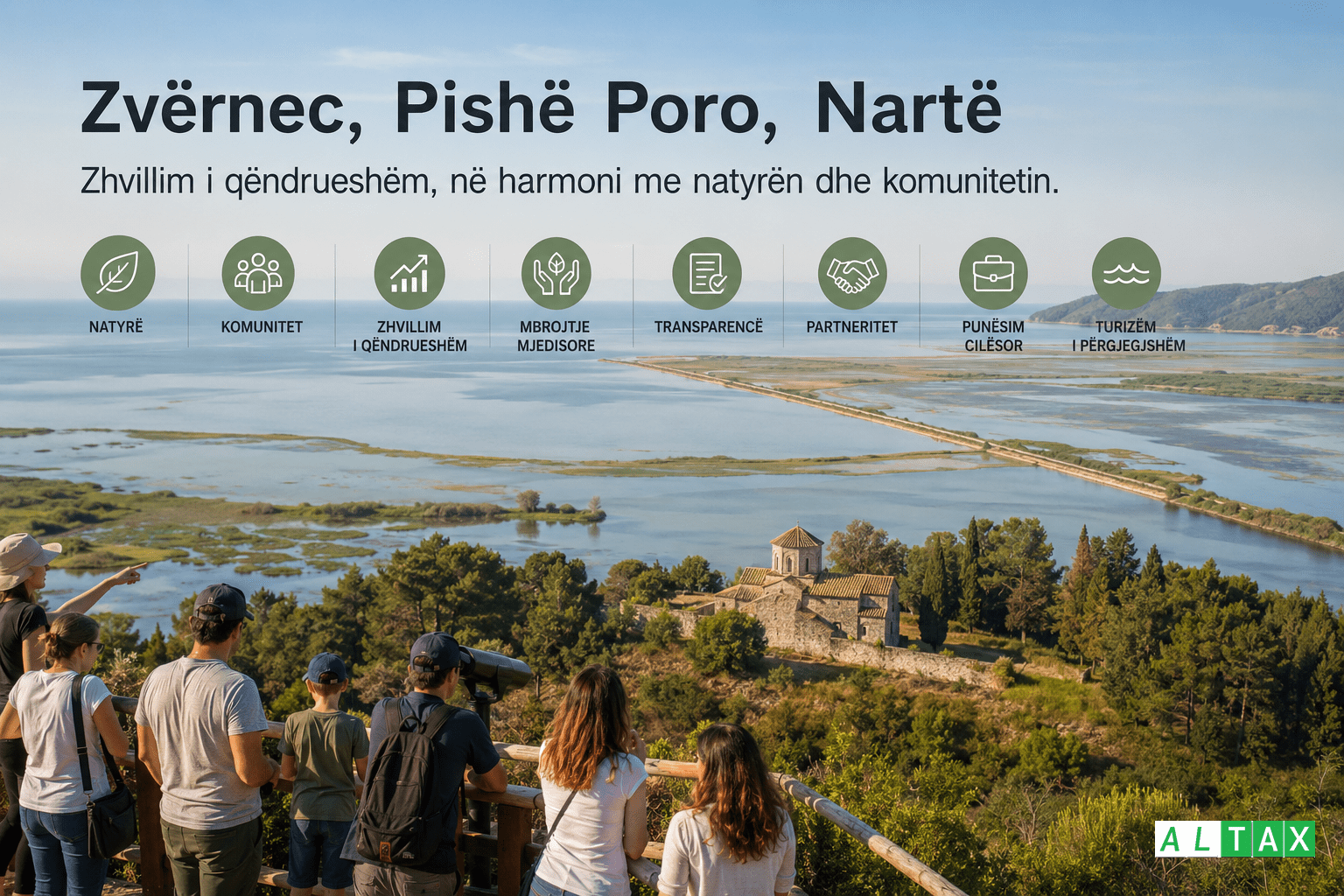
Zvërnec–Pishë Poro–Nartë Project between economic potential and Albania’s institutional test
In the public debate that has accompanied the Zvërnec tourism project, attention has been primarily focused on the magnitude of the declared investment, which according to public information reaches over 4 billion euros. However, in modern standards for the evaluation of strategic investments, the size of capital does not in itself constitute an indicator of economic success. On the contrary, the fundamental question is whether there exists a demonstrable relationship between the investment, net public benefit, and the economic, social, fiscal, and environmental costs it generates.
From this perspective, the Zvërnec project presents a significant institutional contradiction. On one hand, there is an investment that could potentially be among the largest in Albania’s economic history and create a new center of gravity for high-end tourism in the Adriatic. On the other hand, the public documentation that would allow objective verification of economic, social, and environmental claims remains extremely limited. This situation creates a visible gap between the declared ambition and the empirical basis upon which public decision-making should rest.
In this sense, the public interest should not focus on whether the project is desirable or not. The real issue is whether there is sufficient evidence to objectively evaluate its impact.
The claim of 3–4% of GDP represents an extraordinary economic transformation
In 2025, the Albanian economy is estimated to have reached a Gross Domestic Product of approximately 27.7 billion euros. Within this context, the statement that the project could generate 3–4% of GDP implies an annual economic contribution ranging between 830 million and 1.1 billion euros.
To understand the real weight of this figure, it is enough to compare it with the current structure of the Albanian economy. Tourism in the broad sense of direct and indirect contribution is currently estimated to account for more than one quarter of the national economy. This means that a single resort would need to generate a substantial share of the value currently produced by thousands of tourism businesses, hotels, restaurants, tour operators, and related activities across the entire country.
In international analysis, such cases exist, but they are rare and usually associated with very small economies with extreme specialization in tourism. The Atlantis Paradise Island case in the Bahamas is one of the closest examples. There, the resort’s impact was possible because tourism accounted for more than half of the national economy and because the resort functioned as a central node of the country’s economic model.
Although the comparison with the Bahamas illustrates that a single resort can generate significant contributions in very small and highly tourism-specialized economies, a more relevant reference for Albania is Montenegro, due to geographic proximity, economic size, and tourism development model.
Over the past two decades, Montenegro has built a sustained strategy oriented toward premium tourism through large projects such as Porto Montenegro, Luštica Bay, and Portonovi. These investments have attracted several billion euros in private capital and have transformed the country’s international profile, positioning it as one of the leading luxury tourism destinations in the Adriatic.
However, the Montenegrin experience shows a significant difference between the scale of investment and its actual impact on the national economy. Even Porto Montenegro, widely considered the most successful tourism project in the Western Balkans, has generated a direct economic contribution significantly lower than the expectations usually associated with such investments. Its main impact has not come from an immediate increase in GDP shares, but from the gradual creation of a new economic ecosystem linked to marinas, residential tourism, financial services, yacht maintenance, and long-term residential tourism.
This precedent is particularly important for the analysis of the Zvërnec project. If projects that have transformed Montenegro’s tourism structure have produced more gradual and time-distributed macroeconomic effects, then the claim of a 3–4% GDP contribution from a single project in Albania requires a very high level of empirical evidence and economic modeling.
In fact, Montenegro’s experience suggests that the strategic value of such projects does not necessarily lie in their immediate effect on GDP, but in their ability to transform the local economic profile, attract long-term capital, and create high value-added economic activities. For this reason, the real impact of the Zvërnec project should be measured not only through direct tourism revenues, but also through the level of integration with the domestic economy, the degree of local supplier participation, the quality of employment, and the capacity to generate new economic activities beyond the resort itself.
From this perspective, the Montenegrin experience does not exclude the possibility of a large economic impact in Albania, but it suggests that the most ambitious projections should be treated with caution until they are supported by full input-output analysis, independent feasibility studies, and verifiable assessments of net public benefit.
This does not mean that the claim is incorrect. It means that it has not yet been proven.
Employment remains the most vulnerable indicator to overestimation
A similar analysis applies to the claim of creating 10,000 jobs.
In the economics of strategic investment, employment figures are often the most used indicator in public communication, but also the most difficult to interpret without additional information.
In the case of Zvërnec, it is not known how many of these jobs relate to the construction phase and how many to the operational phase. It is not known how many will be permanent and how many seasonal. It is not known what the average wage level will be, the degree of formalization, or the ratio between local and imported labor.
International comparisons show that in similar projects, 35 to 50 percent of total employment is created during construction and disappears after completion. In the operational phase, only a portion of jobs remains active throughout the year, while the rest follows the seasonal tourism cycle.
For Albania there is an additional factor. The luxury hospitality and international resort management segment requires human capital that currently does not exist in sufficient quantity in the domestic market. As a result, the importation of managers, specialists, and foreign experts is almost inevitable.
This creates what development economists call a leakage effect. A portion of the income generated by the project does not remain in the Albanian economy but is transferred abroad through wages, contracts, and imported services.
For this reason, the real economic impact is not determined by the gross number of jobs, but by their quality, productivity, and localization.
The decisive issue is net public benefit
The economic analysis of strategic projects has evolved significantly over recent decades. Today, European institutions no longer ask how much is invested, but how much society gains from the investment.
This is the core of Net Public Benefit analysis.
In the illustrative scenarios included in the analysis, public benefits over a 20-year period may reach around 1.9 billion euros through taxes, social contributions, VAT, and multiplier effects in the economy.
However, public costs may reach around 1.4 billion euros when infrastructure investments, environmental costs, fiscal incentives, and opportunity costs of land are included.
In this case, the net result would be a positive outcome of approximately 530 million euros.
However, what stands out is the wide amplitude of the result. In an optimistic scenario, net benefit may exceed 1.2 billion euros. In a pessimistic scenario, it may turn into a net loss for the state of around 300 million euros.
Thus, the difference between success and failure reaches approximately 1.5 billion euros.
This explains why the European Union, OECD, and international financial institutions consider Cost-Benefit Analysis a mandatory prerequisite rather than a formal document.
In this case, the absence of such an analysis represents the most significant economic gap identified.
The dominant risk is not economic but institutional
The scenario analysis shows that the main obstacle to the project is not the tourism market, financing, or international demand.
The primary risk arises from the quality of the institutional process.
The history of large tourism projects in Europe, the Mediterranean, and the Middle East shows that legal conflicts, incomplete environmental procedures, and lack of transparency have been among the main causes of multi-year delays and financial losses.
In this respect, the most important finding is not what is known, but what is unknown.
The full Environmental Impact Assessment has not been published. The biodiversity analysis has not been published. The cumulative impact assessment has not been published. The Net Public Benefit analysis has not been published. The economic documentation supporting the main investment claims has not been published.
This information vacuum creates the greatest uncertainty.
In economic terms, uncertainty is a cost.
In institutional terms, uncertainty is a risk.
In strategic investment terms, uncertainty is the factor that reduces the credibility of all involved parties.
The project is a test of the Albanian state, not only of the investor
Ultimately, the importance of the project goes beyond Vlora, beyond tourism, and even beyond the investment itself.
In the current phase of EU accession negotiations, Albania is entering a stage where the European Union no longer measures progress by the number of laws adopted, but by the capacity to implement them.
Zvërnec represents a concrete test of this capacity.
It tests whether the Albanian administration can simultaneously ensure economic development, environmental protection, public transparency, and legal certainty.
In this sense, the project is more than a tourism investment. It is a test of the institutional maturity of the Albanian state.
In summary, the analysis does not find evidence that the project is economically unviable. But equally important, it does not find sufficient evidence that its main claims are verified.
Economic potential exists. The potential for regional transformation exists. The potential for job creation and income growth exists.
However, in modern governance standards, potential is not proof.
Today, the strongest finding of the analysis is neither economic nor environmental. It is institutional.
Albania is not facing a lack of ambition to attract transformative investments. The challenge lies in the ability to accompany them with transparency, documentation, and accountability in line with European standards.
For this reason, the fundamental question is whether it will be possible to demonstrate, through verifiable documents and analyses, that the net benefit for Albania is real, sustainable, and greater than the costs society will bear to realize it.
Ultimately, this is the difference between a large investment and a strategic investment.
From analysis of independent prefeasibility “PROJEKTI I ZHVILLIMIT TURISTIK ZVËRNEC – PISHË PORO – NARTË“



Leave a Reply
You must be logged in to post a comment.