


Cost of Corruption and Informality in the Western Balkans (WB6-CCI 2025)
The Western Balkans region continues to suffer from a heavy economic burden caused by corruption and high informality. The total regional GDP for 2025 is estimated at around €168 billion (with a realistic range of €160–175 billion).
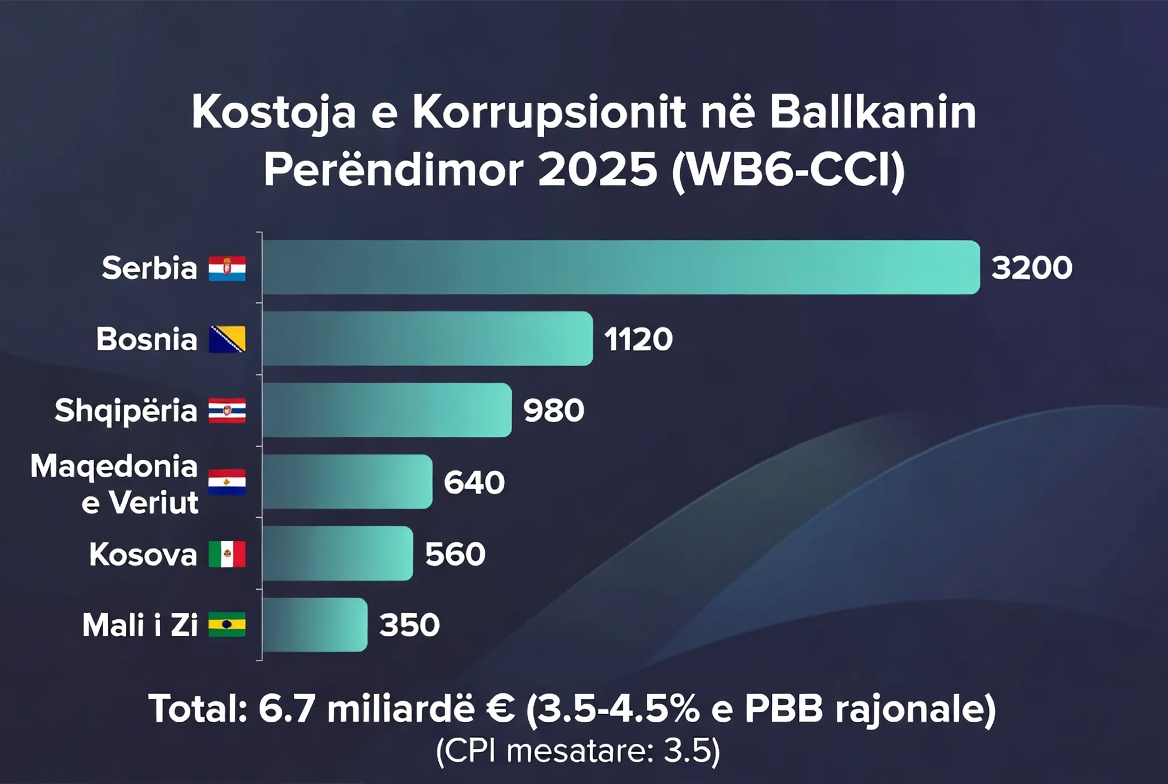
The total annual cost of corruption for the six countries (WB6) is estimated between €5.9 and €7.6 billion, or on average around €6.7 billion in the reference scenario. This represents approximately 3.5–4.5% of regional GDP.
This level of cost is comparable to the annual budgets of several countries in the region and indicates a structural problem that is hindering convergence with the European Union.
Table 1: Cost of Corruption by Country (WB6-CCI 2025)
| Country | GDP (bn €) | CPI 2025 | Informality | Corruption cost (bn €/year) | % GDP | Risk CCI |
|---|---|---|---|---|---|---|
| Serbia | 85.0 | 33 | ~27% | 2.9–3.5 | 3.4–4.1% | 🔴 Very high |
| Bosnia & Herzegovina | 26.0 | 34 | ~30% | 0.95–1.35 | 3.6–5.2% | 🔴 Critical |
| Albania | 27.7 | 39 | ~25% | 0.85–1.11 | 3.1–4.0% | 🟡 High |
| North Macedonia | 15.0 | 40 | ~22% | 0.54–0.74 | 3.6–4.9% | 🟡 High |
| Kosovo | 10.5 | 43 | ~28% | 0.46–0.66 | 4.4–6.3% | 🟠 Medium+ |
| Montenegro | 7.6 | 46 | ~20% | 0.28–0.42 | 3.7–5.5% | 🟠 Medium |
| TOTAL WB6 | ~168 | — | ~25% | 5.9–7.6 | 3.5–4.5% | 🔴 High |
Note: Albania is the ALTAX reference country with verified data. The average CPI for WB6 is 38.3 points, compared to 63.8 in the EU, a gap of 25.5 points.
Annual Cost of Corruption – Average Scenario (bn €)
Serbia = €3.20 bn
Bosnia & Herzegovina = €1.12 bn
Albania = €0.98 bn
North Macedonia = €0.64 bn
Kosovo = €0.56 bn
Montenegro = €0.35 bn
Serbia accounts for around 48% of the total regional cost, driven by its economic size and the depth of institutional problems.
Table 2: Institutional and Investment Risk Matrix
| Country | CPI 2025 | Informality | Cost / GDP | Institutional risk | Investment risk | EU fund absorption |
|---|---|---|---|---|---|---|
| Serbia | 33 | ~27% | 3.6–4.4% | Very high | High — state capture | 50–55% |
| Bosnia & Herzegovina | 34 | ~30% | 3.8–5.2% | Critical | Very high — fragmentation | 35–40% |
| Albania | 39 | ~25% | 3.1–4.0% | High | Medium — procurement challenges | 50–58% |
| North Macedonia | 40 | ~22% | 3.6–4.9% | Medium–High | Medium — procurement challenges | 48–55% |
| Kosovo | 43 | ~28% | 4.4–6.3% | High | Medium — vulnerable | 52–60% |
| Montenegro | 46 | ~20% | 3.7–5.6% | Medium | Medium — concession risk | 55–62% |
1. Serbia
Serbia remains the main source of corruption costs in the region. With the largest economy and the lowest CPI score (33), it loses around €3.2 billion annually. The problem is concentrated in large state-owned enterprises (EPS, NIS, Telekom) and infrastructure projects, where systematic cost overruns reach 20–35%. Institutional capture and political interference in the judiciary create a persistent cycle of impunity.
2. Bosnia and Herzegovina
Bosnia represents the most complex regional case due to its fragmented constitutional structure. Although GDP is lower, the relative cost is very high. Institutional fragmentation blocks reforms, weakens public procurement, and leads to extremely low absorption of EU funds (35–40%). This is the most serious systemic risk in the WB6.
3. Albania
Albania has an estimated cost of €0.85–1.11 billion (3.1–4.0% of GDP). As the ALTAX reference country, its data are more calibrated. Judicial vetting and procurement digitalization are showing positive results, but informality, brain drain, and over-invoicing in procurement remain major challenges.
4. North Macedonia, Kosovo, and Montenegro
North Macedonia shows medium risk with improving trends due to Euro-Atlantic integration. Kosovo has relatively better CPI performance but very high relative cost (up to 6.3% of GDP) due to its small economy and institutional consolidation phase. Montenegro has a more stable profile but remains exposed to risks in concessions and tourism-related sectors.
Corruption and informality in the Western Balkans are not only ethical issues, but a major economic constraint costing over €6.7 billion annually.
Serbia dominates in absolute terms, Bosnia in institutional fragility, while Albania and others remain in an intermediate position. The uneven risk structure shows that without deep institutional reforms—especially in public procurement, judiciary independence, and state-owned enterprise governance—convergence with the EU will remain slow and costly.
The priority must be strengthening transparency, full digitalization of procurement systems, and real independence of anti-corruption institutions. Each improvement in CPI can translate into hundreds of millions of euros in annual savings for regional economies.
Source: ALTAX WB6-CCI model


Leave a Reply
You must be logged in to post a comment.