


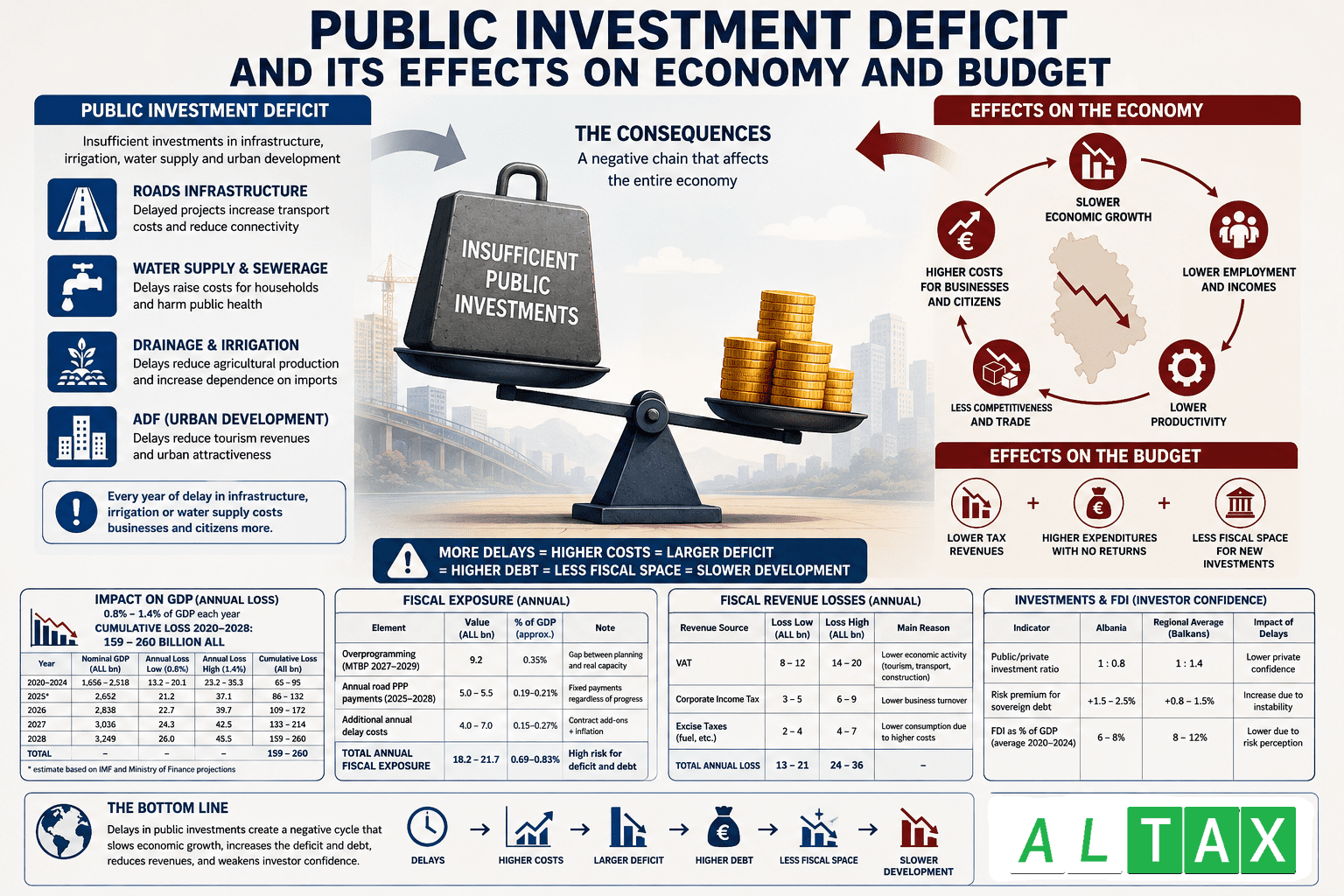
Public investment deficit and its effects on the economy and budget
Delays in public investments do not stop at the direct cost of the project. They create a negative chain that affects the entire economy. This section explains how the damage from delays is transmitted into the real economy, identifying three main channels: direct, indirect, and fiscal. The analysis is based on data from all four sectors (road infrastructure, water supply and sewerage, drainage/irrigation, Albanian Development Fund) and the ALTAX report on the MTBP 2027–2029.
Direct channels – Immediate and visible losses
These are the effects immediately felt by citizens and businesses:
Higher transport and logistics costs (15–35%)
Road projects such as the Tirana Ring Road, Corridor VIII, or the Arbër Road aim to reduce travel time by 40–70%. However, due to delays of 2.2–3.8 years, these savings are not realized on time. The result is:
- Increased fuel costs, driver time, and productivity losses for businesses.
- Freight logistics (imports-exports) become 15–35% more expensive, increasing final prices for consumers.
For example, delays in the Tirana Ring Road increase daily travel time for thousands of residents and trucks, adding logistical costs for supermarkets and factories.
Delays in irrigation/drainage → agricultural production losses
Projects under program 04240 (such as the rehabilitation of the Peqin–Kavajë canals or the Buna embankments) have an average delay of 1.2–2.7 years. This means that thousands of hectares of agricultural land remain without regular irrigation or flood protection.
- Annual losses in agricultural production are estimated at 10–20% in affected areas.
For example, delays in canal rehabilitation in the Fier or Divjakë areas have led to reduced yields of vegetables and grains, increasing dependence on imports and food prices.
Other sector examples
Water Supply & Sewerage
Delays in drinking water supply projects in Durrës or Vlorë increase bottled water costs for households and businesses, adding direct expenses for citizens.
ADF (urban development)
Delays in the rehabilitation of public squares or coastal promenades (such as in Vlorë or Divjakë) reduce direct revenues from seasonal tourism.
Every year of delay in road infrastructure, irrigation, or water supply directly costs businesses and citizens through higher operating expenses.
Indirect channels – Medium- and long-term losses
These effects are more hidden, but more important for economic growth:
Productivity decline (elasticity –0.10 to –0.15)
When transport time or access to water/irrigation is delayed, labor productivity declines.
For example, a 10% reduction in travel time can increase productivity by 1–1.5%.
In Albania, average delays of 2.5–5 years mean that the expected benefits from projects such as the Arbër Road or the Tirana Ring Road are postponed by 4–8 years.
For example, delays in Corridor VIII reduce business access from the Elbasan area to the Port of Durrës, lowering production and export efficiency.
Loss of access to markets, tourism, and employment
Coastal and mountain projects (ADF – Divjakë, Palasë–Dhërmi, Albanian Alps) face delays of 2.5–5 years. This means the tourism season loses its full potential (fewer visitors, lower spending).
For example, delays in the Vlorë promenade or the Divjakë beach area reduce tourist numbers and revenues from hospitality services.
Delayed roads limit workers’ ability to reach employment centers or markets, reducing employment and income.
For example, delays in northern mountain roads (such as the Arbër Road) limit the development of agritourism in Valbonë and Theth.
Delays in drainage/irrigation limit the development of modern agriculture and agritourism.
For example, delays in irrigation systems in the Fier area reduce vegetable production, affecting the food supply chain.
Delays reduce the long-term potential of the economy by blocking access, innovation, and labor mobility.
Fiscal channels – Effects on the state budget
These are the effects that directly impact public finances:
Increased expenditures without returns + PPP exposure
Every year of delay brings contract add-ons, material inflation, and additional supervision costs.
Road PPPs (Arbër Road, Milot–Morinë, Orikum–Dukat) create fixed annual payments of ALL 5–6 billion (2025–2028), regardless of construction progress. This is a predictable but heavy burden on the budget.
The WB Public Finance Review 2025 identifies three additional risk categories:
- Implicit government guarantees from PPPs reach 3–4% of GDP.
- The Vlora TPP presents a contingent liability risk of more than €100 million in unrecovered investment.
- Energy SOEs (KESH, OST, OSHEE) carry off-balance-sheet liabilities not integrated into the central budget.
The IMF Article IV 2025 recommends an annual Fiscal Risk Statement and full integration of PPPs into the budget.
For example, fixed payments for the Arbër Road continue even though some segments are still under construction.
Higher budget deficit + public debt
Overprogramming of 2.25× (MTBP 2027–2029) means that far more projects are planned than can realistically be financed.
Delays postpone completion and increase the need for new borrowing or budget revisions, raising both the deficit and public debt stock.
For example, delays in energy projects (such as the Vlora TPP) increase the need for electricity imports, putting pressure on the deficit.
Lost VAT and tax revenues
Delayed economic activity (tourism, transport, agriculture) generates lower revenues from VAT, corporate income tax, and social contributions.
For example, delays in tourism projects (such as the Divjakë beach area or the Albanian Alps) reduce revenues from seasonal tourism VAT.
Delays in roads connecting rural areas to markets reduce agricultural product sales, lowering taxes collected from farmers and processors.
Delays create a negative cycle of higher expenditures → larger deficit → higher debt → narrower fiscal space for new investments.
Public investment delays are transmitted through the economy via three interconnected channels:
- Direct – higher operating costs for businesses and citizens (transport, logistics, irrigation).
- Indirect – productivity decline and loss of long-term opportunities (tourism, market access, employment).
- Fiscal – pressure on the budget, deficit, and public debt (PPP obligations, lost VAT).
These channels do not operate separately; they form a chain that makes every year of delay far more expensive than what appears in simple budget figures. The cumulative loss reaches hundreds of billions of lek and slows the country’s long-term development.
Public investment delays are not merely a technical or budgetary problem. They have a deep and multidimensional effect on the entire national economy. This section quantifies the real cost of delays for GDP, the state budget, fiscal revenues, and investor confidence. Calculations are based on data from 350–400 projects, ALTAX analysis of the MTBP 2027–2029, and internationally validated economic elasticities.
Impact on GDP (Loss in Economic Growth)
Annual losses are estimated at 0.8–1.4% of GDP. The cumulative loss for the period 2020–2028 now reaches ALL 159–260 billion, after adjustment using the latest nominal GDP data.
Numerical table of GDP losses
| Year | Nominal GDP (ALL bn, approx.) | Annual low loss (0.8%) | Annual high loss (1.4%) | Cumulative loss to date |
| 2020–2024 | 1,656 – 2,518 | 13.2 – 20.1 | 23.2 – 35.3 | 65 – 95 |
| 2025* | 2,652 | 21.2 | 37.1 | 86 – 132 |
| 2026 | 2,838 | 22.7 | 39.7 | 109 – 172 |
| 2027 | 3,036 | 24.3 | 42.5 | 133 – 214 |
| 2028 | 3,249 | 26.0 | 45.5 | 159 – 260 |
| Total | – | – | – | 159 – 260 |
* estimate based on IMF and Ministry of Finance projections
The cumulative loss of ALL 159–260 billion is equivalent to the annual budget of several major ministries or the total capital investment of multiple years. This loss is real and measurable in the form of lower economic growth.
Concrete sectoral examples
- Road infrastructure, where delays in the Tirana Ring Road and Corridor VIII reduce business access, causing a 3–5% productivity loss in affected areas.
- Water Supply & Sewerage, where delays in Durrës and Vlorë negatively affect public health and urban attractiveness.
- Drainage & Irrigation, where delays reduce agricultural yields by 10–20% across thousands of hectares.
- ADF, where delays in tourism projects reduce tourism revenues by hundreds of millions of euros annually.
Impact on the State Budget
Numerical table of fiscal exposure
| Element | Value (ALL bn) | % of GDP (approx.) | Note |
| Overprogramming (MTBP 2027–2029) | 9.2 | 0.35% | Gap between planning and real capacity |
| Annual road PPP payments (2025–2028) | 5.0 – 5.5 | 0.19–0.21% | Fixed payments regardless of progress |
| Additional annual delay costs | 4.0 – 7.0 | 0.15–0.27% | Contract add-ons + inflation |
| Total annual fiscal exposure | 18.2 – 21.7 | 0.69–0.83% | High risk for deficit and debt |
Overprogramming of €9.2 billion and fixed PPP payments create continuous pressure on the budget. Delays add extra costs that force the government either to borrow more or reduce spending in other priority sectors (education, health).
Impact on Fiscal Revenues
Numerical table of fiscal revenue losses
| Revenue source | Annual low loss (ALL bn) | Annual high loss (ALL bn) | Main reason |
| VAT | 8–12 | 14–20 | Lower economic activity (tourism, transport, construction) |
| Corporate income tax | 3–5 | 6–9 | Lower business turnover |
| Excise taxes (fuel, etc.) | 2–4 | 4–7 | Lower consumption due to higher costs |
| Total annual loss | 13–21 | 24–36 | – |
Every year of delay creates a double fiscal loss: higher expenditures + lower revenues. This worsens fiscal balance and increases pressure for new taxes or spending cuts.
Impact on Investments and FDI (Investor Confidence)
Comparative confidence table
| Indicator | Albania | Regional average (Balkans) | Impact of delays |
| Public/private investment ratio | 1 : 0.8 | 1 : 1.4 | Lower private confidence |
| Risk premium for sovereign debt | +1.5–2.5% | +0.8–1.5% | Increase due to instability |
| FDI as % of GDP (average 2020–2024) | 6–8% | 8–12% | Lower due to risk perception |
Systemic delays and overprogramming send a negative signal to investors. The result is a low ratio between private and public investment (1:0.8 versus the regional 1:1.4 average) and a higher risk premium for Albanian sovereign debt.
Major projects such as the Durrës–Prishtina Railway or the Vlora TPP, which remain blocked for years, weaken long-term investor confidence.
Regional comparison of macroeconomic impact
| Indicator | Albania | Western Balkans average | Comparison (Albania vs Region) |
| Annual GDP loss | 0.8–1.4% | 0.4–0.9% | 1.5–2 times higher |
| Overprogramming (times above capacity) | 2.25× | 1.3–1.8× | Significantly higher |
| Cost overruns (average) | 28–42% | 20–35% | Higher |
| Public/private investment ratio | 1 : 0.8 | 1 : 1.2–1.4 | Worse |
| Risk premium for debt | +1.5–2.5% | +0.8–1.5% | Higher |
Albania has one of the most negative impacts from delays in the region, mainly because of extreme overprogramming and high non-advancement rates (73%).
Countries such as Serbia and North Macedonia have improved after implementing PIM reforms, reducing GDP losses below 1%.
Bosnia and Herzegovina faces problems similar to Albania due to weak institutional coordination.
The macroeconomic and fiscal impact of delays is multidimensional and cumulative:
- GDP with annual losses of 0.8–1.4% (ALL 159–260 billion cumulative for 2020–2028).
- State budget with €9.2 billion overprogramming + fixed PPP payments + additional costs.
- Fiscal revenues with VAT and tax losses of ALL 13–36 billion per year.
- Investments & FDI with declining confidence and an unfavorable public/private investment ratio.
These effects create a negative cycle of delays → higher costs → larger deficit → higher debt → narrower fiscal space → fewer effective investments.
Without deep reform, this cycle will continue to slow Albania’s long-term development.
The regional comparison shows that Albania has substantial room for rapid improvement if it follows models such as Georgia’s success or North Macedonia’s reform experience.


Leave a Reply
You must be logged in to post a comment.