


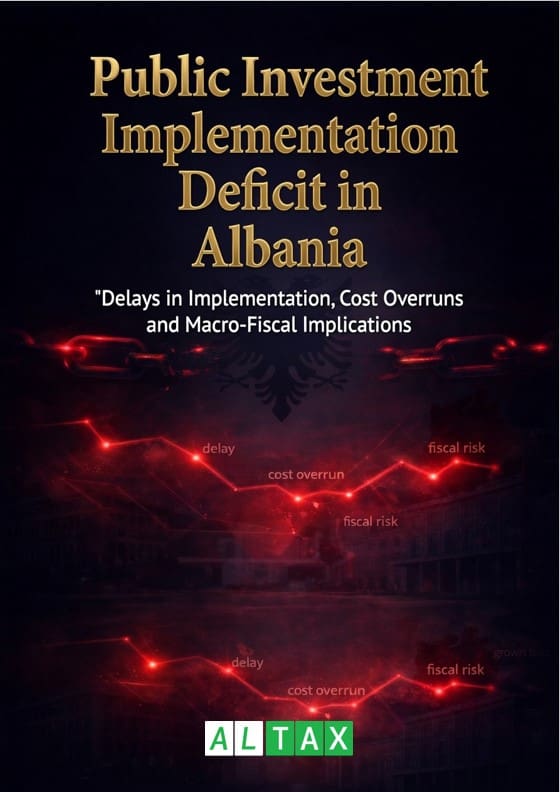
Albania invests heavily, but delivers little — a story of a major implementation deficit
Every year, the Albanian state pours between 5% and 7% of GDP into infrastructure — a level that appears impressive and stands above the average of countries in the region. Millions of euros go toward roads, schools, water networks, drainage systems, and urban and tourism development projects. But if you look at the roads left unfinished, the projects launched with fanfare and forgotten after a few years, or the costs that keep inflating endlessly, you realize that something is wrong.
The new in-depth study by ALTAX Observatory, based on the analysis of more than 350–400 real projects, reveals a bitter reality: Albania does not suffer from a lack of money, but from a systemic execution crisis that costs the economy and citizens on average 0.8 to 1.4% of GDP every year.
What does the reality on the ground show?
The project completion rate (Finish Rate) is dramatically low: only 5–8%. This means that only one out of fourteen projects manages to be completed on time and fully put into public service. Most of them are delayed by an average of 2.5 to 5 years, while costs increase on average by 25–40% (and up to 60% in some urban and tourism projects).
Another major problem is overprogramming. In the 2027–2029 Priority Policy Document, the project portfolio reaches a value of 14.83 billion euros, while the country’s real fiscal capacity is only 8.3 billion euros — that is, 2.25 times more than what we can realistically afford. Only 36% of these projects are fully ready (matured). Furthermore, 73% of the projects have recorded no status change between the two planning documents — remaining stuck on paper for years.
As a result, cumulative economic losses for the 2020–2028 period are estimated at 159 to 260 billion lekë. The multiplier effect (fiscal multiplier) has fallen below 1.0, producing only 60–80 lekë of new value for every 100 lekë invested. In other words, money is being burned without generating the proper return for the economy.
What can change?
The study does not stop at diagnosis. It compares Albania with the successful experience of countries such as Georgia (which raised its Finish Rate from 12% to 31% within 4 years) and proposes a package of concrete and implementable reforms:
The creation of a transparent digital Single Project Pipeline;
An independent Public Investment Management (PIM) Unit;
The establishment of a legal fiscal ceiling to prevent overprogramming;
Performance-based contracts with clear rewards and penalties.
If these reforms are implemented, Albania could save 120–170 billion lekë by 2030, raise the project completion rate to 25–30% within 3–4 years, and significantly increase its ability to absorb European funds under IPA III and the Growth Plan.
Albania does not lack funds. It lacks the political will to change the rules of the game.
This study is a call for immediate action addressed to the government, the opposition, international donors, and the entire civil society. Because efficient public investments are the key to real economic growth, dignified employment, better services for citizens, and a better future for the country.
Read the full study “The Implementation Deficit of Public Investments in Albania.”


Leave a Reply
You must be logged in to post a comment.