


FIA 2025 Report and the Fiscal Reality of Money
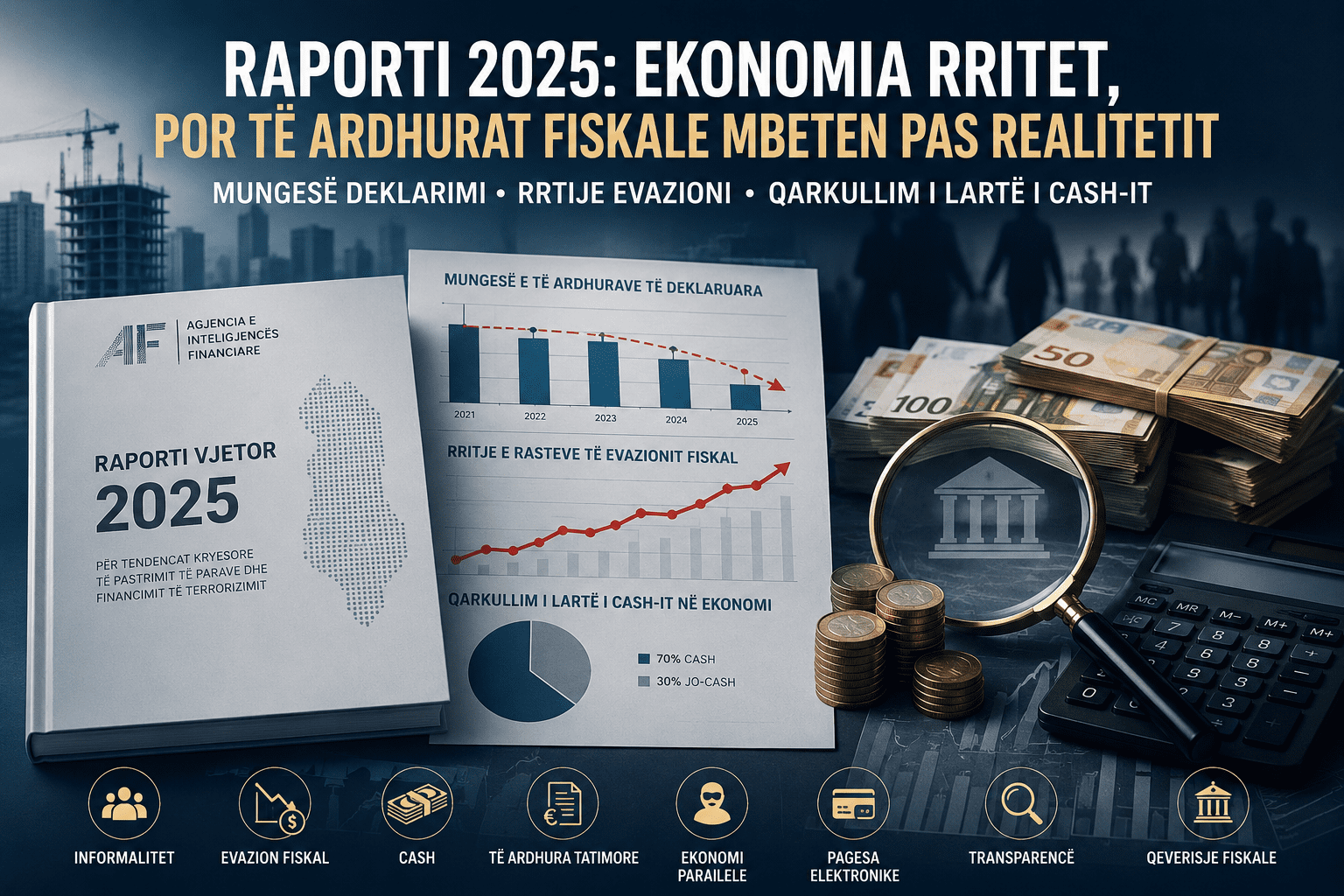
The 2025 Annual Report of the Financial Intelligence Agency (alb. AIF) has brought one of the most persistent problems of the Albanian economy back to the center of the debate: the gap between reported economic growth and the real level of fiscal formalization.
The data in the report evidence a lack of declared income in the tax system, an increase in cases of tax evasion and a high cash flow in the economy, elements that, according to the ALTAX analysis, show that the informal economy still remains a “parallel engine” of economic activity in the country.
Although the Albanian economy has continued to show positive rates of consumption, investment and activity in sectors such as construction, services and trade, the AIF report notes the main contradiction between economic expansion, which is not being proportionally reflected in tax revenues and financial declarations. This means that a significant part of economic turnover is remaining outside the fiscal filter and institutional monitoring.
According to ALTAX’s analytical approach, the phenomenon should not be seen only as a problem of tax evasion by individuals or specific businesses, but as the result of an economic model where informality has gradually been integrated into the functioning of the market.
In many sectors, especially where cash payments dominate, there is a noticeable difference between the real volume of activity and the level of declarations. This situation creates a two-speed economy, where one part pays the obligations and faces high formality costs and another part operates at lower costs due to evasion and lack of traceability.
The AIF report also highlights the increase in the use of cash, an indicator that is usually associated with a high level of informality and difficulties in tracking financial flows. In our economy, payments in physical cash dominate and tax administration, but also financial institutions have more difficulty identifying the source of income, real turnover and final beneficiaries of transactions. This approach to money in the market has increased not only the risk of tax evasion, but also the exposure to money laundering and the distortion of competition in the market.
ALTAX estimates that the problem is closely linked to the current structure of the Albanian economy.
An economy like ours, strongly supported by consumption, construction and sectors with high cash turnover, produces short-term economic growth, but cannot necessarily achieve a sustainable expansion of the tax base. For this reason, GDP growth is not accompanied by the same pace of growth in fiscal revenues or formalization of the labor market.
Another element that emerges from the analysis is the weakness of trust between business and administration.
In conditions where businesses perceive a high fiscal burden, unfair competition and unequal control standards, the incentive for formalization remains limited. On the other hand, the administration continues to rely more on controls and penalties than on building a system with risk analysis, transparency and digital traceability.
According to ALTAX, addressing the situation requires a broader approach than sporadic actions against informality. There is a need to expand electronic payments, reduce formality costs for businesses, strengthen inter-institutional financial analysis and focus fiscal control on sectors with higher risk. Equally important is the creation of a more reliable climate for formal business, where competition is not distorted by the informal economy.
Overall, the 2025 report is a signal that the Albanian economy is facing the ongoing paradox, where economic turnover and consumption increase, while a significant part of this activity remains outside the fiscal system. As a result, the state is losing revenue, the market is being deformed and the growth model is becoming more exposed to financial and institutional risks in the medium term.
Leave a Reply
You must be logged in to post a comment.