


Albania’s port transition, strategic ambition or risk of missing a once-in-a-century opportunity?
The Port of Durrës, historically the main commercial center of Albania, is undergoing a radical transformation, as cargo activity is being moved to Porto Romano (north-west of Durrës), while the old area is being turned into the luxury marina “Durrës Yachts & Marina” in partnership with the Emirati investor Mohamed Alabbar (Eagle Hills).
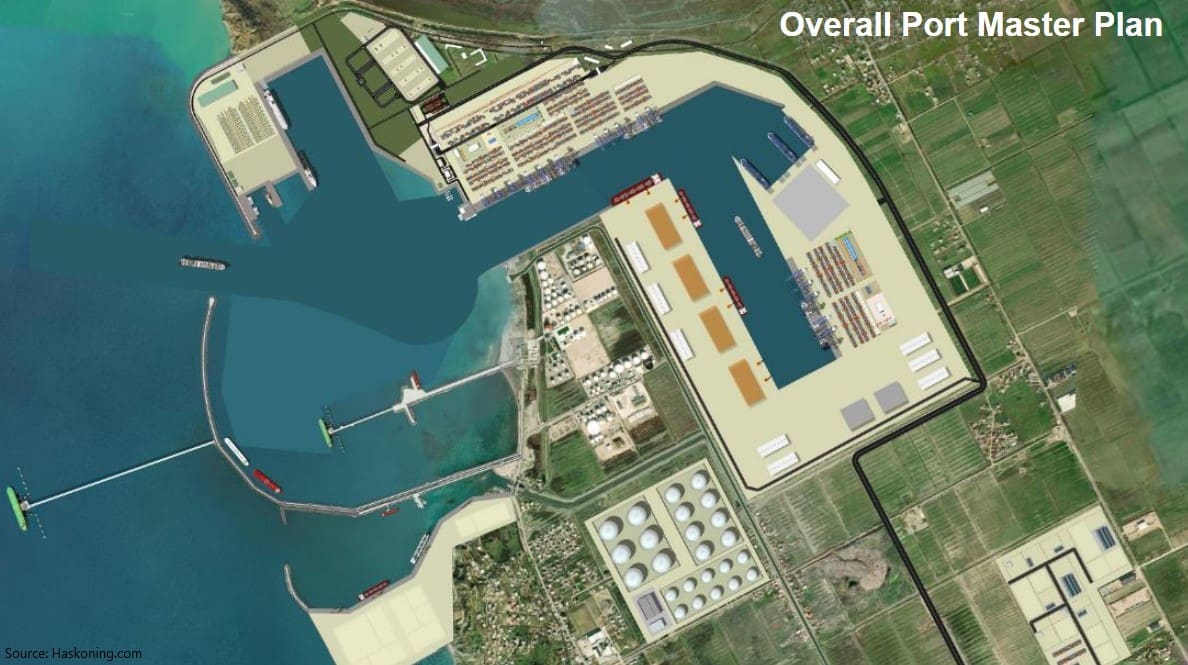
The new commercial project in Porto Romano, with an estimated value of 393–400 million euros (excluding VAT) for the first phase, aims to create a modern port with a depth of 13–16 meters, connected to Corridor 8 and dry ports in Pristina and Skopje.
Strategically, Porto Romano is a “once in 100 years decision”. It connects directly with Corridor 8 (an EU and NATO priority), aims to make Albania a logistics hub for the Western Balkans and to strengthen the military mobility of the Alliance. In today’s geopolitical context, where the Adriatic is a critical corridor between the Mediterranean, Central Europe and Asia, a major port would increase economic sovereignty and Albania’s position as a NATO member. But the current design (only 1,400 m of quay wall and 2.38 ha surface) is considered “too small” by AmCham: it does not reach the depth of 18 m+, the capacity of over 2 million TEU containers, the RoRo/LNG terminals or the large logistics zones that NATO requires. Without revision, Albania risks remaining a “secondary port” dependent on Piraeus or Thessaloniki, losing the opportunity to redefine regional gravity.
However, reality has become problematic.
The tender for the construction of the new port was cancelled for the third time on 11–12 March 2026. The only remaining consortium (Archirodon Construction – Deme Dredging – Società Italiana Dragaggi) withdrew its offer without submitting the financial proposal, for economic reasons and rising global costs. The government describes it as a “crisis coincidence” and promises a “fast and aggressive plan” with a full budget ready, emphasizing that the project has been designed by Royal HaskoningDHV, has passed NATO technical filters and there has been “no dissatisfaction” from the US or the EU.
Meanwhile, the American Chamber of Commerce (AmCham) sent a public letter on March 7, requesting a postponement of the tender and a radical revision of the design. The marina in Durrës is continuing according to plan, but with criticism for lack of transparency and financing partly through the sale of apartments “in the air”.
This situation creates an operational gap, where the old port is losing its commercial function without a ready replacement, leaving Albania in an unclear and delayed transition.
Economically, the project promises growth and a modern port would reduce logistics costs and increase import-export activity, as well as create jobs in logistics and tourism, turning Durrës into an elite destination (as happened in Barcelona).
The total investment (port + marina) reaches billions of euros, with the potential to attract foreign capital and increase tax revenues.
The public cost is high and is accumulating as a direct burden on the state budget.
Only the contract for drafting the detailed technical design of the new port (won in the tender announced on 12 September 2022 by the Durrës Port Authority) has cost 13.8 million euros (initially 1.36 billion lek). The main company Royal HaskoningDHV[1]. (together with the Albanian partners ADEC, Abkons, Taulant and Geo-Eng) has received about 12–13.8 million euros for this phase. In addition, the government has paid 8.2 million euros (815 million lek) only for expropriations of private owners in the Porto Romano area (decision approved in July 2025). Tenders for the construction of the first phase (estimated value 400 million euros, excluding VAT) have been cancelled at least twice (July 2024 and 11–12 March 2026), “swallowing” millions more in administrative procedures, evaluations, complaints and investigations and SPAK has opened an investigative procedure for the entire process.
The total public expenditures so far before a single meter of construction has begun easily reach 22–25 million euros (design + expropriations + the costs of failed tender procedures), therefore funds that have been fully spent without any physical benefit.
Delays are creating additional cost inflation, a hidden cost that falls directly on the Albanian economy.
The base contract for the first phase is 400 million euros. The average global construction inflation (after the energy and materials crisis 2022–2026) ranges between 8–10% per year.
A simple calculation is as follows:
• For a 1-year delay, additional cost = 400 million € × 8–10% = 32–40 million euros extra.
• For a real 2-year delay (as appears from the latest cancellations and the absence of a new concrete plan), cumulative cost ≈ 400 million × [(1.08² – 1) to (1.10² – 1)] = 64–82 million euros additional.
This means that every year of delay “eats” 32–40 million euros from the public budget only from the increase in prices of materials, labor and logistics, without counting borrowing interest if the project is partially financed with loans.
Moreover, the failure to activate the modern port at the planned time creates another hidden economic loss.
The current Port of Durrës processes 7.35 million tons of goods per year (2024). Modernization in Porto Romano was planned to increase capacity by at least 50% (according to the Haskoning master plan), reducing logistics costs for import-export and attracting additional traffic from Corridor 8. Without this, Albania’s economy is losing:
• potential traffic growth (1.5–2 million additional tons per year);
• rerouting of goods[2] to rival ports (Trieste, Koper, Piraeus), where logistics costs for Albanian businesses are 15–25% higher.
If we take an average economic contribution of 50–100 euros per ton (a conservative value from Mediterranean port studies), the annual loss only from the lack of capacity increase reaches 75–200 million euros per year, a hidden cost that taxpayers and businesses are already paying in higher goods prices and competitive losses.
From all calculations it appears that the public cost is not only 400 million euros “on paper”, but it has already begun to accumulate with 22–25 million euros spent + 32–40 million euros additional for every year of delay.
Critics speak of a risk of corruption/opacity (SPAK – Special Anti-Corruption Structure has launched an investigation) and conflict of interest given the fact that the government simultaneously plays the role of initiator, regulator and financier.
But more worrying is the lack of synchronization with global supply chain changes. The crisis in the Red Sea (2024–2026) has forced rerouting of ships through the Cape of Good Hope (+10–14 days delay, higher costs), increasing pressure on alternative Mediterranean–Adriatic routes.
At the same time, nearshoring and friendshoring[3] are making the Mediterranean a new strategic hub. The Adriatic could gain additional traffic from Asia to Central Europe, but only if ports are ready with capacity, depth and multimodal infrastructure.
Albania, with 2–3 year delays and a limited design, risks missing this “train” and goods will go to more efficient ports, leaving the Albanian economy with higher logistics costs and long-term competitive losses. Instead of becoming the “logistics center of Southeast Balkans”, we risk remaining a dependent periphery.
The cases of Barcelona, Hamburg and Piraeus (although not similar to Durrës) show that the transformation of ports is an opportunity, but also a trap if mismanaged.
The first case is Barcelona (Port Vell, 1980–1992). A rapid shift of industrial activity into a tourist marina brought urban regeneration and mass tourism, but also gentrification, rising housing prices and pressure on residents. Albania is repeating this model with the focus on super-yachts and luxury residences, without economic balance, risking turning Durrës into a “resort without industrial soul”.
The second case is Hamburg (HafenCity, over 20 years). Gradual development, with state–private cooperation and preservation of the main logistics function, produced long-term success. But the public cost was very high. Lesson: the transition must be synchronized, not rushed.
The third case is Piraeus (privatization 2016, COSCO/China). Foreign investment brought explosive capacity growth and integration into Belt & Road, but created geopolitical dependence, NATO/EU concerns about labor standards and influence on Greek politics. Albania avoids this (the new port remains state-owned, the UAE investor is a Western partner), but opacity with Alabbar raises doubts about economic “soft power”.
The common mistakes in all three cases are premature relocation without replacement capacity, lack of transparency, bypassing full cost-benefit analyses and lack of linkage with strategic alliances. Albania risks a combination: a “delayed Barcelona” (gentrification + logistics gap) without the benefits of Piraeus.
In the end, relocation is necessary, the old port is outdated, shallow and in conflict with urban development. But the current delays, limited design and lack of transparency are turning a historic opportunity into a real risk. The government is right when it says the project is strategic, but the criticisms of AmCham and the facts of failed tenders cannot simply be labeled as “disinformation”.
From our analysis it is advised that the full feasibility study should be published immediately, revising the design according to AmCham/NATO requirements for depth, capacity and dual use. Meanwhile a transparent tender should be opened with international partners (USA, Italy, EU) for co-financing. The marina and the new port should be synchronized, maintaining the balance between tourism and logistics, while priority integration into Corridor 8 with EU/NATO standards will maximize benefits from nearshoring and global rerouting. If this is done, Albania can emerge as a winner with a competitive port, a more resilient economy and a strong position in the Adriatic. If not, we risk paying billions without benefit and missing the “train” of the century.
[1] increased by about 20% through the decision of the Official Bulletin no. 129/2022)
[2] When the port of Durres experiences delays or limited capacity, goods or shipping lines that would normally pass through it are diverted to other ports such as Thessaloniki, Bari or Koper. The main effect is that trade traffic is not disrupted, but moves away from Albania, resulting in a loss of volume and revenue.
[3] shifting production closer to Europe or allies due to tariffs, the war in Ukraine and tensions with China

Leave a Reply
You must be logged in to post a comment.