


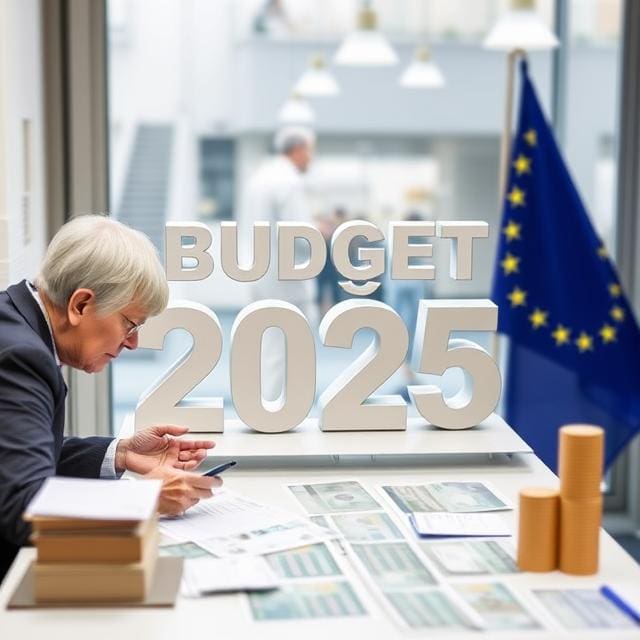
A budget that exceeds the plan, but does it serve the citizen?
The latest figures from the Ministry of Finance show an unusual reality for Albanian public finances. Budget revenues for the period January–August 2025 have exceeded the plan by over 69 million euros. At first glance, this is a significant achievement.
But the essential question is:
- Will this surplus translate into more social security, more sustainable pensions, and higher-quality public services, or will it be distributed in a fragmented way for short-term projects?
Where do the additional revenues come from?
The main sources are VAT and personal income tax.
This indicates two things. First, an increase in labor market formalization, with more employees receiving declared salaries and contributing to the insurance system; and second, a rise in prices and consumption, which has automatically expanded the tax base. So, part of this success is structural, but another part is temporary, because if prices fall, collections may not remain at the same level.
However, for citizens, this is a positive signal. Formalizing wages increases revenues for pensions and reduces room for unfair competition among businesses. This is a necessary step toward a fairer economy.
The risk of end-of-year spending
Experience from recent years shows that budget spending is concentrated in the last months of the year.
This management style brings serious risk. Projects often start in haste, quality declines, and tenders become less transparent. Instead of the surplus translating into social security and long-term investments, there is a risk it will be used for electoral spending or for projects that do not have a real impact on citizens’ lives.
Therefore, the main message is simple. The management of extra funds must be done carefully, prioritizing the citizen, not the political cycle.
Priority must be social security
In a country where over 30% of the population is linked to pension schemes, where education and health suffer from a lack of funds, and where informal unemployment remains a problem, it is clear that any additional revenue must be directed toward strengthening social security.
Pension increases cannot be postponed indefinitely, but they must be supported by an increase in the number of contributors, not just public debt.
Public health requires financing to provide basic services without additional payments from citizens.
Education requires more investment, not only in infrastructure, but in quality, training, and technology.
These are investments that return in long-term productivity, unlike temporary infrastructure projects that often have only a visual effect.
Integration and its costs
At this moment, Albania is in a phase where EU integration is no longer a political slogan, but a real process with concrete budgetary costs. EU standards require higher funds for agriculture, energy, environment, and cybersecurity. If resources are not allocated structurally today, tomorrow we will face greater financial pressure and risk losing EU funds.
Thus, orienting the budget toward harmonization with European standards is inevitable. This should not be seen as a burden, but as a strategic investment for the future.
Budget 2026, a major test
The government has begun drafting the budget for 2026. If this year is characterized by a performance better than expectations, the next year will be the big test.
How will the additional revenues be distributed?
Will they go to new roads and infrastructure projects, or to public services and social security?
If, for 2026, the priority is not clearly set on pensions, health, and education, then any surplus is only a statistical illusion, not a real victory for citizens.
Citizens do not feel the benefit of the ministry’s figures and reports if they do not see a real change in daily life.
Declared wages, secure pensions, free health services, and accessible education are the indicators that make the budget valuable. Otherwise, the surplus is just a table of numbers, justified internally.
Albania is at a moment of rare opportunity.
Revenues are above plan, integration requires harmonization, and citizens have higher expectations.
The major challenge is to transform this surplus into social security and a sustainable economy, not to distribute it in a fragmented way.
This is the moment to show that the budget is not just a financial document, but a social contract between the state and the citizen. And this contract must carry a single message!
Every additional euro must be returned as more social protection, health, and education for Albanian citizens.


Leave a Reply
You must be logged in to post a comment.