


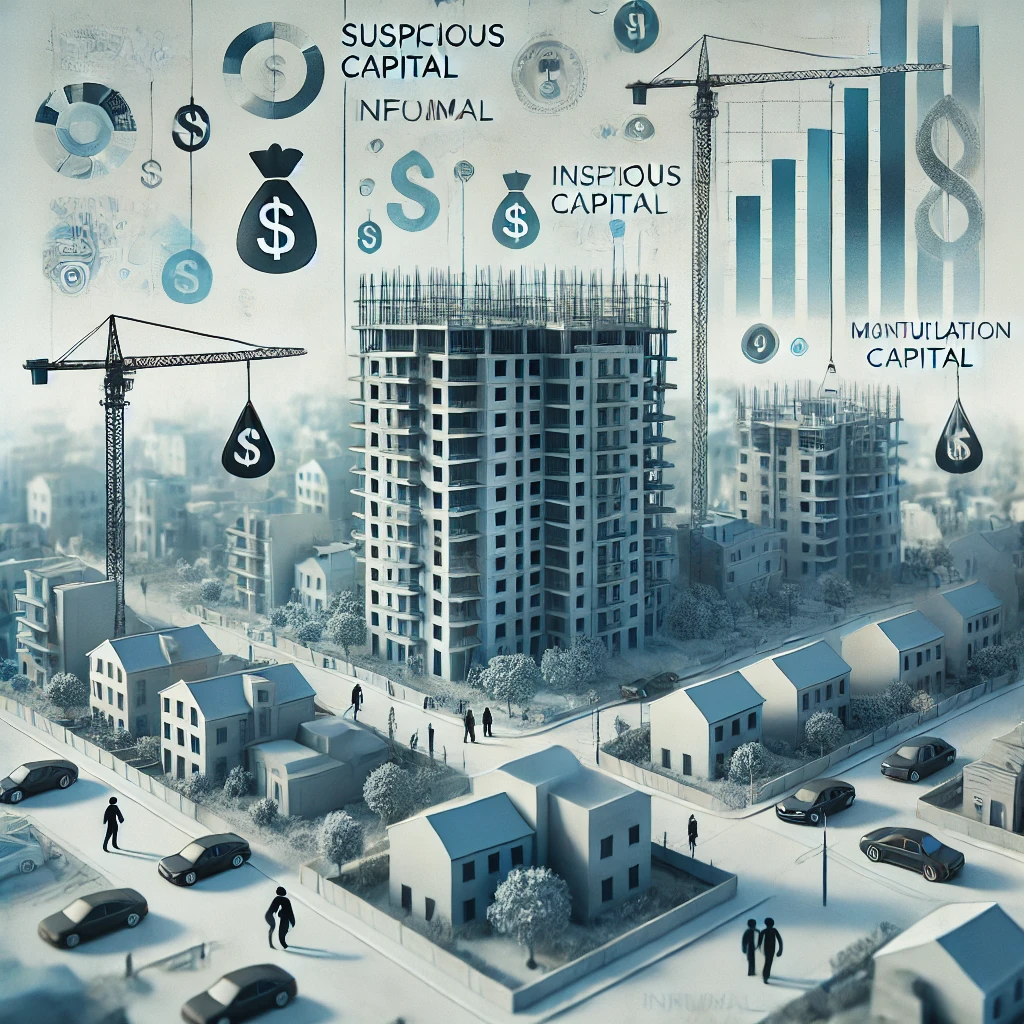
Money laundering in the construction sector and its impact on supply-demand and real estate prices
Money laundering is a phenomenon that has a noticeable impact on sectors such as construction and real estate, especially in economies that do not have strong control and transparency mechanisms.
In Albania, where the construction sector has been prone to informal activities, money laundering is a serious problem. This phenomenon is partly linked to the possibility of hiding illegal sources of financing and laundering money through investments in real estate.
In many cases, construction and real estate are activities where there is a lack of proper transparency regarding the sources of financing. Many times, project developers may use clean sources to hide illegal sources of money. In the construction sector, the use of cash is a common practice to conduct transactions. This allows for easier money laundering without a clear trace of the origin of the money. A builder may use cash-in to buy land or pay unregistered workers, without documenting the origin of the money. This type of transaction is difficult for the authorities to track. For example, a builder can pay his workers in cash, and they may use the same cash to purchase real estate, making it impossible to trace the money path from illegal sources.
An individual involved in illegal activities may use a company linked to construction to launder money. This process may occur through buying and selling land or real estate, making it difficult for authorities to trace the sources of the money.
Another action encountered in Albania is the involvement of other informal actors, such as unregistered workers and consultants who assist in carrying out informal activities. This collaboration can create opportunities for money laundering through these actors who are not under the monitoring of authorities. These actors may help in creating a closed chain of transactions that hide the illegal sources.
A builder may employ workers without employment contracts or use companies that are formally registered as a way to pass money and launder it through construction.
A typical example is the use of money obtained from corruption or crime to finance a construction project, where the investor uses different intermediary companies to mask the true sources of financing.
Real estate is an excellent opportunity for money laundering, as it can be sold and generate quick profits, hiding the origin of the money.
This is especially true in large construction projects, where a chain of transactions can be created that allows money laundering. Real estate can later be sold for high profits, hiding the illegal sources of financing.
This process helps channel illegal capital into construction projects, enabling the use of suspicious resources to finance the construction of real estate.
In this way, builders can achieve higher profits, covering suspicious sources with investments in real estate through the acquisition of permits for high-rise buildings and developments that affect the supply and demand in the market.
In the construction sector, the profit margin is usually linked to construction costs, including materials, labor, and permits.
A standard margin can be around 10%-20% for regular projects. However, when suspicious resources are invested in project financing, as happens with money laundering, the profit margin can increase to 25% – 30% or even more. This increase is often possible due to the high values of real estate, which can be sold at high prices even when the real construction cost is lower.
Money laundering is a factor that helps builders achieve higher profits. This process enables the use of illegal capital to finance construction projects and may lead to an increase in real estate prices, creating a blurry picture of real demand.
Real estate prices, supported by suspicious sources, may be higher than reasonable, leading to an uncertain balance between supply and demand and increasing profits for those benefiting from this process.
High demand for real estate and limited supply can lead to rising prices, enabling builders to achieve faster and higher profits.
If builders are able to sell real estate at high prices, this may help increase profit recovery. However, this may only be sustainable for a certain period, as price increases may create a new balance between supply and demand. When supply exceeds demand, prices may fall, reducing profit.
Fiscal and legal policies, as well as financing opportunities, may influence profit recovery for builders. Favorable fiscal policies, such as the reduction of dividend tax, also apply to builders, providing opportunities to lower the total capital costs. This preferential policy approach increases profits and directly affects market distortion.
Assessment of the percentage of financing from informal sources
In Albania, the construction sector has had a history of using informal sources of financing.
The assessment of the percentage of financing from informal sources in the construction sector is a complex challenge, as this phenomenon is often difficult to measure accurately, especially in developing economies like Albania.
However, some studies and practices show that a considerable percentage of construction projects may be financed from informal sources, including money laundering.
The situation in Albania is even more complex than in these countries due to the high demand for real estate, while the average wage is significantly lower than real estate prices.
This has created opportunities for the use of informal sources of financing to fill the gap between prices and individuals’ ability to finance such investments.
In many developing economies, it is estimated that around 20-30% of construction projects may be financed from informal sources. This financing may include not only undocumented funds but also activities of money laundering through investments in real estate.
In larger projects, especially those involving significant investments from new actors or from individuals seeking to launder money, the percentage of financing from informal sources may be even higher. This phenomenon is particularly evident in projects that require large capital, as they offer increased opportunities to manipulate the financial system, to hide the true sources of financing.
The demand for accommodation, especially in major cities like Tirana and Durrës and tourist areas, continues to be high. This phenomenon is related to accommodation needs from the increased flow of visitors in recent years, as well as from various investors from the diaspora and foreign residents who are willing to pay high prices for real estate.
Nevertheless, the supply of accommodation continues to be high for several years even though the construction of real estate has become more expensive and requires financing that is often not available to the majority of the population.
For example, we may have high demand for villas and apartments on the coast, but their construction is expensive and requires large financial resources, many of which may be financed from suspicious sources. A considerable portion of investors, who may own real estate paid for with suspicious money, may prefer to create opportunities for temporary rentals (such as for tourists), creating a chain financed from informal sources.
Real estate prices and average wage
A major problem is the significant difference between real estate prices and average wages in Albania. Real estate prices, especially those used for tourism or investments from the diaspora, are much higher than the average wage.
The price of real estate is often linked to the average wage for several economic and social reasons:
The average wage is an indicator of individuals’ financial ability to purchase real estate. The lower the average wage, the more difficult it becomes for most of the population to buy a home. Therefore, real estate prices are often closely linked to an individual’s ability to pay for them through savings or loans.
If the average wage is low, the demand for real estate is more limited and this may affect a slower increase in prices. On the other hand, if wages increase, there will be greater demand for real estate, leading to price increases.
The price of real estate is also linked to the ability individuals have to obtain loans. If average wages increase, individuals have more ability to borrow and pay higher installments, which influences demand and prices. Thus, the price of real estate may rise in accordance with wage increases.
The price of real estate is also a reflection of the general level of income and living standards in a country. When the average wage increases, individuals are able to make larger investments, including home purchases. This influences the rise in real estate prices, reflecting improved economic conditions.
Real estate prices may also be influenced by inflation and the rise in the cost of living, which are directly related to average wages. When the average wage increases, there is more possibility for price increases of goods and services, including real estate.
Thus, the connection between the average wage and real estate prices becomes evident due to its impact on individuals’ ability to invest and its influence on the demand and supply in the real estate market.
For example, the average price of a 60 m² apartment ranges from €60,000 to €120,000 in areas like Tirana and Durrës. This price is significantly higher than the average annual wage in Albania, which is approximately €9,240 (€770 x 12 months).
Meanwhile, real estate prices in high-demand areas like the coast can reach up to €2,000/m² or more—a price that is unaffordable for the majority of the population.
This large disparity between the average wage and real estate prices creates a conducive environment for the use of illicit funds.
Individuals with suspicious sources of financing may invest in real estate, using it as a tool for money laundering. This can occur through the purchase and sale of properties where prices can be inflated or reduced to conceal the source of the funds.
Money Laundering through the Construction Sector
Money laundering through the construction sector is a phenomenon closely linked to high prices and strong demand for real estate.
This process can occur through several mechanisms:
- Rapid property turnover (buying and selling within short periods) is a common method for money laundering. This involves selling real estate at high values to hide illegal sources of financing. Properties can be bought and sold quickly without requiring complete documentation on the origin of funds.
- Luxury villas and apartments may be used for short-term rentals, creating opportunities for money laundering through cash payments that leave no trace of the financing source.
To assess the impact of money laundering on the construction sector and on the balance of demand and supply, the following factors must be considered:
- Demand is high due to investments from the diaspora and tourism, but supply is limited, driven by high construction costs and a mismatch with the financial capacities of the local population.
- This percentage may be even higher in large-scale luxury and tourism-oriented projects. In such cases, real estate prices can increase due to opportunities for money laundering.
- The average price of an apartment significantly exceeds the average annual income, creating a wide gap between the population’s purchasing power and their ability to buy property. This gap may be exploited for money laundering.
The connection between Money Laundering in Construction and other economic sectors
There is a strong connection between money laundering in construction and other sectors of the economy, such as banking and taxation, with multiple implications. Money laundering in construction directly impacts these sectors, affecting not only economic stability but also the effectiveness of fiscal and financial policies.
Money Laundering and the Banking Sector
Banks are often used to launder money through suspicious transactions. For example, real estate investments may be linked to dubious deposits or payments that pass through the banking system. This makes it difficult to verify the legitimate source of funds and increases the risk of money laundering through bank channels.
Construction is frequently financed through bank loans. If the source of the loan repayment stems from clean or questionable assets, banks may inadvertently assist in money laundering by approving loans without properly assessing the borrower’s repayment capacity. In such cases, banks can become indirect enablers of illegal activities.
Suspicious banking activity linked to money laundering can undermine the stability of the banking system, increasing financial uncertainty and eroding trust in commercial banks.
Money Laundering and Taxes
Money laundering is often associated with inaccurate income reporting. This occurs when individuals and companies conceal the profits obtained from illegal activities, negatively impacting tax collection.
If individuals or companies use money laundering mechanisms to avoid tax obligations, this directly reduces government revenues. As a result, there are substantial fiscal losses, making it more difficult to fund public services and development projects.
Money laundering may also contribute to the expansion of the informal economy, where workers operate without formal contracts and do not contribute to social security or tax systems. This weakens state finances and creates inequality in the labor market.
Money Laundering and Real Estate Prices
Money laundering can cause artificial inflation in real estate prices. When illicit funds flow through real estate transactions, they create fake demand for property, pushing prices up and disrupting the balance between supply and demand. This phenomenon may be further influenced by the construction of numerous projects financed by suspicious sources.
When properties are acquired by individuals engaged in money laundering, demand distortions may emerge. If illicit financing dominates, property valuations can become unreliable, leading to sudden price drops once such properties are reintroduced into the market.
Impact on economic development and growth potential
When money laundering impacts the construction sector, investments may flow into projects financed not by legal sources, but by laundered funds. This can artificially inflate the construction sector without a sustainable economic base, thus negatively affecting long-term sustainable growth.
Money laundering is often a sign of an informal and disorganized economy. This contributes to an economic environment where income distribution is unequal, and investment opportunities become uncertain.
Is there a link between the number of high-rise building permits and total construction area?
Yes, there is a direct correlation between the number of high-rise construction permits and the total construction area, which can exceed 2 million m² annually. This relationship is influenced by several important factors affecting the construction sector and the real estate market.
The connection between permits and total construction area is tightly linked to urban development demand and the opportunities for building, particularly in large cities and economically developing areas. High-rise permits are a direct indicator of construction activity, reflecting projects that often span over 2 million m² in a year.
Although Albania’s population has been declining by at least 1.15% annually in the last decade—suggesting a potentially lower need for such developments—demand for high-rise construction is not driven solely by demographic factors. It is also sustained by continuous demand originating from money laundering, where real estate investments are used for tourism and other services.
This demand can be amplified through the channeling of informal finances into construction projects, thereby increasing supply for sale and rental in the real estate market.
Urban development and construction demand are also influenced by increased accommodation needs, and high-rise construction offers a practical solution to provide housing for many people within limited space. These large-scale projects help meet housing and infrastructure needs, explaining how 2 million m² of construction can be achieved annually through high-rise building permits.
Impact of high-rise permits on the real estate market
High-rise construction can increase supply and affect real estate price dynamics. This boosts market competition, enabling more buying and selling opportunities.
However, a negative consequence may occur when excessive permit issuance is used to channel informal finances, including money laundering through real estate investments—especially when such investments are backed by questionable sources.
Large-scale construction projects often require substantial capital and may be funded by informal or suspicious sources, leading to an increase in permits and built-up areas.
While the sector offers many opportunities for money laundering, this can distort the real estate market and price structures.
Properties developed using informal sources can result in inflated prices that do not reflect the true market value. This phenomenon can harm legitimate investors and create a more difficult environment for those seeking to develop sustainable projects.
If a market is influenced by illegal activities such as money laundering, foreign investors may withdraw, seeking safer and more regulated opportunities elsewhere. The fear of becoming involved in illegal activities can negatively affect investment flows and create uncertainty for legitimate investment.
When money laundering becomes a common practice in the real estate sector, a negative cycle may form—developers begin to invest in projects tied to informal sources, leading to further increases in property prices. This trend can have damaging effects on both legal buyers and investors.


Leave a Reply
You must be logged in to post a comment.