


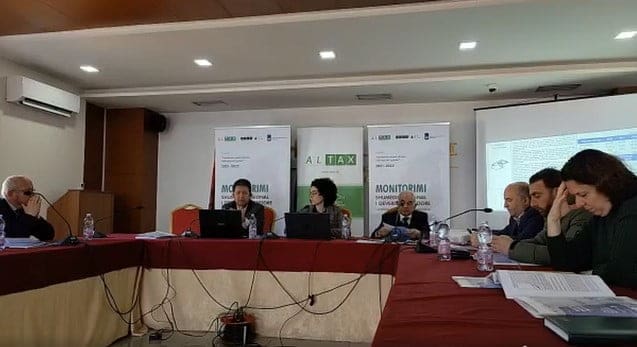
Another deliberative dialogue based on the social audit in Dibër
On Tuesday, April 11, ALTAX with the experts started with the presentation of the report with the findings and comments related to the need for municipalities like Dibra to have the guarantee that the central government preserves and does not exceed the financial and decision-making independence of the local government through the imposition of programs and strategies, which have had an impact very late and with a loss of time waiting for the coordination of processes.
Accountability through consultation on the cost and benefit of the decisions made by the government on our behalf was one of the topics discussed and addressed by the attendees, despite the absence of the City Council.
In the multidimensional analysis and audit of Dibra, with a material elaborated and dedicated directly to the problems that the district and the municipality have together with the development processes, we identified as the first need to talk about the economy.
Investments made in recent years are oriented according to development programs towards the urban environment, road infrastructure and UK and moderately towards agriculture, but not towards market promotion, orientation of new activities and an approach to mitigate the influencing factors in migration and emigration.
But, in the experts’ analysis, there was also the discussion on the local budget with its two wings.
The indicator of local tax revenues has a rate of advancement in administration at above average levels, but far from achieving the budget objectives and PBA forecasts. Even for 2022, as we mentioned in the 2021 Report, “The local budget, which depends on transfers from the state budget, is also affected by the still unfulfilled objectives of the 2019-2022 SMFP and sectoral strategies that weigh on the planning performance of the budget of the Municipality.”
Meanwhile, optimistic planning and the lack of full realization of the allocated spending fund are the challenges to address both levels of government.
Dibra local governance’s policy is based on the law on consultation by implementing the consultation calendar, as an obligation for open governance and budget discussion processes with public participation. However, in the stages of the consultation, civil expertise is missing, and no opposition or analytical reinforcement of the citizen’s voice and concerns is found.
Based on the lack of measurement of the level of local corruption, the CSO, the Anticorruption Directorate, or the donors should be requested to modify the action plan for the creation of the regional corruption index, and on this ranking, objectives should be set for lowering the Municipality in the ranking, with the same methodology as for the national index.
A discussion that we at ALTAX have at the center of our attention is the workforce and its qualifications based on the level of indicators available for the country.
According to the 2022 Competitiveness Report, Albania is ranked last in the region for the low level of employees with secondary and higher education, but also for the truncated number of professionals and technicians, giving influence also in the ranking for work productivity for employees.
Although the challenges for education are great, the exposure of the problems must be accompanied by in-depth studies and actions with the recently approved strategic objectives, but with corrections based on the local situation.
The entire economic and social situation in 2022 appears to us with sufficient indicators to analyze that the anti-crisis measures and the efforts to recover the economy have not succeeded in creating a climate of confidence in stronger consumption than two years ago.
While the redistribution of social funds should begin to receive increasing funds from the budget in relation to capital investments, even though it seems like a paradox in the conditions of the infrastructure emergency in the country. A large discussion and lobbying by the government should be the promotion of the second and third columns of pension funds, which are in the public interest to be strengthened today to minimize the insolvency crisis of the current scheme tomorrow.
Civil society representatives requested that the government’s intervention regarding social expenses is necessary, but also vital for municipalities like Dibra, which can do little in this approach with the funds they collect from taxes and local fees.
Meanwhile, the representatives of the Municipality expressed their appreciation of the work done so far by the Municipality of Dibra but requested that dedicated reports that help them and the citizens continue to be discussed even after the meetings.

Leave a Reply
You must be logged in to post a comment.