


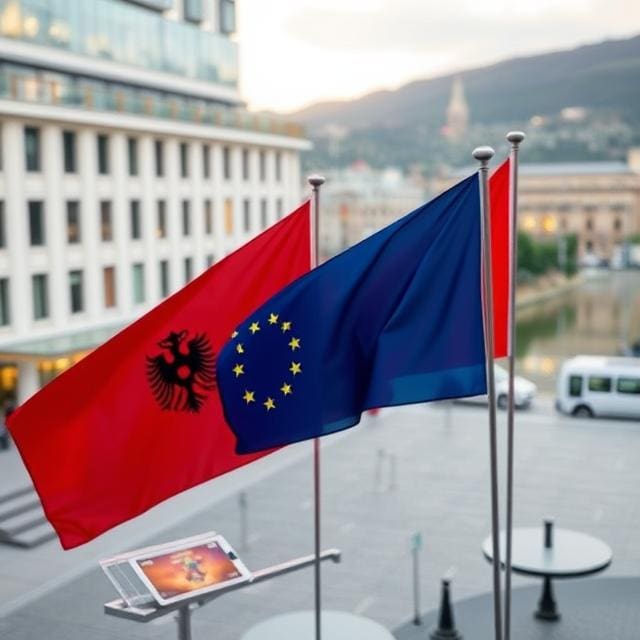
The Transformation of cross-border payments in Albania and the Region
In recent years, the cross-border payment system has entered a phase of profound transformation, reflecting not only technological developments but also the geopolitical tensions in the region.
The modernization and digitalization of the payment system are among the key initiatives aimed at increasing the efficiency of channeling international capital. Traditional banks are upgrading their existing networks, while new platforms are being explored, such as central bank digital currencies (CBDCs), stablecoins, and cryptocurrencies.
The goal is to reduce costs and processing times while expanding access to international markets.
However, in this transformation, the impact of geoeconomic tensions cannot be ignored, as they may raise barriers and slow the flow of cross-border funds.
Albania, unlike some countries in the region, still operates a centralized system, with payments mainly processed through correspondent banks. This is expected to change after October 7, 2025, when the agreement enabling payments through the SEPA system is set to become operational.
High fees and processing delays remain a significant obstacle for small businesses and individuals, limiting market flexibility and the country’s ability to participate in international markets.
The Key Role of Financial Intermediaries
Correspondent banks and fund managers are currently the only actors capable of channeling international capital, and their efficiency depends on their ability to manage risks and invest in digitalization.
In the absence of sufficient coordination and with only partial completion of cross-border payment infrastructure, intermediaries often face delays and additional costs, reducing the volume of capital flows and increasing the economy’s sensitivity to exchange-rate fluctuations.
Albania’s highly euroized and dollarized economy makes the exchange rate particularly vulnerable to these fluctuations, exposing businesses and individuals to financial risk.
Compared with other Western Balkan countries, Albania’s situation highlights the need for greater improvement and coordination.
- Croatia has integrated the SEPA system and benefits from more flexible capital flows and higher exchange-rate stability.
- Albania and Kosovo, by initiating SEPA implementation and modern payment initiatives, are progressing toward greater flexibility and financial stability but still have room for stronger coordination.
- Serbia, with advanced infrastructure, operates a payment network that allows larger capital flows and greater stability against real-sector shocks.
- Bosnia and Herzegovina and North Macedonia remain in a situation somewhat similar to Albania’s, but with slightly higher sensitivity to external fluctuations.
Nevertheless, the two Albanian-speaking states still lag behind in finalizing and coordinating cross-border payment infrastructure, underlining the need for sustained investment and full implementation of existing initiatives.
Main Challenges
The key issues arising from this context are clear.
High costs and delays hinder access to international markets and reduce the flexibility of financial intermediaries. Dependence on foreign currency makes the economy highly sensitive to exchange-rate movements, increasing financial risk for individuals and businesses.
Furthermore, political and economic tensions in the region can trigger geoeconomic fragmentation, creating additional barriers within the cross-border payment network.
Another critical aspect concerns the management of financial shocks. While infrastructure improvements can increase capital flows, they can also heighten short-term volatility, requiring protective financial-market policies and currency-hedging instruments.
From a critical perspective, the reform and modernization of cross-border payments should not be seen merely as a technological implementation, but as an intersection of technology, macro-financial policies, and regional cooperation.
To achieve the full benefits, Albania must intensify investments in digital infrastructure, harmonize regulations with regional partners, and focus on financial risk management. Integration with regional systems such as SEPA and advanced regional platforms can strengthen exchange-rate stability and enhance access to international capital.
Comparative Table of Regional Infrastructure and Modernization
| Country | SEPA/Integration Status | Modernization Initiatives | Potential Effect on Capital & Exchange Rate |
| Albania | In progress | Advanced | Increases capital, more stable exchange rate against real-sector shocks, more sensitive to financial shocks |
| Kosovo | In progress | Advanced | Increases capital, more stable exchange rate against real-sector shocks, more sensitive to financial shocks |
| Serbia | Active | Highly advanced | Higher capital inflows, stable exchange rate against real-sector shocks, some sensitivity to financial shocks |
| Croatia | Active | Highly advanced | Flexible capital, more stable exchange rate, easier adaptation to international fluctuations |
| Bosnia & Herzegovina / North Macedonia | Active | Initial stage | Similar to Albania, but more sensitive to external fluctuations |
This comparison clearly illustrates that Albania lags behind other Western Balkan countries in modernizing cross-border payments.
While Serbia and Croatia have benefited from full integration into regional systems and SEPA—securing more flexible capital and greater exchange-rate stability, Kosovo and Albania, by initiating SEPA implementation and other fintech initiatives, have the potential to advance toward increased flexibility and financial stability. Bosnia and Herzegovina and North Macedonia still face more centralized systems and significant delays, highlighting the need for stronger coordination and completion of existing initiatives.
This shows that Albania urgently needs to coordinate investments in digital infrastructure and improve intermediary networks, learning from regional examples to increase the efficiency and resilience of international capital flows.
The comparative data confirm that modernization and regional integration are not optional, but essential to reduce sensitivity to financial volatility and to enhance Albania’s competitiveness in international markets.
In conclusion, Albania has significant room for improvement and modernization. Every initiative should be viewed not only as an infrastructure reform but as a necessary effort to reduce vulnerability to financial crises and to seize the opportunities of regional and European integration. An integrated approach, based on technology, financial policy, and regional cooperation is the key to ensuring that the transformation of cross-border payments delivers real and sustainable benefits.

Leave a Reply
You must be logged in to post a comment.