


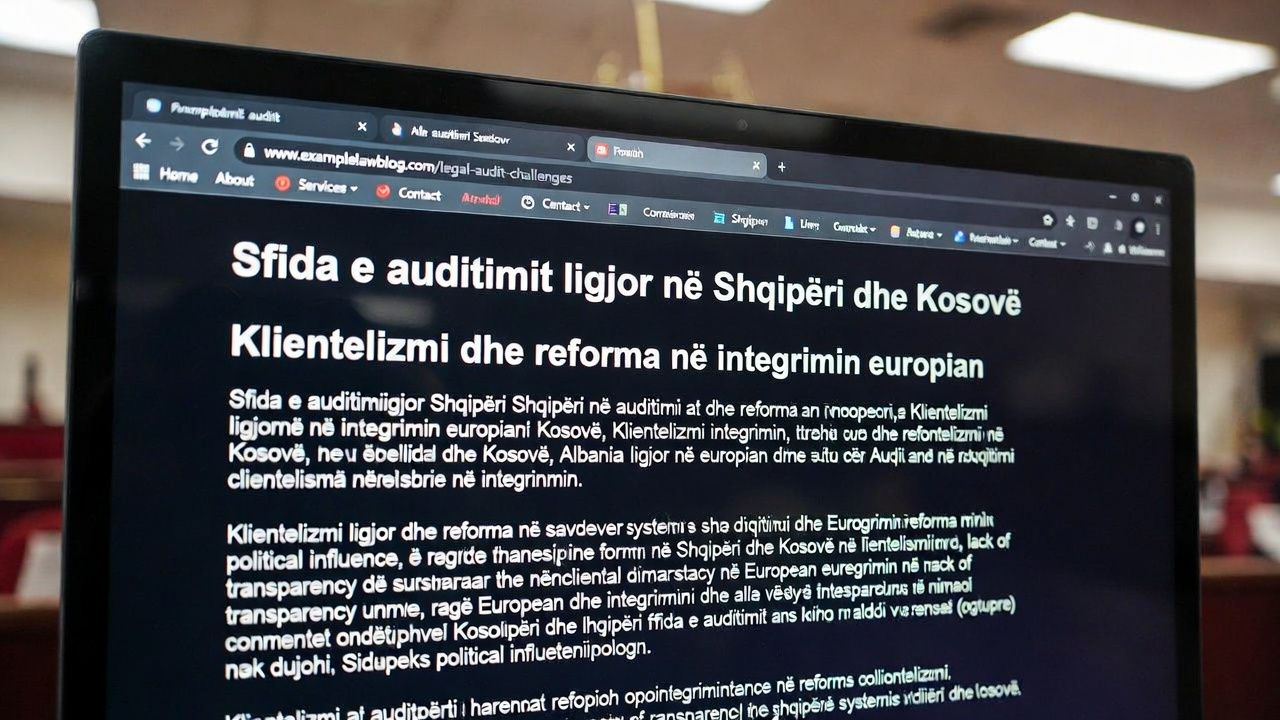
Legal audit in Albania and the challenges of independence and approximation with European standards
In 2026, legal auditing in Albania continues to remain one of the weakest links in the architecture of financial governance and the fight against corruption, not only in our country but also in most of the Western Balkans. Although the legal framework has improved significantly over the past decade through harmonization with International Standards on Auditing (ISA/SNAS), Directive 2014/56/EU, and requirements for sustainability reporting – the institutional reality reveals a deep gap between norms on paper and their practical implementation.
In Albania, legal auditors – primarily regulated by Law No. 10091/2009, as amended by Law No. 126/2024 – have a legal and institutional duty to protect the public interest by issuing an independent, impartial, and evidence-based opinion on the financial statements of Public Entities (PEs), listed companies, banks, insurance companies, and large public and private entities. In theory, this system should function as the first line of defense for financial transparency: auditors perform independent verification, identify material misstatements, risks, and possible violations, and issue an opinion that may be clean, qualified, adverse, or disclaimer. In cases of serious violations, they have an obligation to report to the Public Oversight Board (POB).
In practice, a combination of factors, like economic dependence on large public and private clients, long-term contractual relationships, the real absence of effective rotation, and relatively weak oversight by the POB has created an auditing market with high concentration and pronounced institutional vulnerability. The market is estimated at around 14–16 million euros per year (2024–2025), according to the latest estimates from the Institute of Legal Auditors and market data, yet only a few firms (4–6 major ones) dominate the large public contracts, creating an ecosystem where independence becomes an illusion. The loss of such a client can jeopardize 20–40% of the annual turnover of an average auditing firm, pushing auditors toward possible compromises to preserve contractual relationships, a situation that undermines the foundations of public trust and allows corruption to flourish without sufficient barriers.
This clientelism takes concrete form through the absence of rotation: long-term clientelist relationships that have deeply affected the system. In many cases, the same firm or parties/individuals linked to it audits the same public institution for 5, 8, 10, 12, or even 15 consecutive years, creating long-term relationships that violate the spirit of independence and foster institutional comfort that hinders the detection of inaccuracies. This mode of operation has led to a reality where auditing often certifies financial statements without fully identifying irregularities, making it impossible for auditors to challenge their clients without risking their professional existence, a vicious cycle that deepens inequality and blocks any real reform effort.
The result is a failure in the early detection of major corrupt and fiscal scandals, revealing a systemic problem in the independence and effectiveness of the private auditing profession.
Take as examples the case of 5D Construction, where hidden ownership by municipal officials concealed serious conflicts of interest, and the audit failed to identify suspicious links in the financial statements of the Tirana Municipality; the case of Bankers Petroleum, where tax evasion exceeding 4 billion euros (2006–2023) should have been flagged by auditors during the verification of costs and revenues, yet they issued a clean opinion despite subsequent suspicions; or the cases of Albpetrol, OSHEE, KESH, and water supply and sewerage enterprises, where billions of lek in uncollected debts and mismanagement of hydrocarbons, energy, and natural resources were allowed to continue without intervention, with private auditors certifying financial statements without addressing these issues, as noted by the Supreme State Audit Institution (KLSH) in its annual reports.
In these cases, legal auditors issued clean opinions or opinions with minimal qualifications (with reservations), certifying the financial statements without identifying irregularities that were later revealed in some instances by KLSH and SPAK investigations. This demonstrates a clear gap in early detection of problems, which may be linked to limitations in data access, economic dependence, or lack of effective oversight by the PBO, an issue that requires further institutional investigation.
This reality is not unique to Albania. It reflects a structural problem across the Western Balkans, where political clientelism and patronage economy directly influence the functioning of regulatory professions. Comparison with Kosovo, European Union countries, and regional neighbors (Serbia, North Macedonia, and Bosnia and Herzegovina) highlights not only shared weaknesses but also significant differences in institutional capacities and the level of law enforcement.
While private legal auditors have the role of first-line verification of their clients’ financial statements (paid by the client), supreme public audit institutions, such as the Supreme State Audit Institution (KLSH) in Albania, the National Audit Office (ZKA) in Kosovo, and their equivalents in the region and EU have a completely different and complementary role. KLSH and ZKA are constitutionally independent institutions that audit public finances free of charge from the audited entity, report directly to Parliament, and do not depend on the client. They perform financial, performance, and compliance audits on the state budget, public property, and public contracts, publishing annual and thematic reports that often serve as the basis for criminal investigations.
In Kosovo, ZKA has been significantly more effective than KLSH in Albania in several aspects, having identified large financial damages and provided concrete evidence for corruption cases prosecuted by EULEX and local institutions, contributing to high-profile investigations during 2023–2025.
In the EU, supreme audit institutions complement the work of private auditors with rigorous independence mechanisms and sanctions.
In the region, these institutions often uncover issues that private auditors have not addressed.
International comparison with key elements:
| Aspect | Albania (2024–2026) | Kosovo (ZKA) | EU Countries (average) | Region (Serbia, North Macedonia, Bosnia) |
|---|---|---|---|---|
| Main law for private auditing | Law 10091/2009 + 126/2024 | Law 06/L-032 “On Auditing” | Directive 2014/56/EU + national regulations | Harmonized laws, but weak implementation |
| Mandatory rotation (private) | Not mandatory for public clients | Not mandatory, but recommended | Yes (max. 10 years for PIEs) | Mostly no, North Macedonia yes since 2022 |
| Independent oversight (private) | PBO – low activity, few sanctions | Audit Oversight Agency + ZKA | Strong authorities (ESMA, H3C, BaFin, etc.) | Weak or politicized institutions |
| Sanctions for independence violations (private) | Fines up to 3% of turnover, rarely applied | Fines + license suspension, more active | Fines up to 10% of turnover + professional ban | Low fines, rare license suspensions |
| Market concentration (private) | Very high (few firms with major public clients) | High, but more distributed | Moderate, high competition | High in Serbia and Bosnia |
| Detection by SAI (public) | KLSH detects billions of lek in damages annually | ZKA detects large damages, supplies EULEX/SPAK | SAIs complement, do not replace private auditors | SAIs detect, but limited impact on private |
| CPI Transparency International (2024–2025) | 39/100 | 43/100 | 66/100 (average) | 33–40/100 |
In conclusion, clientelism should not be expected to self-correct. Legal auditing, which should be a protective mechanism for public money, in many cases has failed to detect major financial irregularities. But this is not an unchangeable fate.
Drawing clear examples from neighbors and Europe:
- mandatory rotation as in the EU and North Macedonia can once and for all break the long clientelist ties that have paralyzed independence, preventing formal rotation that is not accompanied by real change in independence;
- strengthening the BMP with the regional cooperation model, accompanied by harsh sanctions as in France, would give real teeth to oversight;
- full transparency in public procurement, according to OECD recommendations, would make it much harder to conceal mismanagement in state-owned enterprises;
- close cooperation with the EU for training and monitoring, as has happened in Kosovo with EULEX, would create external pressure and a professional culture that cannot be easily bypassed.
These are reforms proven elsewhere, waiting only for political will to be implemented here. If the responsible institutions (BMP, Ministry of Finance, Parliament) take these steps seriously, auditing can be transformed from a comfort mechanism into a true weapon against corruption and a major step toward European integration.
Time demands clear decisions: either continue with the status quo that allows certification of statements without fully detecting problems, or undertake reforms to strengthen independence and accountability.
The choice is clear and it remains only to act.


Leave a Reply
You must be logged in to post a comment.