


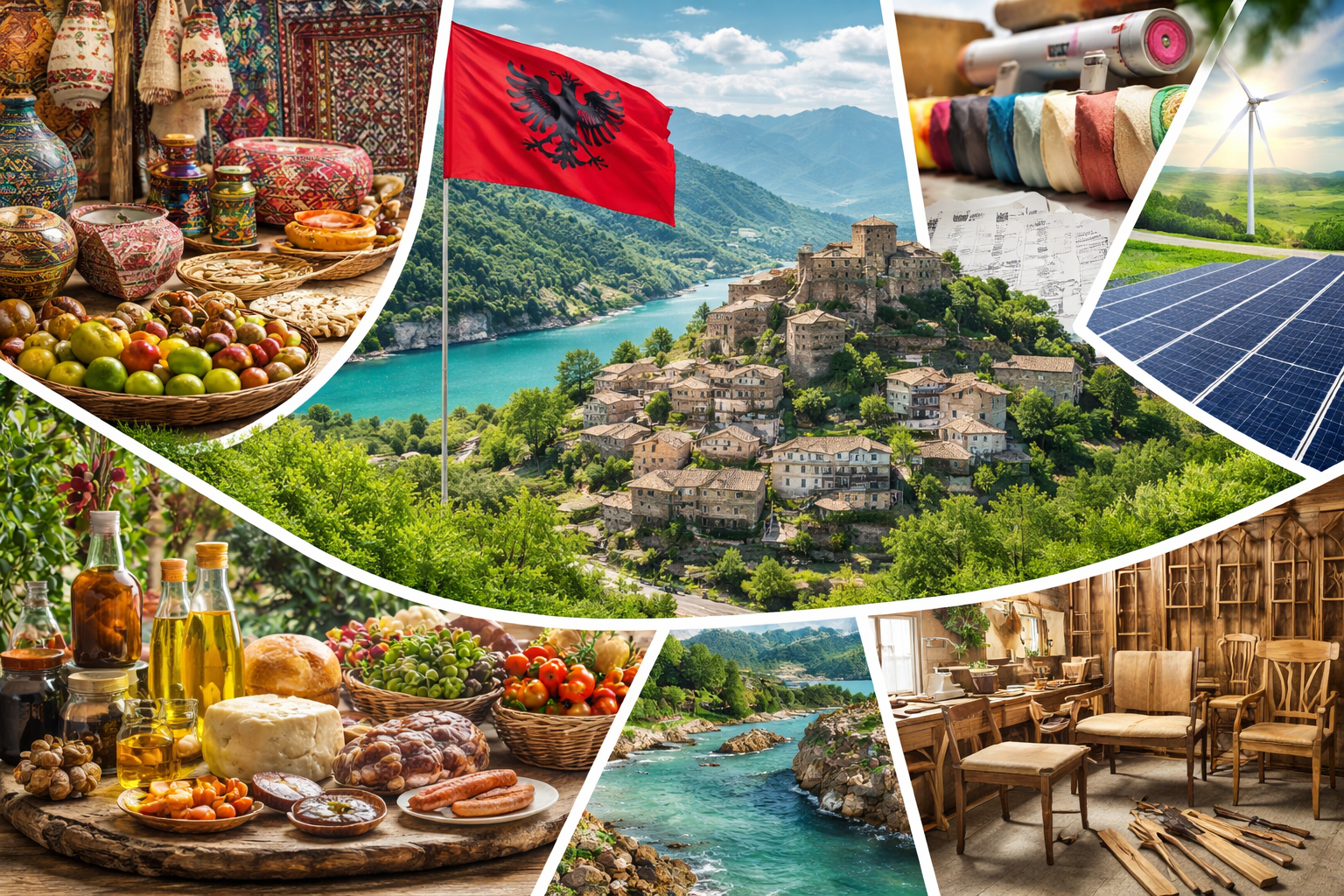
How is export achieved with the “Made in Albania” brand?
The question of how to achieve export with the “Made in Albania” brand is not simply a marketing issue, but a national economic development strategy. It is about moving from an unidentified, valueless and reputationless export, towards a model where Albania is no longer simply a country of production, but a country of brand. This is a transformation that requires not only individual business commitment, but a complete package of state-business coordination for 10–15 years.
The reality today is clear and critical.
Most products coming out of Albania are unbranded, with a low price per unit, or produced on behalf of others, i.e. fason, raw materials, manual labor. This means that the price is set by others, the main profit is not collected here and the identity of the product is lost. In this sense, any “Made in Albania” labeling without a real structure is simply an empty slogan.
What does “Made in Albania” really mean?
Not just a geographical label, but a guarantee of quality, standards, history, reliability and reputation. So, it should mean technical standard, ethical standard and commercial standard, creating an institutional brand that unites private and public. For this, the fundamental condition is the transition from cost to value. The old model competes with price, manual labor, style and low profit. The “Made in Albania” model competes with quality, know-how, final product, identity and sustainable profit.
The real architecture to build this brand is built on five inseparable pillars.
The first is standardization. Real certifications (ISO, HACCP, CE, GlobalGAP), functional laboratories and national quality controls create the basis that gives strength and sustainability to each brand.
The second is the selection of sectors. The National Brand is not built for every product, but for 5–7 strategic sectors, such as quality agri-food, tourism and premium artisanal products, designer textiles, wooden furniture, bio/organic products, green energy and technical services.
The third is the transition from exporter to brand owner. This transition implies the development of design, packaging, marketing, intellectual property management and the creation of direct sales channels.
The fourth is economic diplomacy. No country has managed to build a national brand without the active involvement of the state, through economic embassies, participation in international fairs, signing trade agreements and joint coordination of national branding.
The fifth is financing and protection. To build a sustainable brand, guarantee funds, branding grants, certification subsidies, export insurance and currency hedging are needed. These elements work together as pillars that hold the brand in the market. Without them, any ambition to export under the “Made in Albania” brand becomes practically unattainable, as only the largest companies can survive in the absence of financial support and protective instruments.
But the structural obstacles are real.
The extreme fragmentation of businesses, the lack of industrial clusters, disorganized logistics, the lack of national reputation and sectoral strategies mean that many enterprises do not have the opportunity to become brands.
The problem is not the lack of desire, but the system does not allow it.
The economic formula for success is clear. Economic success requires that the product be of quality, real standards, private brands, public reputation and state support work together; without one of these elements, any initiative risks remaining just a fason without added value.
In practice, the path of an Albanian business must go through several stages, where initially a certified product is needed, then building a brand with a name, logo, packaging and marketing, choosing target markets, i.e. not “anywhere”, building sales channels through distributors, e-commerce and direct contracts and public support through fairs, financing and diplomacy.
This is the only cycle that can make exports truly sustainable and with a “Made in Albania” identity.
In this context, the launch of the “Export On” portal by the government has the potential to be a coordination tool, connecting businesses with information on standards, certifications, target markets and financial support.
But the challenge lies in implementation.
If the portal is not accompanied by comprehensive policies that include standardization, strategic sector selection, financial protection and economic diplomacy, it may remain a symbolic and reactive initiative, more propaganda than a real development instrument.
So, “Made in Albania” is not just an export label.
It is a national development project that requires structural cooperation between the state and businesses.
When this cooperation is lacking, even an initiative like “Export On” or “Business House”, although successful in promotion, may remain only a symbol without real impact on the market and without the possibility of filling the gap that today characterizes Albanian exports. If only time is bought, but not a concrete product and real reform, the damage becomes even greater, losing precious opportunities to be involved in the redesign of global value chains and to integrate Albania into international markets with a competitive and sustainable offer.
Leave a Reply
You must be logged in to post a comment.