


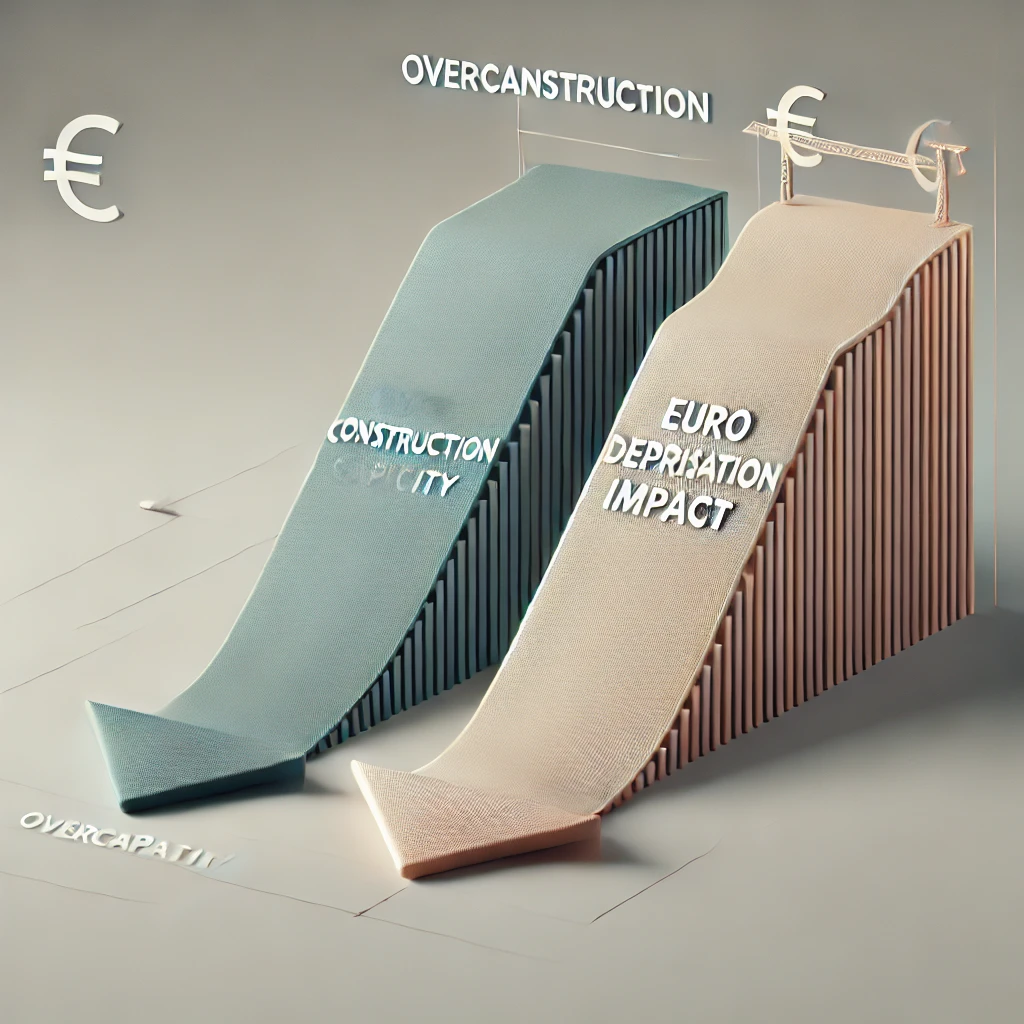
Foreign Trade in January 2025: The impact of oversaturation and euro depreciation on the economy
To analyze and compare export and import data, the primary focus is on the changes in indicators during January 2025 relative to previous periods. January 2025 presents mixed trends: some product groups show improvements compared to January 2024, while others reflect challenges or weakening compared to December 2024. Below are detailed analyses with tabulated data and corresponding commentary.
Total Exports and Imports
| Period | Exports (€ mln) | Change (%) | Imports (€ mln) | Change (%) |
| January 2024 | 29.793 | – | 60.196 | – |
| January 2025 | 31.251 | +4.9% | 60.273 | +0.1% |
| December 2023 | 37.588 | – | 72.752 | – |
| December 2024 | 25.669 | -31.7% | 78.812 | +8.3% |
- Exports in January 2025 increased by 4.9% compared to January 2024, reflecting a seasonal rebound following the December 2024 decline.
- Imports in January 2025 remained nearly unchanged from January 2024 but differed significantly from December 2024 (+8.3%), indicating increased consumption and demand during the year-end period.
Main commodity groups
Food, Beverages, and Tobacco
| Period | Exports (€ mln) | Change (%) | Imports (€ mln) | Change (%) |
| January 2024 | 3.620 | – | 9.916 | – |
| January 2025 | 3.771 | +4.2% | 10.912 | +10% |
| December 2023 | 4.748 | – | 12.424 | – |
| December 2024 | 4.843 | +2% | 13.408 | +7.9% |
- Exports and imports in January 2025 show relative stability compared to January 2024.
- Differences from December 2024 reflect seasonality and higher year-end demand.
Minerals, Fuels, and Electricity
| Period | Exports (€ mln) | Change (%) | Imports (€ mln) | Change (%) |
| January 2024 | 5.648 | – | 6.357 | – |
| January 2025 | 9.510 | +68.4% | 7.365 | +15.9% |
| December 2023 | 7.661 | – | 7.901 | – |
| December 2024 | 5.188 | -32.3% | 9.021 | +14.2% |
- Exports in January 2025 increased by 68.4% compared to January 2024 and recovered strongly from December 2024.
- This likely reflects higher production of energy or mineral output.
- Imports (+15.9%) indicate increased demand compared to January 2024.
Textiles and Footwear
| Period | Exports (€ mln) | Change (%) | Imports (€ mln) | Change (%) |
| January 2024 | 9.243 | – | 5.808 | – |
| January 2025 | 8.546 | -7.5% | 5.846 | +0.7% |
| December 2023 | 9.025 | – | 7.351 | – |
| December 2024 | 7.236 | -19.8% | 7.194 | -2.1% |
- Exports in January 2025 declined by 7.5% compared to January 2024, and the drop deepens when compared to December 2024 (-19.8%).
- Imports remain stable, but the decreased demand in the textile sector remains a concern.
Construction Materials and Metals
| Period | Exports (€ mln) | Change (%) | Imports (€ mln) | Change (%) |
| January 2024 | 5.484 | – | 10.753 | – |
| January 2025 | 3.823 | -30.3% | 8.792 | -18.2% |
| December 2023 | 10.018 | – | 10.244 | – |
| December 2024 | 2.926 | -70.8% | 8.811 | -14% |
- Exports in January 2025 show continued decline (-30.3% vs January 2024 and -70.8% vs December 2024), reflecting weakening of the construction sector and falling metal prices.
- Imports also decreased, suggesting reduced construction investment.
General Commentary and structural implications
January 2025 reflects important challenges for Albania’s economic structure. The downturn in the construction sector signals domestic market saturation and weakening international demand for building materials. This underscores the need for economic diversification and a shift toward more sustainable and specialized export markets.
Domestic market oversaturation also highlights limitations in infrastructure investment and calls for better policies to stimulate urban development and promote value-added construction.
Meanwhile, the textile and garment sector is facing a dual shock: falling demand from core European markets and the negative effects of the euro’s depreciation. This sector—historically a major Albanian exporter—is showing vulnerability due to external dependence and competitive pressures. If supportive policies such as subsidies, technology upgrades, and fiscal relief are not introduced, Albania risks losing a major source of employment and income.
Need for a balanced economic strategy
Overall, these developments emphasize the urgency of a balanced economic policy that reduces dependence on fragile sectors such as construction and tourism, and supports the development of high value-added sectors like technology, sustainable tourism, and processed agriculture. Albania needs a strategic approach that not only mitigates the impact of seasonal and international fluctuations but also builds a foundation for more resilient and diversified economic growth.


Leave a Reply
You must be logged in to post a comment.