


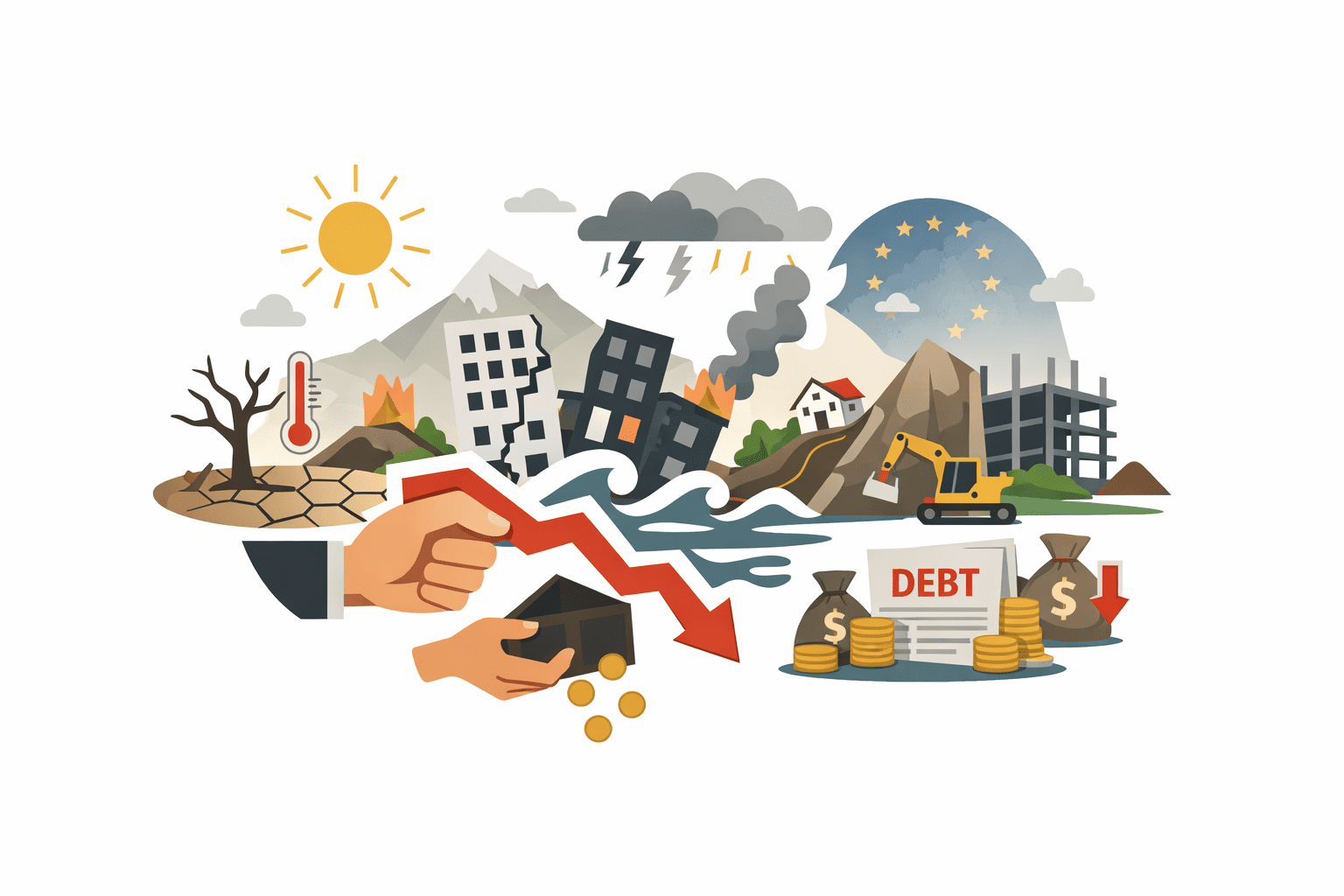
Albanian economy facing climate changes and governance
The economic impacts of natural disasters in Albania today represent one of the clearest reflections of the intersection between the climate crisis, failures in public governance, and a development model that for decades has operated without sustainable economic, territorial, and environmental criteria. What is often labeled in public discourse as a “natural disaster” is, in fact, the result of a cumulative process, where natural hazards are amplified by poor decision-making, lack of effective preventive investments, and structural weaknesses of the state. In this sense, disasters are not isolated events, but symptoms of a development model that produces repeated economic losses and undermines long-term growth prospects.
Albania has experienced significant climatic changes over the past 15 years, with rising temperatures and extreme precipitation. Recent data show that Albania faces high and increasing exposure to floods, droughts, fires, and earthquakes, with estimated average annual losses of around 150 million euros, most of which are linked to earthquakes and floods.
This level of losses translates into a continuous contraction of economic potential, with direct effects on GDP, public finances, agriculture, energy, and social welfare. Over the past decades, these shocks have reduced annual economic growth by 1–2%, increasing poverty, migration, and pressure on public debt, while the real costs are far higher than those reflected in official statistics.
Climate change acts as a catalyst, increasing the frequency and intensity of extreme events, while ineffective state functioning (such as lack of investments and weak governance) and unregulated development (deforestation, uncontrolled urbanization, and land exploitation) further exacerbate the response to natural disasters.
Rising temperatures, projected in the range of 2.4–3.1°C by mid-century, and precipitation instability have significantly increased the frequency and intensity of extreme events. Meanwhile, the massive fires of summer 2025, spread across several districts, demonstrated that the combination of extreme temperatures, drought, and forest degradation generates high economic costs, not only in the form of loss of natural capital, but also through damage to agriculture, tourism, and local production chains.
At the same time, the floods of early 2026 in Durrës, Shkodër, and other areas highlighted once again that urban infrastructure and flood protection systems are not adapted to the new climatic reality, causing power outages, evacuations, and significant economic losses during an already sensitive period for the economy.
These consequences are made even worse by state malfunctioning and the chronic lack of preventive investments. The Albanian state has shown negligence in risk management, including the absence of sewage systems, waste management, and climate-resilient infrastructure. The World Bank report on Climate-Resilient Road Assets emphasizes that bridges and roads in Albania are highly vulnerable to floods and earthquakes due to lack of maintenance.
Reports from audit assessments by the Supreme State Control (KLSH) have repeatedly highlighted that institutions are unprepared, resulting in billions in losses. For example, floods over the past 30 years have caused damages amounting to 2.5 billion dollars, mainly due to failure of preventive policies.
Risk management of natural disasters in Albania is characterized by institutional fragmentation, poor planning, and mainly reactive approaches. KLSH has stressed the lack of integrated strategies for flood management, maintenance of hydrotechnical infrastructure, forest protection, and territorial control, as well as serious weaknesses in monitoring and early warning systems. In many cases, public funds are used post-disaster for compensation and reconstruction, while preventive investments remain insufficient or ineffective, creating an annual financial gap of over 130 million euros for managing average disaster risks.
The example of repeated floods in Shkodër is a clear indicator of this inherited structural failure. The lack of sustained investments in flood protection infrastructure over more than three decades, combined with unregulated territorial development and poor watershed management, has led to repeated losses in property, livestock, and economic activities, creating ongoing insecurity for residents and damaging local macroeconomic balances. KLSH has also highlighted that damage assessments are often partial and based on post-event reactions, without in-depth cost–benefit analyses or mechanisms linking public spending to real risk reduction.
Unregulated development of natural and territorial resources is the third pillar of this problem. Uncontrolled urbanization, construction in high-risk areas, deforestation, and unsustainable land use have significantly increased the exposure of economic assets to natural hazards. KLSH audits have pointed out that failure to implement regulatory plans, weaknesses in construction control, and lack of forest and drainage channel rehabilitation have substantially worsened the effects of floods and landslides.
According to the World Bank, environmental degradation in agriculture and watersheds has worsened climate impacts, leading to soil acidification and more frequent floods. Unauthorized construction in high-risk areas has amplified earthquake damages, such as the 2019 event, which caused losses worth billions of euros. This is directly linked to failure to enforce environmental policies, creating a fragile economy.
In the energy sector, high dependence on hydropower without sufficient diversification exposes the economy to drought risks, creating fiscal risks and increasing energy import costs in unfavorable climatic years.
A critical dimension of this problem is the lack of risk transfer mechanisms. With minimal insurance coverage for households and businesses, the financial burden of disasters falls almost entirely on the state budget and families. This situation forces the government to rely on budget reallocations, borrowing, and donor aid, creating recovery delays, high coordination costs, and negative effects on fiscal stability.
In the long term, this interaction between climate, weak governance, and unregulated development turns natural disaster risk into a structural barrier to economic development and European integration. Without a fundamental change in approach, economic losses risk increasing to levels that could reach several percent of GDP each year, especially under future climate scenarios.
Solutions require a transformation in how the Albanian state plans, invests, and manages risk. Investments in climate-resilient infrastructure, supported by strong cost–benefit analyses, have the potential to multiply economic benefits through avoided damages. Strengthening the coordinating role of institutions, creating a unified data platform for risks and post-disaster expenditures, and implementing KLSH recommendations for territorial control and resource management are essential steps. Equally important is the development of a functional disaster insurance market, diversification of energy sources, and restoration of active forest and land management.
In essence, to minimize natural disasters, the government must prioritize investments in resilient infrastructure, anti-corruption policies, and resource management. The World Bank report on CCDR suggests that adaptation can reduce damages under all climate scenarios. Immediate action is required to break the cycle of losses.



Leave a Reply
You must be logged in to post a comment.