


Performance of the Albanian economy in Q1 2026 and prospects for the full year
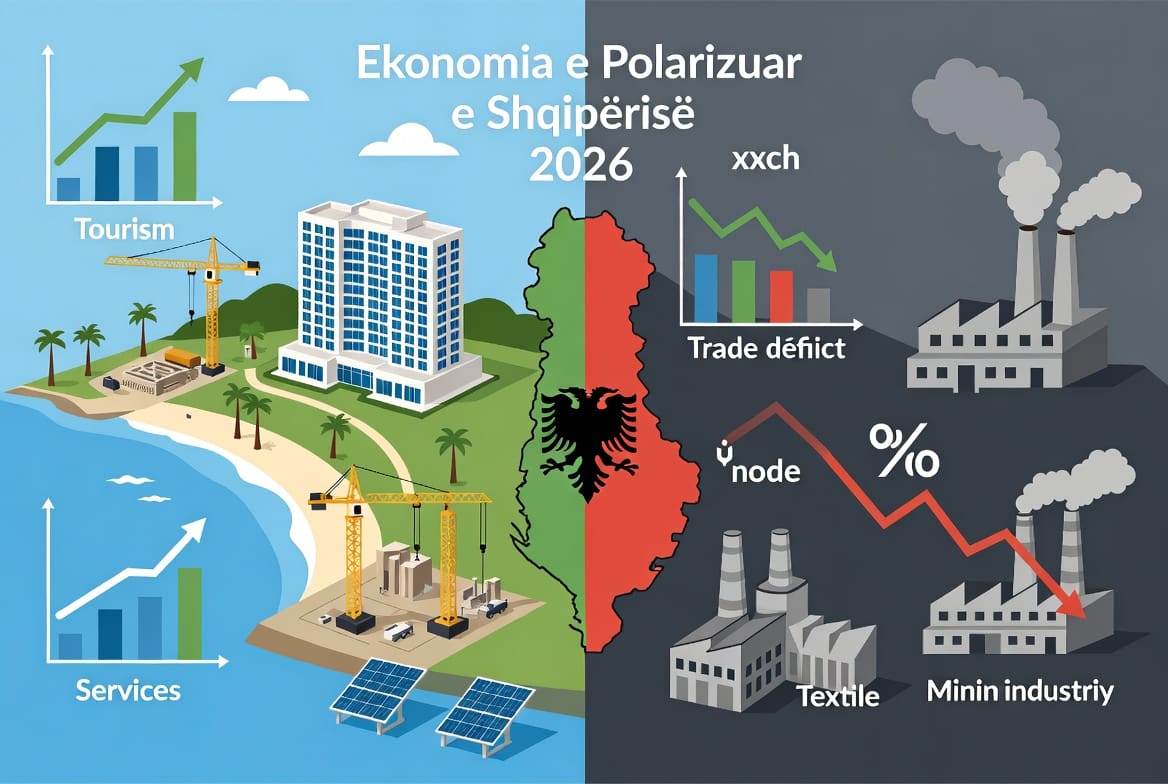
The Albanian economy in the first quarter of 2026 continues to display a polarized and fragile growth pattern, typical of a transition economy that relies on a few strong yet vulnerable pillars, while traditional productive sectors are losing ground. INSTAT data on goods producers, services, and foreign trade during the first months of the year reveal a reality in which domestic consumption, tourism, construction, and energy are compensating for the structural weaknesses of the manufacturing and extractive industries. This model, although generating superficial growth, is deepening territorial and sectoral inequalities, making long-term recovery more difficult without serious policy intervention.
In the goods-producing sector, indicators for Q1 2026 highlight a marked contradiction. Industry as a whole recorded a decline in net sales volume of 3.1% and production of 4.9%, with employment decreasing by 2.9%. The extractive industry is in collapse (-28.1% sales), while manufacturing achieved a modest growth of +2.5%. This reflects the challenges of external competition, the strong Albanian lek exchange rate, and the lack of diversification toward value-added production.
On the positive side, Electricity, Gas, and Steam recorded spectacular performance with sales up by +17.6% and production up by +45%, driven by investments in new capacities (especially solar energy). Construction continues as a strong engine (+8.6% sales, +7.2% production, +5.6% employment, and +22.4% wage fund), while water supply and waste management show steady growth. Strong wage growth in these sectors (often above 13–22%) indicates pressure on costs, but also improved incomes for employees.
The reality is that the economy is behaving like a services-and-construction economy with a developing energy component, while the industrial base is eroding. This trend, if it continues, will create a high dependence on construction cycles and weather conditions (for hydropower), making growth less resilient to external shocks.
Services remain the main pillar of economic activity. In Q1 2026, net sales volume increased significantly in Real Estate (+31.5%), Hotels (+12.6%), Bars and Restaurants (+8.4%), and Trade (+4.6%). Employment and wages followed the positive trend, with wage growth reaching up to +35% in real estate. This reflects the continuation of the tourism boom and foreign investment in property.
However, some subsectors such as Transport (-3.8%), Information & Communication (-1.6%), and Office Administration (-5.4%) show weakness. This indicates that growth is concentrated in consumer-driven and speculative activities, rather than in high-productivity services such as technology or advanced logistics.
For the 2027–2029 period, this model supports domestic consumption and tourism revenues but risks market saturation and diminishing returns in tourism, as well as the emergence of a two-speed economy, with Tirana and the coastline on one side and the inland regions on the other.
Data for May 2026 confirm a deep trade deficit (48.2 billion lek, +5.1% year-on-year). Exports increased modestly by +2.8%, driven by food products, construction materials, and machinery, but textiles and footwear (a traditional sector) are losing ground. Imports increased by +4.1%, dominated by energy and consumer goods.
This structure indicates an economy that consumes more than it produces for export, with a negative balance that continues to finance growth through remittances, tourism, and FDI. However, failing to take action toward a shift to manufacturing and high-value exports will further deepen the trade deficit and increase fiscal pressure as well as pressure on foreign exchange reserves, which have increased up to now. In other words, their positive impact will be consumed by this policy approach, which undermines the 2026–2030 industrial strategy that is still under discussion within institutions.
Forecasts by international institutions (IMF around 3.4%, the World Bank slightly more conservative) suggest moderate growth for 2026, supported by tourism, renewable energy, construction, and consumption driven by rising wages. However, Q1 2026 trends signal a risk of slowdown if external demand from European Union countries weakens or if the construction cycle cools.
How is the economy actually behaving?
It is an economy that is growing but not undergoing deep transformation, and this growth cycle is destined to slow unless the economic model changes. The current model favors growth based on consumption and investments that are not always productive, rather than growth based on innovation, exports, and human capital. This model keeps our economy growing at a modest pace, but it is failing to change the way prosperity is created. Jobs are being created and wages are increasing in some sectors, but the country is producing less, remains dependent on imports, and the benefits of growth are not being distributed equally. This means that current growth may not be sustainable in the long term.
What can be expected from this trend?
Under the baseline scenario, Albania is expected to maintain an economic growth rate of around 3.2–3.5% during 2026, leading to gradual improvements in income and consumption. However, this growth will remain largely quantitative rather than transformative, precisely when transformation is needed more than ever.
This means that, in the absence of structural reforms such as industrial diversification, productivity growth, more efficient management of natural resources, reduction of informality, and investments in skills and human capital, the Albanian economy may remain trapped in the middle-income trap.
This means that the pace of growth will be insufficient to curb emigration, create high-value-added jobs, and meet the growing needs for financing social services, healthcare, and pensions.
According to ALTAX, the transition toward a new development model, an “Albania 2.0” economic model, requires more progressive fiscal policies, support for domestic production and manufacturing, the creation of a sovereign fund based on the exploitation of natural resources, and a more balanced approach to territorial development.
Leave a Reply
You must be logged in to post a comment.