


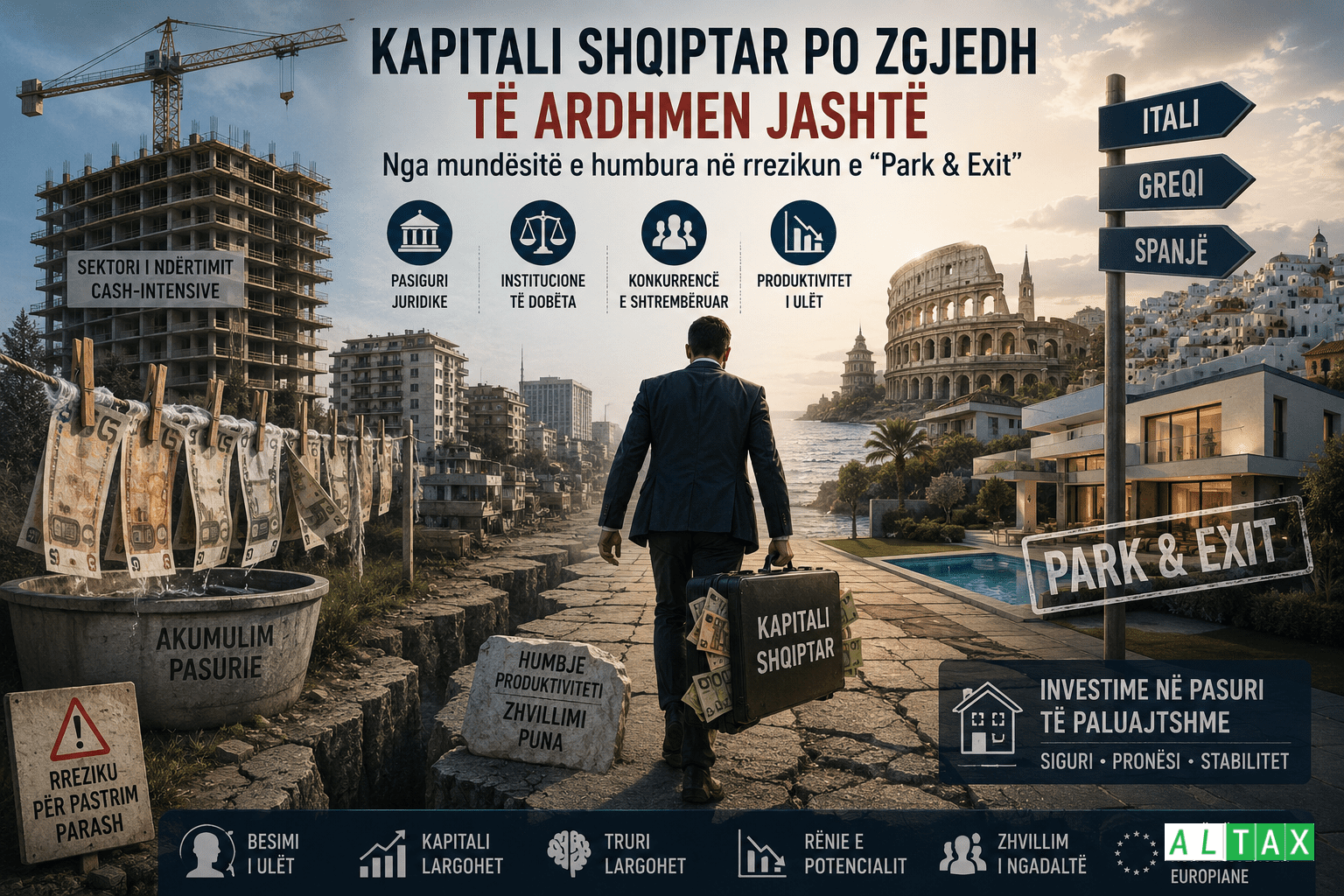
The outflow of Albanian capital abroad
At first glance, the increase in Albanian investments abroad could be interpreted as a sign of the financial strengthening of the private sector.
After all, only economies that have managed to generate capital surpluses can invest beyond their borders.
However, when the structure of these investments is analyzed, it becomes clear that Albania is not experiencing a normal process of internationalization of capital. It is facing a more complex phenomenon, where domestic capital is seeking security abroad instead of seeking development opportunities within it.
The extraordinary increase in real estate investments in Italy, Greece and Spain does not reflect the expansion of Albanian companies in European markets, nor the creation of new production, technological or commercial networks.
On the contrary, it shows that an increasingly large part of the wealth created in Albania is being transferred to safe assets, with low risk and with stronger legal protection. In economic terms, this is a vote with capital against the quality of the domestic institutional environment.
When businesses and individuals with high financial capacities choose to buy property in the European Union instead of investing in industry, technology, modern agriculture or value-added services in Albania, they give a clear signal about their perception of the country’s economic future.
Capital is behaving rationally.
It is moving away from an environment where legal uncertainty, informality, distorted competition and the lack of developed financial markets limit the possibilities for long-term productive returns.
In this sense, the increase in capital outflows is more than a financial issue.
It is an indicator of economic confidence. Every time an Albanian entrepreneur buys an apartment in Milan, Munich or Valencia instead of financing a productive investment in Albania, the economy loses not only capital, but also the potential for jobs, innovation and productivity growth.
The phenomenon becomes even more worrying when analyzed in parallel with the structure of foreign investments entering the country.
Albania is attracting record levels of foreign direct investment, but a dominant part of it is focused on construction, tourism, real estate and reinvested profits. This creates an important paradox.
Foreign capital is entering mainly to build and benefit from the real estate market, while Albanian capital is leaving precisely for real estate abroad. Instead of creating a productive investment cycle that strengthens the country’s industrial and export base, an economic model based on asset turnover rather than value creation is being consolidated.
This development also raises serious questions about the origin of some of these funds.
International reports have for years identified the construction sector and the real estate market as areas with high exposure to money laundering.
In this context, there is a risk that part of the capital created or legalized in Albania is subsequently transferred to jurisdictions with stronger legal and financial standards. This would represent a shift from the capital accumulation phase to the export phase, creating what is increasingly known in the economic literature as the “Park & Exit” model. Capital is temporarily parked in the domestic market and then moved to markets that offer greater long-term security.
The consequences of this dynamic are not limited to the balance of payments. They affect Albania’s development model itself.
An economy where domestic capital leaves, talent emigrates, and new investments are concentrated in sectors with relatively low productivity risks falling into a long-term slow-growth trap.
Economic growth may continue to look satisfactory in statistics, but the ability to generate sustainable welfare and higher wages gradually weakens.
If this trend continues, Albania could face a historical paradox.
The country could register record inflows of foreign capital while simultaneously losing the most dynamic part of its private capital.
In such a scenario, the economy will continue to build more, but not necessarily produce more. There will be more assets, but not necessarily more productivity. There will be more accumulated wealth, but not necessarily more development.
For this reason, the issue is not how to stop capital outflow. The issue is how to create the conditions for Albanian capital to find economic reasons to stay. The economic history of countries that have achieved successful convergence with the European Union shows that capital is not held back by administrative or fiscal barriers. It is held back by reliable institutions, functional justice, fair competition, and real profit opportunities in productive sectors. Ultimately, the outflow of Albanian capital should not be read simply as a balance of payments statistic.
It is an indicator of the confidence that economic elites have in the country’s future. Precisely for this reason, the way this phenomenon will evolve over the next decade may serve as one of the most important barometers for understanding whether Albania is moving towards European convergence or towards the consolidation of a rentier economy based on real estate, consumption, and capital transfers abroad.


Leave a Reply
You must be logged in to post a comment.