


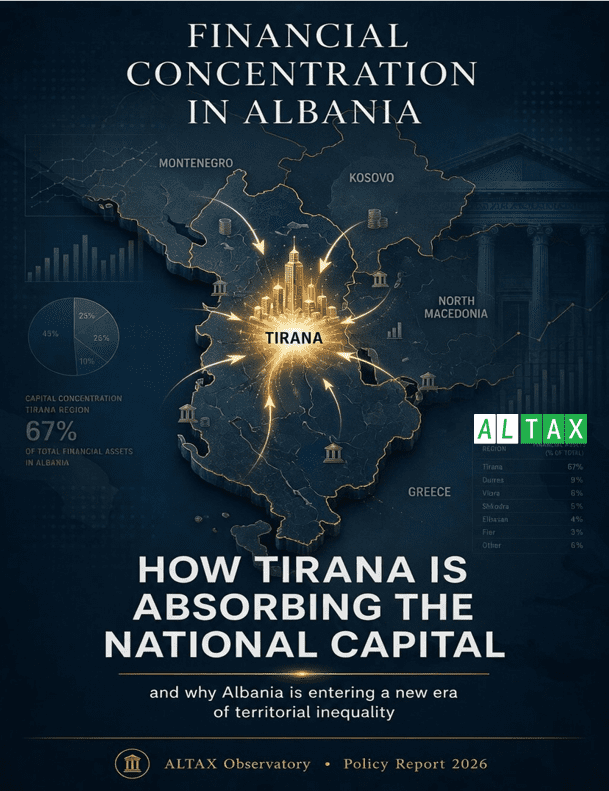
Extreme concentration of banking capital in Tirana and the redesign of Albania’s economic geography
In economies that develop in an organic and balanced manner, savings are usually distributed roughly where income and economic activity are generated. Industrial cities build deposits on the basis of production, tourist areas on services and seasonality, agricultural regions on the agrarian cycle, while urban centers rely on trade, finance, and technology. For decades, bank deposits have functioned as a map not only of savings but also of the real distribution of economic power within a country. Albania in 2026 is gradually moving away from this model, making deposits the clearest indicator of the redesign of the country’s economic geography.
Over the past decade, especially after 2018 and more strongly following the pandemic, bank savings have been concentrated at an unusual pace in Tirana. At the end of 2025, deposits in Tirana reached approximately 892 billion ALL, almost half of the national total. The share of Tirana together with Durrës has exceeded 55–60 percent of national deposits and lending, creating a level of financial concentration similar to the Herfindahl-Hirschman Index of an oligopolistic market.
The time comparison between 2015 and 2025 shows a dramatic shift. While before 2015 deposits were relatively more widely distributed, after 2015 and especially after 2020 they were massively channeled toward the center. The ALTAX Observatory analysis of Bank of Albania data shows an unusually high concentration rate for a small economy. In 15 years, Tirana’s share of national deposits increased by 19 percentage points, from 35 percent in 2010 to 54 percent in the first quarter of 2026. Together with Durrës, the metropolitan area today controls 61 percent of all deposits in the country.
The evolution of bank deposit concentration is clearly presented in the table below:
Table: Evolution of bank deposit concentration
| Year | Share of Tirana | Tirana + Durrës | HHI (approx..) | Level of concentration |
| 2010 | 35% | 42% | 1,800 | Medium |
| 2015 | 42% | 49% | 2,200 | Medium |
| 2020 | 48% | 55% | 2,600 | High |
| 2025 | 53% | 60% | 3,050 | Ver high |
| 2026 Q1 | 54% | 61% | 3,150 | Extremely high |
The table shows the evolution of three key indicators, where the territorial share of Tirana, the combined metropolitan-financial share, and the HHI index have moved from a medium concentration zone toward an extremely high level of concentration.
Albania can no longer be read as a homogeneous economic space. The dynamics of capital, migration, investment, and productivity have created a fragmented development map, where regions follow increasingly different trajectories. At the center stands Tirana, as the dominant metropolitan region, which has created an almost monopolistic financial and economic gravity. The capital is no longer only the administrative center of the country, but the node where banking capital, lending, higher-productivity businesses, real estate investments, a labor market with relatively more competitive wages, and most urban consumption are concentrated. This concentration has created a self-reinforcing capital cycle. The more investment and population are attracted toward Tirana, the more its comparative advantage increases relative to the rest of the country. In economic terms, Tirana functions as a gravitational economy, absorbing not only financial resources but also human capital, entrepreneurship, and development energy from peripheral regions.
Around this dominant pole, several transitional urban centers are emerging, which can be considered micro-growth poles of the Albanian economy. Durrës is gradually consolidating as the country’s main port and logistics hub, benefiting from trade integration and transport infrastructure. Vlora and Saranda are building a new economic profile based on tourism, services, and energy potential, while Shkodra is gaining importance as a center of mountain tourism and nature- and culture-related economies. Fier remains an area with industrial and agro-processing potential, where the combination of agriculture, energy, and industry can create more sustainable development bases. However, these poles are still in transition. They have the potential to generate regional growth but have not yet achieved the economic autonomy and financial magnetism of Tirana.
In contrast to these dynamic areas, there is a group of weak peripheral regions where the economic process is accompanied by a gradual loss of developmental critical mass. Counties such as Kukës, Dibër, parts of Lezhë, inland Elbasan, or areas of Korçë face continuous emigration, demographic aging, shrinking local consumption, and a reduction in formal economic activity. In these territories, the economy suffers not only from a lack of investment but from the progressive weakening of the market’s own base. Fewer active people, fewer businesses, fewer loans, and less local capital recycled within the region create a stagnation spiral, where the territory gradually loses its capacity to generate endogenous development.
The two figures below together show a dramatic and rapid transformation of Albania’s financial geography.

Figure 1: Evolution of territorial share of bank deposits, 2010–2026 Q1. Source: Bank of Albania; ALTAX Observatory calculations.
Tirana has increased its share from 35 percent in 2010 to 54 percent in 2026, i.e., +19 percentage points in only 16 years. Together with Durrës, the two areas now account for 61 percent of all bank deposits in the country. This shows an extreme concentration of financial capital in the metropolitan area.

Figure 2: HHI index of territorial concentration of banking capital, 2010–2026 Q1.
The red zone indicates the “high concentration” level according to ALTAX methodology. The Herfindahl-Hirschman Index has risen from 1,800 to 3,150, crossing the 2,500 threshold around 2020 and confirming that after the pandemic, concentration has become even more aggressive.
The territorial HHI serves as an indicator of the territorial centralization of national capital. The crossing of the 2,500 threshold in 2020 and the reaching of 3,150 in 2026 Q1 clearly places Albania in the zone of high territorial concentration. This level increases systemic risk for the entire national economy, because the financial system becomes overly dependent on a single center.
The loan-to-deposit ratio shows a pronounced territorial divergence. While Tirana and Durrës show a ratio above 110 percent, peripheral regions have fallen below 60 percent. This divergence has significantly deepened over the past decade.

Figure 3: Loan-to-Deposit ratio by territorial typology, 2015 vs. 2026 Q1 comparison. Source: Bank of Albania; ALTAX Observatory calculations.
The divergence is not accidental. It reflects banks’ preference for areas where collateral is secure and liquid, mainly metropolitan real estate, creating a self-reinforcing cycle.
One of the most visible mechanisms of this transformation is the financialization of the urban real estate market.

Figure 4: Real estate prices (€/m² range) and share of mortgage lending by area, 2025. Source: INSTAT, Bank of Albania; ALTAX calculations.
Apartment prices in Tirana fluctuate in the range of 1,770–2,200 €/m², significantly higher than in other areas. Around 65 percent of mortgage loans are linked to the Tirana market, while other regions account for only a small share. This process has created a metropolitan self-reinforcing cycle, where property in Tirana has become the most favorable financial asset in the Albanian economy. In the long term, this model creates a high-metropolitan-gravity economy. Tirana absorbs savings, investments, human capital, and credit, while other regions gradually lose the critical economic mass necessary for autonomous development. The main challenge for Albania today is not only economic growth, but its territorial distribution. Without targeted policies for regional balancing, the risk is that differences will deepen to the point where reversal becomes very difficult.


Leave a Reply
You must be logged in to post a comment.