


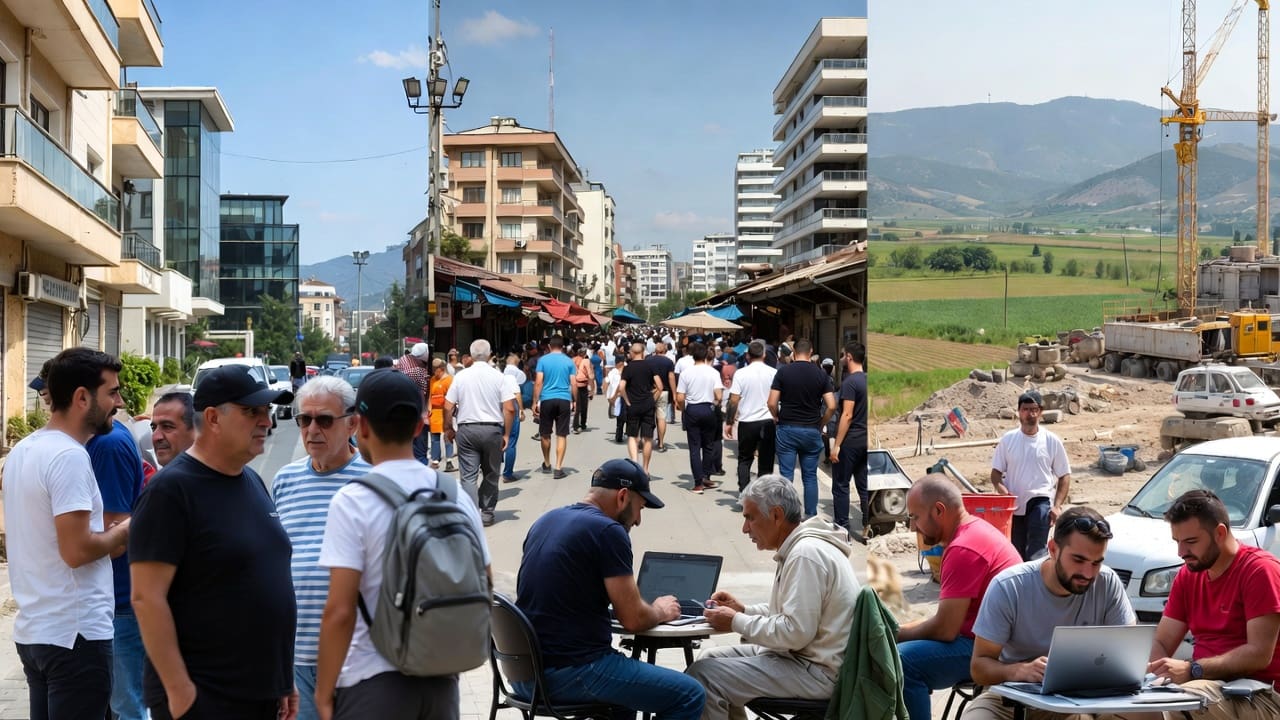
Record wave of immigration to Albania 2025, economic opportunity or social and demographic crisis?
At the end of 2025, Albania entered uncharted territory for its modern history: 27,514 foreign nationals with valid residence permits, an absolute record representing an increase of 22% (+4,800 people) in just one year and a doubling compared to 2020.
Applications rose by 47% (19,321 requests), confirming that this is no longer a temporary phenomenon, but a structural change in the country’s demographic and economic profile.
Employment accounts for 65% of the reasons, family reunification 15%, while studies only 5%, shifting immigration from a social to an economic dimension. Leading are Kosovars (6,076, +32%), followed by Italians (+75%), Indians (+47%), Filipinos (+130%), Egyptians (almost +100%), Turks, Americans (+164%) and other Asian groups such as Myanmarese and Chinese.
Albania, a country historically symbolic of massive emigration, is gradually transitioning from an “exporter of people” to an immigration destination.
At its core, the real dilemma remains between the numbers and the future trend.
Is an economically sustainable and demographically reproductive society being built, or is an illusion of growth being created that fundamentally threatens the future of pensions, social cohesion, and the very basis of long-term development?
A “breath of fresh air” for a workforce-strapped economy
From an economic perspective, immigration appears as an emergency solution for an increasingly empty labor market. Key sectors such as tourism, construction, IT, hotels, restaurants, agriculture, and textiles face a pronounced shortage of workforce, as 28,000 Albanians leave net every year.
In this gap, Indians and Filipinos fill services, Egyptians fill agriculture, while Americans bring remote work models and higher consumption, creating a new cycle of demand in the market.
However, the real economic contribution of foreigners is neither uniform nor fully domestic. A large portion of migrant workers, especially from Asia and Africa, do not spend all their income in Albania but save as much as possible and send remittances to their families in their countries of origin. This means that although they generate value and sustain certain sectors, their net effect on consumption, money circulation, and indirect taxes is lower than the gross employment statistics suggest.
Foreigners contribute to GDP through consumption, taxes, and in some cases investments, especially in tourist and urban centers, but this contribution is polarized. Digital nomads and American or Italian retirees transform Albania into a low-cost “living destination,” increasing rents, local spending, and economic activity. Conversely, low-wage workers exhibit survival-driven economic behavior, prioritizing sending money abroad rather than integrating into the domestic economy.
From a demographic perspective, immigration is seen as a symbolic alleviation of population aging, since most foreigners are 25–45 years old, while Albania has fertility around 1.3 and a population of about 2.4 million, at risk of falling below 2 million by 2050. In practice, however, this effect is limited because most migrants do not settle permanently, do not bring families, and do not meaningfully contribute to demographic reproduction or pension system stabilization.
In numbers, with only 1.1–1.2% of the population, immigration remains small, but the 102% growth in just 5 years indicates a trend that, if mismanaged, could create an economy reliant on temporary labor, with weak domestic consumption and limited impact on long-term development. In this sense, current immigration functions more as a buffer for labor market crisis than as a real engine of a new development model.
The harsh reality: why the public feels it differently
Behind the positive figures lies a far more complex and tense reality than official statistics suggest. Social dumping and low wages are the main concern: Asian workers are often accepted for lower wages than Albanians in construction, textiles, and services, creating unfair competition, lowering work standards, and in practice partially replacing domestic labor. The paradox is that young Albanians leave precisely because of low wages, while the market is filled with workers accepting the same poor conditions.
At the same time, Tirana and Saranda are experiencing direct pressure on the housing market and public services. Rents are rising rapidly, hospitals and schools are overloaded, while social integration of foreigners remains almost nonexistent. The lack of serious language, cultural, and institutional orientation programs increases the risk of community isolation and the creation of micro-social ghettos.
Although most migrants arrive legally, public perception is shaped by insecurity: concerns about petty crime, informality, and cultural mismatch. In political and media discourse, the narrative of “replacement” is reinforced, a symbolic but powerful fear in a country that has lost hundreds of thousands of residents over three decades and sees demographic decline as an existential threat.
The biggest problem, however, remains the lack of long-term immigration policy. Work permits are issued quickly to address urgent business needs, but without real mechanisms for wage protection, sector quotas, quality standards, or integration strategies. Only 40 people applied for permanent residence, clearly showing that most migrants are not building lives in Albania, but functioning as temporary, circulating labor.
In this sense, demographics are not saved by 27,000 foreigners, who cannot compensate for the 28,000 Albanians leaving each year. Nor can they stabilize the pension system or restore labor market balance. In fact, the return of the diaspora must be encouraged, and policies are needed to make Albania attractive for long-term residence, which is a challenge and difficult work for governments that, instead of addressing it, follow short-term, easy paths with unknown long-term consequences.
Albania among neighbors, repeating their mistakes
Regional comparison makes the situation even clearer. Greece, with about 7.7–8% foreign population and 30 years of experience, still faces difficult integration and social tensions. Bulgaria uses quotas and control policies, ensuring slower and more sustainable growth, while Serbia experiences a wave similar to Albania after 2022, with rising housing prices and social polarization. Kosovo, on the other hand, remains an emigration country, a reflection of Albania’s future if the current trend continues.
Albania is moving rapidly toward neighboring models but without the institutional and legal infrastructure they have built, risking repeating the same mistakes without the capacity to handle the consequences.
The records of 2025 shows a numerical victory but not long-term planning. Without new immigration laws, sector quotas, progressive taxes for employers who exploit foreign workers, integration programs, and real wage protection, this wave could turn into a social problem within 5–10 years.
The choice is clear: either a multicultural and integrated Albania, attracting talent and returning the diaspora, or a country with social tensions, urban ghettos, and collapsing demography. The government, businesses, and civil society have a very narrow window to act before the trend is no longer a wave, but an uncontrolled tsunami. This is the moment for real policy and serious debate, not slogans. Albania should not remain simply a “free labor country,” but become a place where Albanians want to return and foreigners want to integrate. In fact, current immigration remains more a “cosmetic aroma,” a superficial solution that masks but does not solve the structural demographic and social crisis.


Leave a Reply
You must be logged in to post a comment.