


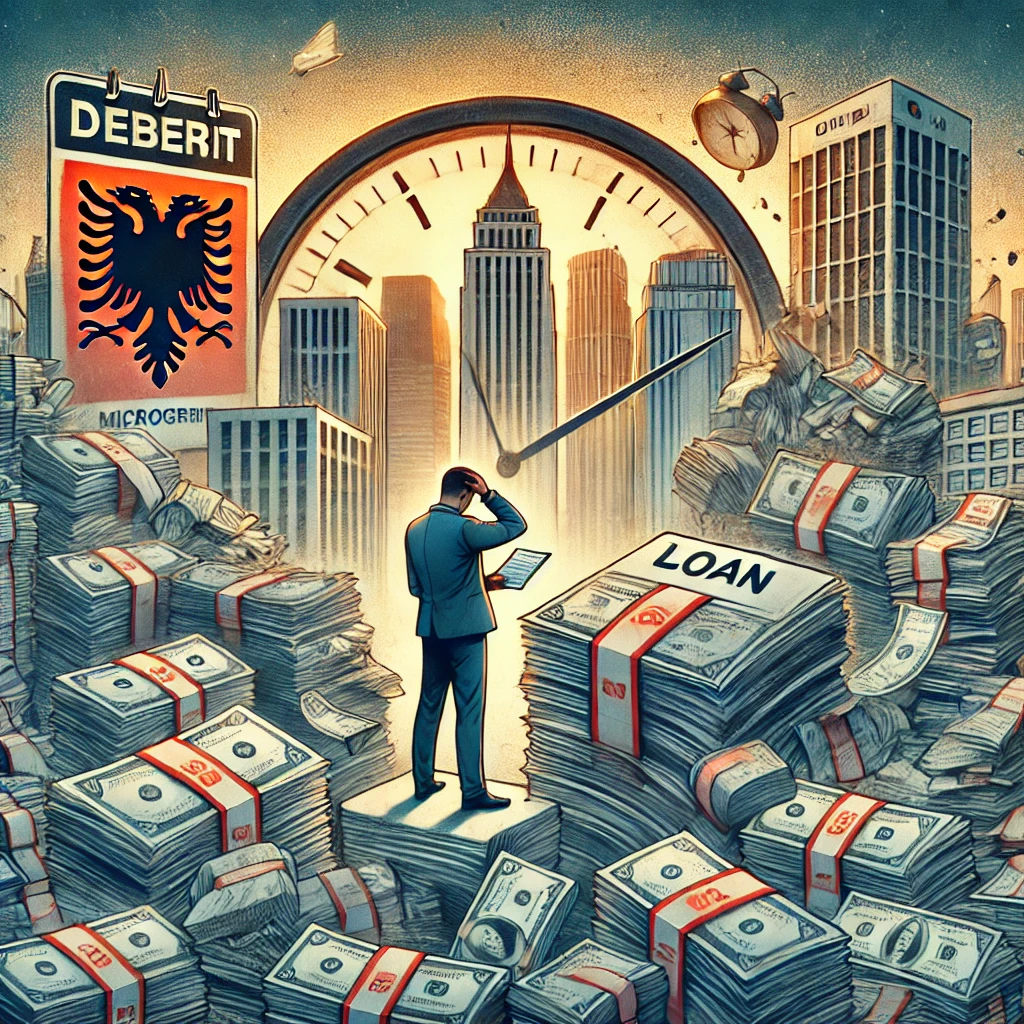
Individual debt dependency and institutional insecurity
In an economy where wages do not rise in line with inflation and the cost of living—as is the case in Albania—individuals are often forced to rely on external sources to maintain a minimum standard of living. This creates a deep dependency on financial systems and may lead to a persistent debt cycle, where individuals are closely tied to creditors and financial institutions.
This phenomenon has a significant impact on economic well-being and profound consequences for individuals and families, leaving them in an insecure situation with little opportunity to escape the cycle.
In Albania, credit dependency has worsened due to deficiencies in the oversight and regulatory systems of the financial sector. In a closed and de facto controlled market, where financial institutions and government policies often favor the interests of banks and micro-lenders, individuals are compelled to seek loans and microcredits to cover daily needs and maintain living standards.
Many citizens are closely tied to these financial institutions, which in many cases provide credit under harsh conditions and high interest rates, forcing them into a perpetual debt cycle.
This phenomenon is the result of policies that, rather than protecting citizens, favor the interests of powerful financial groups and ignore the needs of individuals.
A clear example is how individuals who have taken on significant debt often face a lack of opportunities to increase their income or improve their living conditions. Much of their income is spent on debt repayment, leaving them unable to invest in their career development or manage the rising cost of living.
A family that has taken out loans to cover daily expenses may face a situation that makes it difficult to maintain a stable standard of living and to create opportunities for future investment. This is an economic model based on consumer debt and dependence on financial systems for survival, making it difficult for individuals to achieve economic freedom.
In comparison, other Balkan countries—such as Serbia, North Macedonia, and Bosnia—have experienced similar phenomena, where personal debt has become an inseparable part of life for many individuals.
However, these countries also have more developed oversight and regulatory systems that help mitigate these issues.
For example, in Serbia, where the microcredit system is also strong, there is more state oversight, limiting the potential for misuse and abuse by creditors. Moreover, regulatory policies are stronger, making it more difficult for banks and micro-lenders to manipulate repayment terms and impose harsh lending conditions.
Another aspect that deepens the problem in Albania is the strong influence of the financial lobby and institutional capture.
Banks and micro-lenders are able to directly influence financial policies and regulators, creating a system that favors the interests of powerful financial groups. In such a situation, individuals are unprotected and forced to rely on credit to maintain a basic standard of living.
In this regard, Albania differs from many other countries in the region, where—even though banks are powerful—there are more efforts to balance the interests of citizens with those of financial institutions.
For example, in North Macedonia, there have been efforts to regulate and supervise the microcredit sector and to create opportunities for individuals in need, without forcing them into unrewarded dependence.
Within this context, the situation in Albania has worsened due to a political culture of institutional capture, which has hindered the development of a strong oversight system.
This culture has created an environment where financial policies are more oriented toward supporting the interests of powerful financial groups than those of citizens. Such policies have contributed to the spread of consumer debt and dependence on micro-lenders, creating an insecure environment for citizens and deepening economic inequality.
This phenomenon is a result of political irresponsibility and a short-term profit-oriented approach, ignoring the citizens’ need for a fair and protective financial system.
Another important aspect is that policies favoring consumer debt often create a deep gap between the rich and the poor.
Economic inequality is reinforced by a financial system that allows lending without sufficient oversight and fails to guarantee borrower protection. This situation is comparable to what has occurred in many developed countries during the post-neoliberal era, where dependence on credit and debt has been a way for individuals to maintain their standard of living—yet it has led to increased financial insecurity and worsening economic inequality.
In conclusion, Albania’s model of a closed and controlled market has created a situation of debt dependency, where individuals are tightly bound to financial institutions and forced to use credit to maintain a minimal standard of living. This debt cycle has deep consequences for individuals and families, leaving them unprepared for economic shocks and vulnerable to harsh credit and microcredit conditions.
In this context, deep reforms are urgently needed to strengthen supervision and transparency in the financial sector and to prevent abuses that directly impact individuals’ economic security.

Leave a Reply
You must be logged in to post a comment.