


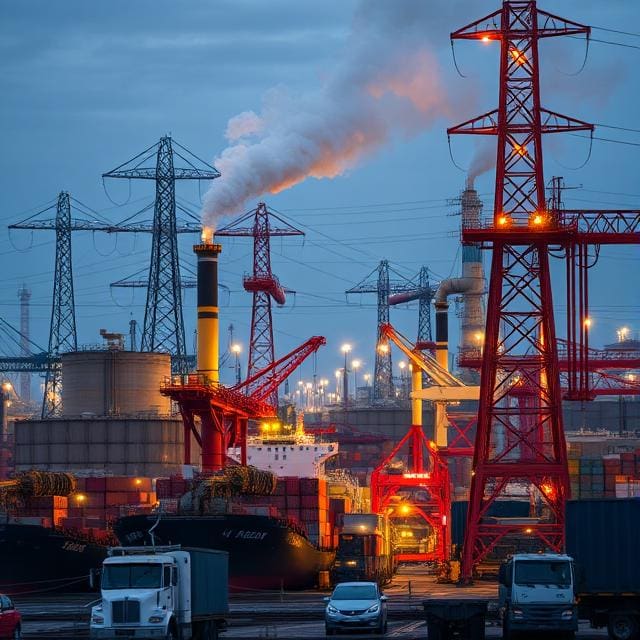
Goods manufacturers trend, Q2 2025
INSTAT data for Q2 2025 show a mixed picture for manufacturing and related economic activities
The latest figures reveal a diverse economic dynamic, where some sectors are facing declines while others continue to grow at a solid pace, reflecting a differentiated pattern of development.
1. Industry
- The net sales volume index fell by 6.2% compared to the same quarter of the previous year.
- The production volume index recorded a mild decline of 0.5%.
- Employment in industry decreased by 3.2%, while the wage fund grew by 4.5%.
This shows a consolidation of manufacturing activity, where, despite lower sales and production volumes, wages have increased—likely to preserve workforce capacity and maintain staff motivation.
- Extractive industry remained broadly stable, with a minimal rise in sales (+0.1%) and production (+0.7%).
- Manufacturing industry registered sharper declines, with sales down 7.5% and production down 0.9%.
2. Electricity, Gas and Steam
This sector posted slight decreases in sales (-0.1%) and production (-5.2%).
Employment declined by 2.6%, while the wage fund increased by 6.3%, suggesting restructuring and investment in skill retention despite lower output.
3. Water Supply, Waste Treatment and Management
Net sales dropped by 4.7% and production by 0.6%, but employment rose slightly by 0.5%, and the wage fund grew by 7.7%.
This indicates that even with lower activity volumes, service delivery and staff investment remain priorities.
4. Construction
Construction continues to move counter to the broader goods-producing economy:
- Net sales increased by 5.2%,
- Production rose by 4.8%,
- Employment grew by 3.6%,
- and the wage fund surged by 16.1%.
This reflects a dynamic construction sector, making a strong contribution to national economic growth, with visible investments in infrastructure and higher staff compensation.
5. Main Industrial Groupings
- Intermediate goods: -15.2% annual sales, but +4.3% quarterly growth (seasonally adjusted).
- Energy: +0.2% annual growth, but -3.5% quarterly decline.
- Capital goods: -0.7% annual decrease, +3.1% quarterly growth.
- Durable consumer goods[1],: +0.9% annual growth, +0.1% quarterly growth.
- Non-durable consumer goods[2]: +4.8% annual growth, +0.1% quarterly growth.
This pattern shows that intermediate goods are the most affected by weaker industrial demand, while consumer goods—especially non-durables—are providing stability to overall production.
In conclusion, the second quarter of 2025 paints a divided picture for Albania’s goods-producing sectors:
- Industry and energy are experiencing mild declines, highlighting challenges in production and sales.
- Construction and consumer goods remain strong drivers of economic growth.
- Wage growth across most sectors points to a strategy of retaining skilled workers and improving standards, despite fluctuations in output.
Overall, the data suggest that the Albanian economy is undergoing a restructuring phase, with some sectors showing resilience and dynamic expansion, while others face demand and productivity pressures.
For further details, visit INSTAT – Goods-Producing Activities.
[1] Includes production of electronic consumer products, furniture manufacturing, and other industries
[2] Includes food processing, beverage production, tobacco products, garment manufacturing, leather and leather goods production, printing and media replication, and other industries

Leave a Reply
You must be logged in to post a comment.