


Albania 2.0, from Consumption to Sustainable Production”
The economic model “Albania 2.0” is not a set of technical reforms nor one development strategy among many alternatives. It represents a paradigm shift in how development itself is understood: from growth as an end in itself to sustainability as a condition for economic survival. In this sense, “Albania 2.0” is not an ideological choice, but a structural necessity.
The essence of the model is not how fast the economy grows, but whether society can reproduce itself over time without destroying its foundations: population, natural resources, public health, and institutional capacity. An economy that grows by consuming these foundations is not a developing economy, it is a system spending future capital to finance the present.

Thus, the shift is from a model that extracts resources, consumes them, and replaces them with imports, to a model that produces real value, regenerates its base, and retains value domestically. Growth should no longer come from expanding consumption and construction, but from increasing real productive capital: fertile land, sustainable energy, human capital, technology, and functional institutions.
From a Consumption Economy to a Production Economy
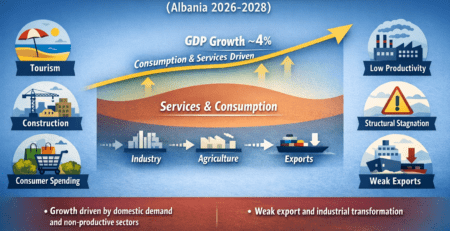
The transition from a consumption-based to a production-based economy is the cornerstone of “Albania 2.0.” The current structure of the Albanian economy typifies a non-resilient system: growth depends largely on remittances, construction, and seasonal tourism, while imports dominate both food and energy. This generates a superficial sense of prosperity, but builds no real developmental capacity.
In essence, today Albania’s economy does not create new value; it recycles money coming from abroad. This means that welfare is derived not from domestic productivity but from unstable external flows beyond the country’s control. Such an economy is not a development economy but a transfer economy, highly exposed to global, geopolitical, or financial shocks.
“Albania 2.0” requires a clear shift: investments must go to modern agriculture, green industries, processing, and technology, aiming to build domestic value chains. The principle is brutally simple: every euro must either increase exports or replace imports.
If it does neither, that euro does not build development.
Currently, Albania produces only about one-third of its own food needs, leaving it extremely vulnerable to climate events, global price shocks, and supply crises. Climate-smart agriculture with efficient irrigation, resilient varieties, and modern technology is no longer a rural sector; it becomes national macroeconomic infrastructure. It transforms into an inflation buffer, a social stabilizer, and a real foundation for long-term development.
From Quantitative Growth to Real Resilience
The classical model equates success with GDP growth: the higher the number, the “more successful” the country. But GDP measures only money in circulation, not whether this money builds or destroys the real foundations of society.
“Albania 2.0” reverses this logic. Success is measured by far more concrete questions that guide policy:
- How much food does the country produce for itself?
- How much energy is produced cleanly?
- How many natural resources are preserved?
- How many people are staying and returning?
This implies a deep statistical and political paradigm shift. GDP is no longer an objective in itself but a consequence of a well-functioning system. Real objectives become food security, environmental quality, resilience to climate shocks, and real productivity per capita. When these improve, economic growth naturally follows; when they degrade, GDP growth is merely an accounting illusion.
In this context, the National Adaptation Plan (~$9.8 billion) is not an “environmental cost” but macroeconomic insurance. Without this plan, climate losses are expected to reach 7–25% of GDP by 2050, a structured, permanent recession, not a cyclical crisis. Adaptation is not a luxury; it is a condition to avoid systematic impoverishment.
From Electoral Politics to Intergenerational Policy
The shift from electoral politics to intergenerational policy is perhaps the hardest, yet most fundamental, change needed to realize “Albania 2.0.” The current decision-making system operates mostly on four-year horizons dictated by election cycles, prioritizing actions that yield quick, politically visible results. This mechanism may be effective for short-term management but is incapable of addressing structural challenges that span decades.
The problem is that the fundamental realities of development do not respect the electoral calendar. Demography cannot be corrected within a single government term, climate cannot be stabilized with an annual budget, and natural capital cannot be regenerated through a single reform. All of these require time, continuity, and consistent policies over 20–30 years, not fragmented interventions tied to immediate interests.
Therefore, “Albania 2.0” requires a deep shift in governance logic: from policies aimed at winning elections to policies focused on survival and the well-being of future generations. This includes genuine, long-term pro-family policies to curb demographic decline, energy strategies through 2040–2050 to ensure security and independence, and protection of natural resources not as reserves for rapid exploitation but as national assets to be preserved and enhanced in value.
Here, the state is no longer a manager of electoral cycles but the custodian of intergenerational capital.
Systemic Logic of the Model (Feedback Loops)
The systemic logic of the “Albania 2.0” model is based on how the main variables of the economy, environment, and society interact through feedback mechanisms. Unlike the traditional model, where sectors are treated separately and policies are linear measures, this model sees development as an interconnected system, where every intervention produces chain effects throughout the economic and social structure.
At the core are positive feedbacks, or virtuous cycles. For example, investments in renewable energy do not only have an environmental impact. They reduce pollution, improve public health, increase labor productivity, and ultimately translate into real and more sustainable economic growth. Thus, an energy policy simultaneously becomes a health, social, and development policy. The same logic applies to climate-smart agriculture: investments in technology and efficiency increase yields, reduce dependence on imports, stabilize prices, and strengthen social security. In this way, a traditionally weak sector transforms into a source of macroeconomic stability.
At the same time, the model operates through controlled negative feedbacks, which act as brakes against degradation. Limiting emissions and managing pollution are not only about reducing environmental damage but also about preserving natural resources, which are the basis of long-term productivity. These measures prevent the depletion of natural capital and avoid what systems theory calls “overshoot,” i.e., exceeding ecological and social limits, which would later lead to inevitable decline.
At its core, this logic mirrors the “Stabilized World” scenario in the “Limits to Growth” model: not unlimited, blind growth, but a dynamic balance, where the economy grows within the limits that natural and social systems can sustain. The goal is not to maximize production at any cost but to optimize development so that society maintains the capacity to regenerate and function sustainably over time.
Economic Superiority of the Model
“Albania 2.0” is economically superior precisely because it breaks a common illusion of development: the idea that faster short-term growth is always better growth.
The main paradox is that the sustainable model seems slower at first, as it requires significant investments in adaptation, renewable energy, modern agriculture, and resource protection. These investments do not immediately produce consumption and quick profits, but they build structural capacities that yield returns over time.
This is where its real advantage lies. Unlike the traditional model, which generates growth by consuming resources and accumulating hidden costs, the sustainable model avoids cumulative losses caused by climate degradation, worsening public health, and depletion of natural capital. Instead of these costs appearing later as fiscal crises, high health expenditures, or import dependence, they are neutralized at the investment stage.
At the same time, this model increases real productivity. A healthier workforce, cheaper and sustainable energy, more efficient agriculture, and higher-tech industries translate into more value added per unit of labor and capital. This leads to real growth, not just nominal GDP expansion.
A third, often underestimated, effect is the reduction of structural government costs. A healthier society places less burden on the healthcare system, a more balanced demographic structure eases pressure on pensions, and a more self-sufficient economy reduces the need for food and energy imports. Thus, the sustainable model not only raises income but also lowers mandatory expenditures.
In macroeconomic terms, this logic can be summarized in a clear ratio: every €1 invested in adaptation and resilience yields €2–10 in economic return in the medium and long term. This means that “Albania 2.0” is not an idealistic or moralistic vision of green development but a rational financial model that maximizes investment returns while minimizing structural risks for the future.
The Real Difference with Albania 1.0
The real difference between Model 1.0 and “Albania 2.0” is not the growth rate on paper, but how that growth is built and what it leaves behind.
The current model is growth that consumes its own base: it generates economic activity today by depleting resources, people, and natural capital that should support tomorrow’s development. On the surface, GDP grows, but the system is weakened at its core.
In the 1.0 scenario, economic growth is accompanied by a shrinking active population due to emigration and declining birth rates, continuous depletion of natural resources, and rising pollution. These processes operate in parallel, creating a negative spiral: the economy appears to move forward, but society loses the capacity to sustain that growth over time. The result is not an immediate crisis but a “soft collapse,” characterized by chronic stagnation, social pressure, and lack of long-term prospects.
In contrast, Model 2.0 represents growth that reproduces its own base. Rather than relying on expanding consumption, it increases real productivity through investments in people, technology, and sustainable resources. This model aims to stabilize society, preserve natural capital, and improve real well-being, not just nominal indicators. Growth produced in this way is more sustainable because it is built on foundations that strengthen over time, not on ones that are consumed.
Model 1.0 produces growth that pushes the problem forward, while the sustainable model creates development that resolves it at its root. One leads to false stability that gradually deteriorates; the other to long-term stability that increases the country’s economic and social resilience.
This is why the difference between the two models is not merely technical but deeply structural and decisive for the future.
The question is not whether Albania will grow economically for a few years, but whether it will be able to function as a sustainable society after 2040. “Albania 2.0” provides a clear answer: growth only makes sense if it builds the future, not if it consumes it. And for this reason, this model is not an idealistic vision but the most rational, realistic, and responsible path for the country’s development.

Leave a Reply
You must be logged in to post a comment.