


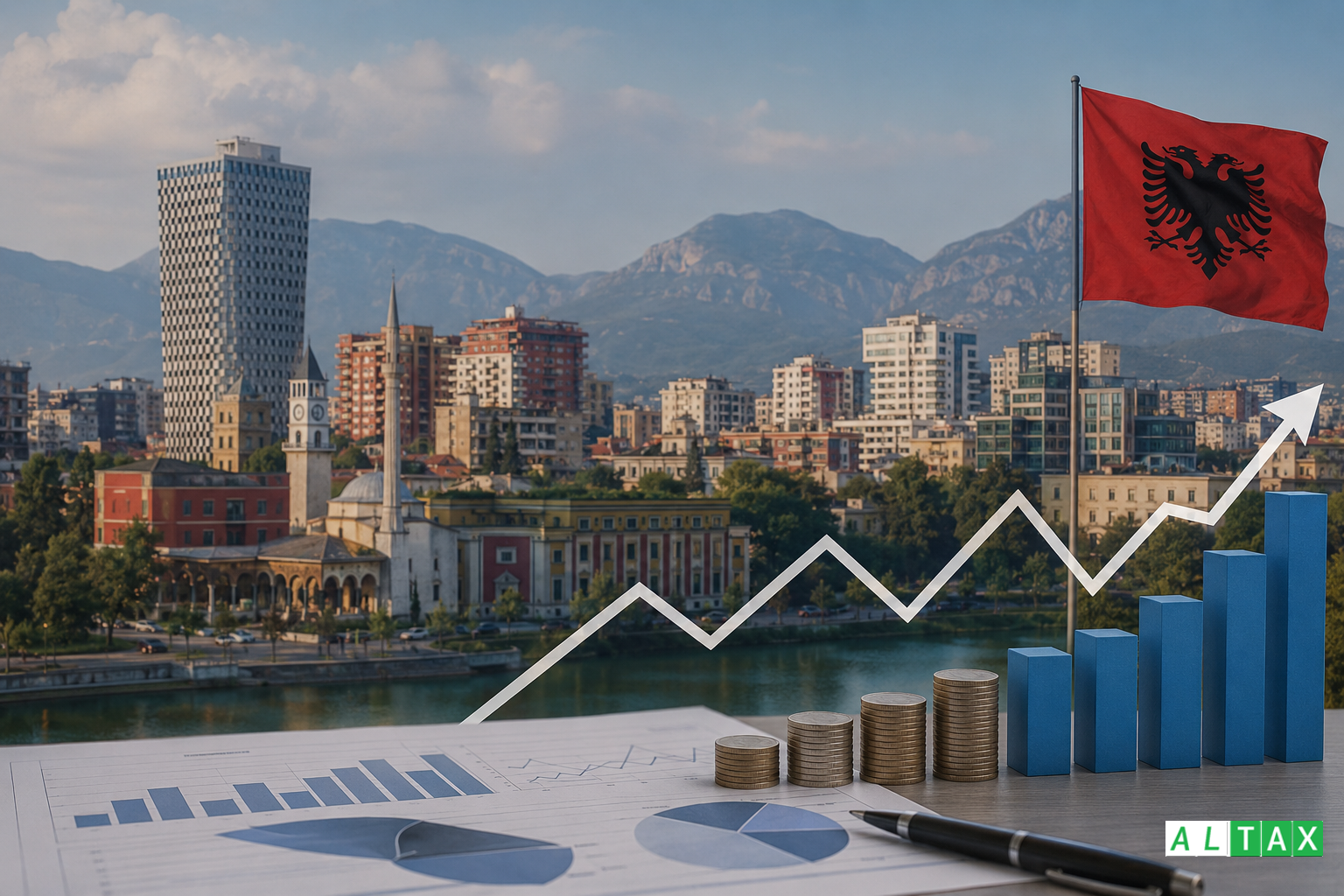
Economy of Albania maintains stability, but faces structural constraints in almost the first half of 2026
The Albanian economy continues to maintain acceptable macroeconomic stability during the first months of 2026, but is clearly showing signs of slowdown and lack of deep structural transformation.
According to the analysis of independent economic minds, annual growth is expected to remain around 3.5 to 3.6 percent. This growth is mainly supported by domestic demand, tourism and the construction sector. However, it remains mainly quantitative and not qualitative, leaving deep problems such as high informality, emigration, low productivity and heavy dependence on a few sectors unresolved.
In relation to the perspective of integration into the European Union, Albania successfully passes the macroeconomic stability test. But it still fails to show sufficient progress in real convergence with European standards. The current economic model is operating below its potential, which could reach 4 to 5 percent with deep reforms in the rule of law, the labor market, green energy and competition.
Economic growth remains moderate
Preliminary data for the period January-May 2026 show calm economic activity. Construction and services maintain the main weight, while tourism is entering a maturation phase at lower rates than in 2023-2025. Projections by international institutions confirm this trend. The World Bank and the IMF expect growth of 3.4 percent, the European Commission 3.3 percent, while the EBRD around 3.5 percent.
Analysts estimate that the current economic model is reaching its limits. Growth continues to rely on consumers, construction and tourism, but without a significant increase in high-value exports or improved productivity, it is not creating sustainable well-being for the majority. Inequality is deepening, with profits accumulating in a limited number of actors, while the middle class is feeling strong pressure.
Slightly rising inflation and foreign trade
Inflation has increased modestly, reaching 2.8 percent in April 2026. The main pressure comes from prices in transport, energy and tourism services. The Bank of Albania has kept the key interest rate unchanged, but the economy remains vulnerable to external shocks such as fluctuations in oil and energy prices.
In foreign trade, exports have grown faster than imports, slightly reducing the trade deficit. However, structural dependence on imports remains high. Foreign direct investment is coming mainly in solar energy and tourism, but their effect on domestic value chains remains limited.
Labor market and inequality
Unemployment has reached historically low levels, around 8.3 to 8.7 percent. Wages in the formal sector are increasing, but informality remains high and reaches close to 30 percent of GDP. Wage growth is outpacing productivity, weakening international competitiveness. Emigration of educated youth is creating serious labor shortages, while wealth inequality is widening.
Fiscality and the challenge of corruption
The budget deficit is being kept under control, at around 2 percent of GDP, while public debt has fallen to around 53 percent. However, the implementation of public investment remains weak. According to independent estimates, the economic cost of corruption is reaching worrying levels, with direct and indirect losses that could reach up to 1-1.5 billion euros per year.
Tourism remains the main driver, but it is seasonal. Solar energy is expanding, but dependence on hydropower creates risks. Construction makes a major contribution, but its long-term effect on the economy is limited.
Experts recommend a rapid transition to a new development model that focuses on light industry, modern agriculture, information technology and clean energy. The fight against informality, deep reforms in education and the labor market, greater transparency in procurement and the maximum use of European funds with strict monitoring are essential steps.
Albania has a historic opportunity with the negotiations for membership in the European Union. But if it continues with the same model, growth will remain mediocre and prosperity will be distributed unevenly. As analysts often emphasize, the country does not simply need more growth, but better and more sustainable growth.


Leave a Reply
You must be logged in to post a comment.