


Albanian rentier economy between statistical illusion, social polarization and the risk of structural collapse
The Albanian economy is currently in a phase that at first glance can be interpreted as growth, development, and modernization. Macroeconomic indicators report an expansion of Gross Domestic Product, an increase in investments, a boom in the construction sector, and an intensification of tourism activity.
However, beneath this statistical surface lies a much more complex and problematic reality of deep polarization of the economic structure and the breakdown of income redistribution mechanisms.
At its core, the current polarization of the Albanian economy is not the result of a natural economic transformation, as usually occurs in countries that move from agriculture to industry and then to high value-added services.
On the contrary, it is mainly the product of selective government intervention in the allocation of public and private resources, directing capital toward a few sectors and a few actors.
Instead of the market, competition, innovation, and productivity leading economic restructuring, in Albania we are within a model where public capital, permits, concessions, indirect credit, and fiscal and urban policies are concentratedly channeled toward construction, real estate, and seasonal tourism.
These sectors have become the artificial axis of economic growth, producing an economy in which profits are concentrated at the top, while risks and costs are distributed across society.
This mechanism creates a typical paradox for rentier economies, with formal GDP growth but a real weakening of well-being. Capital does not go where new value is created, but where there is political access and institutional privilege. The result is the economy we live in today, which generates asset inflation, especially in the real estate market, while real wages remain low, the productive sector is suppressed, and income inequality increases.
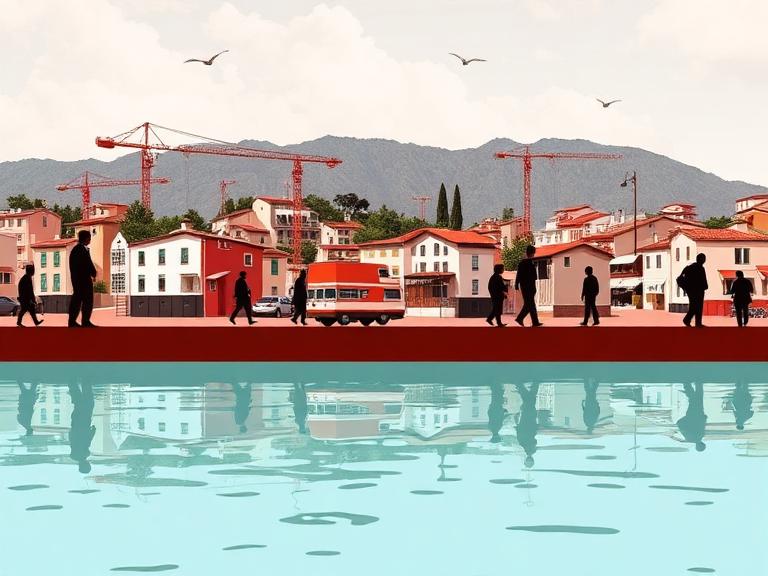
Construction and tourism are presented as “successful” sectors because they rapidly increase monetary volumes, generate many transactions, and are visually evident in the urban space.
But in deep economic terms, these sectors have low productivity, create insecure and seasonal jobs, have a weak technological multiplier, and do not increase human capital.
Construction and tourism produce volume, but not development.
The Albanian paradox becomes even stronger, as while more towers are built, emigration increases, unemployment among qualified young people rises, the gap between prices and wages widens, and dependence on remittances grows.
This is a classic symptom of economies that develop non-productive but rent-generating sectors, where wealth is not created through work and innovation, but through control of land, licenses, and privileges.
In this model, the mechanism of income redistribution is profoundly broken.
The winners are large developers, businesses linked to public contracts, financial actors close to the government, and owners of urban land.
The losers are workers, educated youth, productive businesses, agriculture, and the middle class.
This means that incomes rise at the top of the pyramid, while society’s consumption is artificially sustained by debt and remittances.
In this political economy, high corruption in Albania is not a moral deviation or an individual problem, but a structural consequence of this economic model.
When the state decides who gets permits, who gets concessions, who benefits from public projects, and who enters protected markets, then corruption becomes a functional instrument of the system, not merely a violation of the law.
It is the mechanism through which economic rent (clientelist and speculative profit) is distributed.
Global economic history offers clear examples of the failure of this model.
Spain before the 2008 crisis built an economy based on construction, with rapid growth and artificially low unemployment, but ended up in banking collapse, public debt, and a lost generation.
Greece built an economy based on tourism, public services, and debt-driven consumption, and ended up in a sovereign crisis, mass impoverishment, and brain drain.
Even today’s Dubai, the extreme model of a rentier economy, functions only because of oil and global capital flows, a model that is not exportable to Albania.
The fundamental difference lies between organic economic transformation, which is driven by productivity and increases human capital, and politically dictated transformation, which is driven by the short-term interests of power, concentrates capital, encourages speculation, and increases emigration. Albania is clearly in the second model.
If this trajectory continues, the long-term consequences are inevitable.
The economy will remain fragile, dependent on external flows, with a structural trade deficit and rising debt.
Society will face a shrinking middle class, rising relative poverty, social polarization, and loss of trust in the state.
Politics will evolve toward an increasingly clientelist state, with captured institutions and formal but non-functional democracy.
In conclusion, the current Albanian economic model is a rentier economy with a façade of development, but with a weak productive foundation.
This model cannot produce long-term well-being and cannot retain human capital, dissolving the existing middle class and real competition.
In pure economic terms, Albania is not developing, as it is recycling inequality under the guise of investments.
And here lies the most critical political and historical point!
Such an economy always ends either in financial crisis, or in growth below potential with mass emigration, or in an increasingly authoritarian regime that seeks to manage social discontent through control rather than development.
Polarization and the breakdown of the redistribution principle do not end from within the system itself, but only when fiscal capacity is exhausted, when debt becomes unsustainable, when external flows stop, or when society no longer accepts inequality as normal.
In any case, the end of this model does not come as a soft reform, but as a painful economic, social, and political correction.


Leave a Reply
You must be logged in to post a comment.