Bashkohuni me ekipin tonë. A jeni gati të rrisni biznesin tuaj? Mëso më shumë


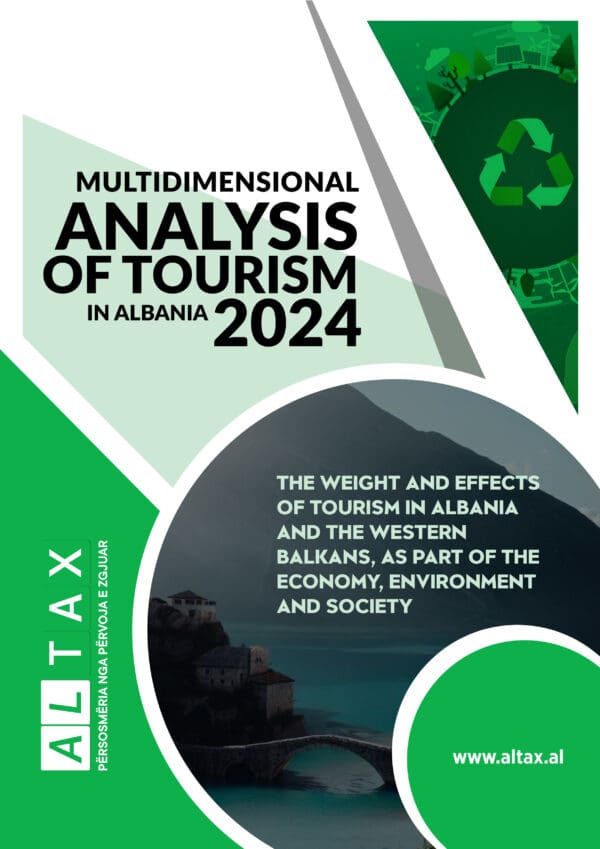
MULTIDIMENSIONAL ANALYSIS OF TOURISM IN ALBANIA, 2024
13 €
MULTIDIMENSIONAL ANALYSIS OF TOURISM IN ALBANIA is designed at the methodological level, as a multidimensional analysis of tourism. The paper presents a scheme that combines a confrontation of the arguments and facts of the tourism industry with the demands and reality of the economy and Albanian families.
The analysis provides an analysis, adopting a multidimensional methodology, using different sources of information on the general trend and development of the tourism industry in Albania.
The part of the paper is organized as follows:
After the introduction, the statistical indicators of the economic and budgetary impacts of Albanian tourism and the countries of the Western Balkans are discussed, analyzing also the expenses per tourist, in order to penetrate better into the interior of the influencing effects at the individual level.
Meanwhile, in the other part, the confrontation of the flow of tourists with the possibilities of Albania to host tourists according to the requirements for consumption and standards are analyzed.
Following the analysis, the clarification of benefits for families and their well-being, for the local budget and for the state budget was used.
The following section provides an overview of the development of each of the sectors that are directly or indirectly involved in the tourism industry and the regional indicators of the register of businesses and their fiscal contributions.
An important part is the analysis of the effects of informality and overvaluation of the Lek by developing it as a composite indicator in function of the sustainability of tourism.
The last section provides a general approach on the concept of strengthening sustainability and intermingled with the problems that the intensification of tourism falls within the framework of the global perspective.
Finally, some concluding comments and remarks are given.
- Description
Description
In the context of the expansion and development of the tourism industry in Albania, we have analyzed in a multi-directional approach the economic, social and environmental performance, treating it according to the tourism sustainability model.
This analysis, considering all the most important tourism development policy documents, has adapted the arguments according to strategic planning, suggesting the development of tourism as a multisectoral sector that should ensure an appropriate balance between the current and future opportunities of the areas in a economy based not only on tourism.
Due to the multidimensional nature of the concept of sustainability and the difficulties encountered in measuring tourism performance, composite indicators have been increasingly used as useful tools for operationalizing sustainability.
In this paper, the study of the sustainability of tourism in the Albanian regions is based on building a composite indicator that uses many criteria for the collection and analysis of various economic, social, fiscal and environmental indicators.
Tourism developed on the model of sustainability requires the representation of different examples of sustainability, as well as other concepts that consider the performance of the industry applicable according to the circumstances as well as a view of the fair distribution of the state budget considering the basic principles of welfare redistribution.
This analysis can serve as a starting point that stimulates public and private debate and promotes improvement actions to achieve tourism sustainability in the perspective of facts and arguments in a consolidated version of facts and statistics.
Our analysis aims to develop a composite document that will be used for a comparative analysis of the sustainability performance of Albanian tourist regions and compared with the performance of neighboring countries.
The summary preparation of the indicators was made possible with the support of ALTAX staff. Their meticulous attention to detail has been an inspiration and has kept our work on track from the initial moment until the final draft of this paper was prepared.
Related products
-
ALTAX PRODUCTS
Economic growth in Albania: Influencing factors yesterday, today and tomorrow
Original price was: 22 €.20 €Current price is: 20 €. -

-
ALTAX PRODUCTS
Investment climate and tax system in Albania 2015
Original price was: 12 €.10 €Current price is: 10 €. -
ALTAX PRODUCTS
Tax freedom day and tax burden in Albania and Balkans, 2015
Original price was: 35 €.30 €Current price is: 30 €. -
ALTAX PRODUCTS
Tax notes for construction industry in Albania
Original price was: 15 €.14 €Current price is: 14 €. -
ALTAX PRODUCTS
Albania: Impact of economic and fiscal policy in the agriculture
Original price was: 35 €.30 €Current price is: 30 €. -
ALTAX PRODUCTS
PSAs in oil industry, tax system and corruption
Original price was: 22 €.20 €Current price is: 20 €. -
ALTAX PRODUCTS
Natural disasters – Financial and fiscal effects, Policy and experience for tackling them
Original price was: 14 €.11 €Current price is: 11 €.