Bashkohuni me ekipin tonë. A jeni gati të rrisni biznesin tuaj? Mëso më shumë


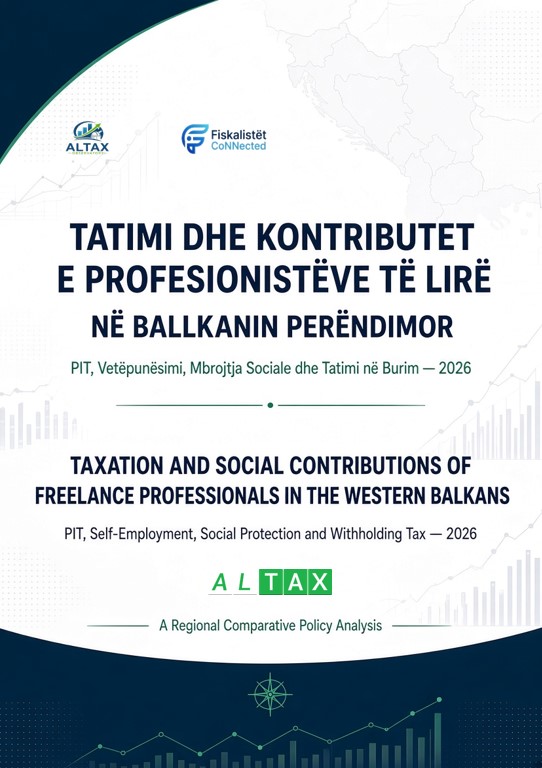
TAXATION AND SOCIAL CONTRIBUTIONS OF FREELANCE PROFESSIONALS IN THE WESTERN BALKANS
0 €
This report of ALTAX Observatory presents an in-depth comparative analysis of the tax systems and social contributions applied to freelance professionals across the six Western Balkan countries (Albania, Kosovo, Montenegro, North Macedonia, Serbia and Bosnia and Herzegovina) for 2026. By constructing a three-tier Tax Burden Model — (I) the statutory rate, (II) the burden on the taxable base after deductions, and (III) the total mandatory fiscal burden including social contributions. The study moves beyond traditional rate comparisons and measures the real burden paid by freelancers under four concrete gross-income scenarios (€10,000, €25,000, €50,000 and €100,000).
Key findings show that the tax base, deduction regimes and mandatory contributions have a greater impact than the PIT rate itself. Montenegro, North Macedonia and BiH converge at an 8 % total burden, while Serbia pays 2.5–3.5 times more to provide full social protection. Four of the six countries leave freelancers without mandatory contributions, raising long-term questions about the sustainability of pension systems. VAT thresholds vary by up to six times, and the cross-border dimension (WHT, DTTs and the reverse-charge mechanism) is becoming increasingly important for professionals working with foreign clients.
The report identifies policy implications across four dimensions: tax neutrality, social protection, administrative simplicity and cross-border competitiveness. It offers a useful analytical framework for policymakers, researchers and professionals interested in labour-market formalisation and the attraction of digital talent in the region.
Keywords: personal income tax, freelance professionals, social contributions, tax burden, Western Balkans, withholding tax, self-employment, tax policy
- Description
Description
Ky raport i ALTAX-it ndërton Modelin e Barrës Fiskale për profesionistët e lirë në gjashtë vendet e Ballkanit Perëndimor (BP6), duke kaluar përtej krahasimit të thjeshtë të normave statutore drejt një analize me tre nivele: (I) norma statutore, (II) barra mbi bazën tatimore pas zbritjeve, dhe (III) barra totale fiskale e detyrueshme, duke përfshirë kontributet shoqërore. Modeli testohet mbi katër skenarë konkretë të ardhurash bruto vjetore (€10,000 / €25,000 / €50,000 / €100,000) për një profesionist tip: rezident, pa punonjës, pa të ardhura kapitali, pa persona në ngarkim.
This ALTAX report builds a Tax Burden Model for freelance professionals across the six Western Balkan economies (WB6), moving beyond a simple comparison of statutory rates toward a three-tier analysis: (I) the statutory rate, (II) the burden on the taxable base after deductions, and (III) the total mandatory fiscal burden, including social contributions. The model is tested against four concrete annual gross-income scenarios (€10,000 / €25,000 / €50,000 / €100,000) for a representative professional: resident, no employees, no capital income, no dependents.
Gjashtë gjetjet kryesore / Six Key Findings
- Konvergjenca e PIT-it. Diferenca mes PIT-it të punëmarrësve dhe profesionistëve të lirë është më e ngushtë se diferencat në bazën tatimore dhe regjimet e shpenzimeve të zbritshme që qëndrojnë pas saj.
- PIT convergence. The gap between employee and freelancer PIT is narrower than the differences in the underlying tax base and deductible-expense regimes.
- Divergjenca e mbrojtjes sociale. Diferenca më e madhe institucionale lidhet me kontributet e detyrueshme shoqërore, jo me PIT-in.
- Social protection divergence. The largest institutional difference concerns mandatory social contributions, not PIT.
- Thjeshtim kundrejt mbrojtjes. Taksimi më i ulët ose i thjeshtuar i profesionistëve të lirë shpesh përkon me mbulim më të dobët të detyrueshëm social.
- Simplification vs. protection. Lower or simplified freelancer taxation often coincides with weaker mandatory social-insurance coverage.
- Dimensioni ndërkufitar. Trajtimi WHT dhe DTT bëhet gjithnjë e më i rëndësishëm ndërsa profesionistët e lirë punojnë ndërkufitarisht.
- Cross-border taxation. WHT and DTT treatment becomes increasingly relevant as freelancers operate across borders.
- Reforma e Serbisë. Serbia paraqet regjimin strukturalisht më të diferencuar në rajon pas reformës së 2023-shit.
- Serbia’s reform. Serbia represents the most structurally differentiated freelancer regime in the region following the 2023 reform.
- Fragmentimi rajonal. Pavarësisht normave PIT relativisht të ngjashme, gjashtë juridiksionet ndryshojnë ndjeshëm në baza tatimore, zbritje, detyrime kontributesh dhe arkitekturë pajtueshmërie.
- Regional fragmentation. Despite broadly similar PIT rates, the six jurisdictions differ substantially in tax bases, deductions, contribution obligations and compliance architecture.
Krahasimi i rëndësishëm nuk është më norma statutore e PIT-it, por baza tatimore mbi të cilën aplikohet ajo normë. 10% mbi €100,000 me pak zbritje nuk është e njëjta gjë me 10% mbi €100,000 pas zbritjesh të konsiderueshme — dhe pikërisht këtu qëndron “tax-base arbitrage” rajonale.
…but the tax base to which that rate applies. A 10% rate on €100,000 with few deductions is not the same as a 10% rate on €100,000 after substantial deductions — and this is precisely where regional “tax-base arbitrage” resides.
Related products
-

-
-
ALTAX PRODUCTS
Minimum wage increase and consume prices in Albania
Original price was: 15 €.13 €Current price is: 13 €. -
ALTAX PRODUCTS
Tax burden in Albania, Kosovo and Balkans, 2018
Original price was: 35 €.32 €Current price is: 32 €. -
ALTAX PRODUCTS
Tax system and investment climate in Albania, 2016
Original price was: 12 €.9 €Current price is: 9 €. -
ALTAX PRODUCTS
Tax gap in Kosovo and Albania, 2014
Original price was: 35 €.33 €Current price is: 33 €.