Bashkohuni me ekipin tonë. A jeni gati të rrisni biznesin tuaj? Mëso më shumë


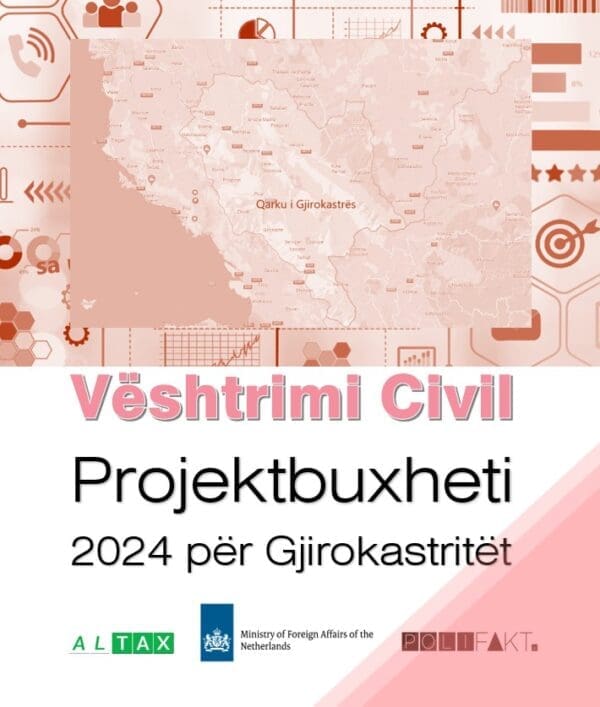
Civil Insight: Draft budget 2024 for Gjirokastra ‘s citizens
0 €
The public budgeting process is a process where important public decisions are made. For this reason, it is seen as a fantastic opportunity for citizen participation.
In the traditional approach to budgeting, the roles of citizens in budget processes are limited, while in the citizen-based approach, they play an increasing role. This budgetary approach used by central administrations is mostly used in local administrations.
Dialogue between administrators and citizens is a useful mechanism for increasing accountability in contested areas.
Such dialogue is a valuable tool to improve citizens’ trust in government. It harmonizes budget decisions with the current priorities and values of citizens. Additionally, participation can feed useful information into the budget. Citizens in cities with higher participation were less cynical and more supportive of local governments.
The 2024 Municipal Budget is an initiative that serves as a technical opposition approach and reflection of the citizen voice based on our Social Audit methodology for local government, which ALTAX experts presented at the beginning of 2022.
In the analysis that compares the achievements of the year 2023 (operational data), as well as the reactions of the citizens summarized by the questionnaire for this purpose during September – October 2023, it is used as a data based on two directions to make an approach of the points of meeting and those who are divided between the budgetary and regulatory offer of the municipality with the requests and reactions of the local public.
A productive approach that is valid in the economic situation and context is the summary with the comments of local business representatives, prominent individuals, students, but also with the strong involvement of the active part of the civil society, which also participates in its widespread.
The budget prepared by the municipality is based on and divided into five categories, which cover a) Salaries and contributions, b) Goods and maintenance, c) Local services, d) Debts and subsidies and d) Capital investments.
- Description
Description
Local governments can make an important contribution to public welfare through the implementation of government policies and the provision of local public services that are important to local citizens.
Their special fiscal advantage lies in the proximity of citizens to decision-makers and administrators of the programs that provide the services.
Local government has the potential to be the most transparent and responsible level of government in providing services to citizens.
However, the full realization of this promise requires strong fiscal administration to reflect citizens’ interests in local programs and to develop policies in a fiscally sustainable manner. Thus, resources do not lose efficiency and can become effective, based on full operations, and narrowing of corrupt acts. The potential for citizen responsiveness means little if resources intended to provide services slip into the pockets of local politicians and bureaucrats.
The immutable reference according to the format already drawn up by the municipality based on the standard model instructed by the Ministry of Finance and Economy does not accept essential changes, as they are the copyright of the government.
The main challenge of engaging citizens in the process of public discussion on local budgeting is that the budget presented to them has already been drawn up and in the consultations, it remains only to accept those facts, when it is necessary to give time and help with civil expertise and local intellectuals to be created the bases for arguments and a structured citizen’s voice in front of the municipality
At the stage in which the budget is prepared and presented in project form, it is difficult to change the budget lines and the allocated amounts. Citizens seeing this and from the experience of the past years have realized that their proposals do not have a significant impact on the budget, are discouraged and hesitate to participate in hearings.
Therefore, a simple practical solution would be for the mayor/local leaders to conduct consultations and public opinion polls before drafting the budget.
Another area that needs to be much more active is online public information, which is published slowly and at best is difficult to access in published formats, creating difficulties in reading and downloading documents.
In the meantime, it would be advisable, according to our experience, to have a discussion with several sessions regarding the implementation of the approved annual budget, from which citizens hear local implementations and performance, but also about certain budget restrictions determined by the Ministry of Finance.
A preliminary information, as well as especially its publication, would help the expertise to give ideas, would stimulate the debate within the citizens and would serve as a dedicated support in the dialogue of the local government with the central institutions.
In some cases, unsolicited capital investment project initiatives or projects that are not a public priority, but part of certain interest groups, have appeared.
In the commitment according to the law “On public notification and consultation”, for which we have communicated not only with the public but also with the Assembly Commissions and the Government’s Good Governance Unit, we are determined regarding essential changes to adhere to some basic principles of good governance.
The citizen-oriented administration approach in the report refers to such broad issues as: increasing the quality of administration in public management, strengthening accountability mechanisms, ensuring transparency in the provision of public services, involving expertise and society groups civil society in policy making, improving trust in the state, and improving the quality of public service.
Related products
-
ALTAX PRODUCTS
Tax system and investment climate in Albania, 2016
Original price was: 12 €.9 €Current price is: 9 €. -
-
ALTAX PRODUCTS
Albanian budget performance 1996 – 2016
Original price was: 65 €.55 €Current price is: 55 €. -
ALTAX PRODUCTS
Minimum wage increase and consume prices in Albania
Original price was: 15 €.13 €Current price is: 13 €. -
ALTAX PRODUCTS
Albania: Impact of economic and fiscal policy in the agriculture
Original price was: 35 €.30 €Current price is: 30 €. -
ALTAX PRODUCTS
Taxation trends in Western Balkans, 2020
Original price was: 18 €.15 €Current price is: 15 €. -
ALTAX PRODUCTS
Tax burden in Albania, Kosovo and Western Balkans, 2020
Original price was: 35 €.32 €Current price is: 32 €.