Bashkohuni me ekipin tonë. A jeni gati të rrisni biznesin tuaj? Mëso më shumë


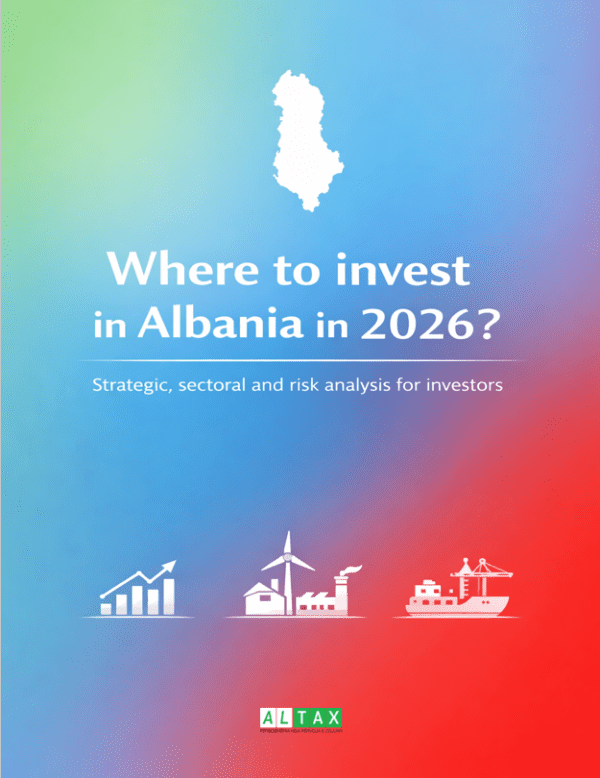
Where to Invest in Albania in 2026?
0 €
Albania in 2026 continues to offer significant investment potential, particularly in the context of European integration and support from international funds. The Albanian economy is characterized by steady growth and the development of strategic sectors, while also facing structural challenges that require careful consideration by investors.
According to official data from the Albanian government and the Bank of Albania, as well as international reports from the European Union (EU), the International Monetary Fund (IMF), and the World Bank, the economy is projected to grow by 3.5% in 2025 and 3.6% in 2026. This growth is driven primarily by domestic consumption, the construction sector, and foreign direct investment (FDI), which reached record levels of €1.71 billion in 2024–2025.
Sectors with high investment potential include:
- Infrastructure and logistics, where public investments and public-private partnerships (PPPs) can offer medium-term returns.
- Tourism and hospitality, due to increasing foreign visitors and the development of new destinations.
- Renewable energy, including projects supported by EU funds and institutions such as the EIB and EBRD.
- Technology and digitalization, encompassing startups and digital services, with opportunities for innovation and integration into international markets.
- Real estate, particularly in major cities and tourist areas.
- Agriculture and agribusiness, leveraging land resources and export potential.
However, these opportunities come with considerable challenges:
- Corruption and lack of transparency, especially in tendering processes and the judicial sector.
- Property rights and land management issues, which affect the security of sustainable investments.
- Administrative inefficiency, slowing project implementation and legal procedures.
- Geopolitical and climate risks, requiring careful planning to minimize potential losses.
The approach of this report is realistic yet promotional, based on evaluations and analysis from the EU (2025 Progress Report), IMF (Article IV Consultation 2025), and World Bank (Western Balkans Regular Economic Report, Autumn 2025). These reports highlight that despite progress, investing in Albania still demands careful attention, reliable partnerships, legal guidance, and risk management.
Public investments are expected to reach 6.5% of GDP in 2026, focusing on strategic projects supported by EU funds (e.g., around €32 million for energy) and financing from institutions such as EIB/EBRD. The Strategic Investment Law has been extended through December 2026, offering fiscal incentives, although EU reports caution that it may create inequalities and corruption risks.
This report is structured by key sectors, combining macroeconomic data, sectoral statistics, and information on ongoing public and private projects. This integrated approach provides a comprehensive overview of investment opportunities and challenges, helping investors make informed strategic decisions and plan investments in a dynamic economic and institutional environment.
- Description
Description
This analytical document, entitled “Where to Invest in Albania in 2026 – Strategic, Sectoral, and Risk Analysis for Investors”, is based on macroeconomic, fiscal, and institutional developments in Albania during 2025–2026, as well as planned or ongoing public and private projects in key economic sectors. The analysis relies on data and assessments from international institutions (IMF, World Bank, European Union), reports on investment climate, and local studies on economic development, regional disparities, and fiscal sustainability.
The document aims to provide a structured, realistic, and critical reference for domestic and foreign investors, identifying the sectors with the highest investment potential in 2026 (tourism and hospitality, renewable energy, infrastructure and logistics, technology and digitalization, real estate, agriculture and agribusiness), along with the actual conditions under which these investments can be realized. The analysis does not serve as mere promotion but as strategic guidance on risk–return trade-offs and medium-term investment predictability.
The study integrates the assessment of physical, energy, financial, and institutional infrastructure, highlighting the role of public investments, public–private partnerships, EU funds (EIB, EBRD), and private capital. Special attention is given to structural challenges affecting investor decision-making, such as access to credit and financing costs, emigration and shortage of skilled labor, regional disparities, climate-related risks and energy dependence, informality, and legal security, including property ownership issues and contract enforcement.
The document includes a comparative sectoral assessment according to feasibility in 2026, identifying sectors with more stable returns and manageable risks, as well as those requiring higher risk tolerance and local experience. In this way, it serves as a guidance tool for strategic investment planning, project structuring, and dialogue between investors, financial institutions, and local partners, in the context of Albania’s European integration process and the need for sustainable economic development.
Related products
-
ALTAX PRODUCTS
Tax notes for construction industry in Albania
Original price was: 15 €.14 €Current price is: 14 €. -
ALTAX PRODUCTS
Tax burden in Albania, Kosovo and Western Balkans, 2020
Original price was: 35 €.32 €Current price is: 32 €. -
ALTAX PRODUCTS
Investment climate and tax system in Albania 2013
Original price was: 11 €.10 €Current price is: 10 €. -
ALTAX PRODUCTS
Tax system incentives in Macedonia
Original price was: 16 €.11 €Current price is: 11 €. -
ALTAX PRODUCTS
Economic growth in Albania: Influencing factors yesterday, today and tomorrow
Original price was: 22 €.20 €Current price is: 20 €. -

-
ALTAX PRODUCTS
The federal system of taxes in Bosnia and Herzegovina
Original price was: 8 €.6 €Current price is: 6 €. -
ALTAX PRODUCTS
Tax system and incentives for investments in Albania
Original price was: 12 €.8 €Current price is: 8 €.