Bashkohuni me ekipin tonë. A jeni gati të rrisni biznesin tuaj? Mëso më shumë


Albanian Wellbeing Index (AWI) 2025
0 €
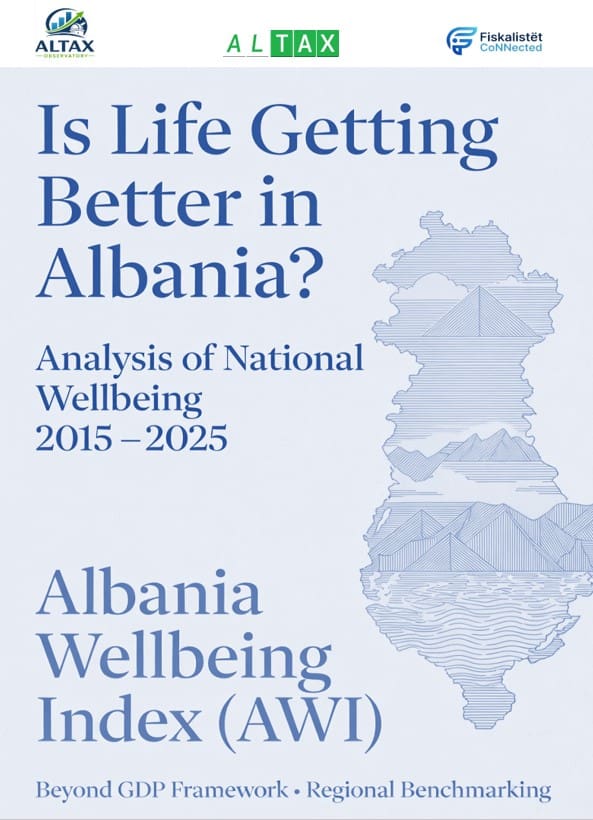
This document provides an in-depth analysis of economic and social wellbeing in Albania for the decade 2015–2025, covering key indicators of economic wellbeing, inequality, health and longevity, education, subjective wellbeing and the environment. The analysis is based on official data from INSTAT, the World Bank, Eurostat, UNDP, WHO and EU-SILC, using the “Beyond GDP” approach to measure real progress.
Albania has recorded real GDP per capita growth of ~45–50%, a reduction in poverty from 27.5% (2015) to 19.2% (2024), a historic transition to “Very High Human Development” (HDI 0.810) and measurable improvements in health, education and gender equality. The Albania Wellbeing Index (AWI), constructed by ALTAX, shows an advance from 52.4 points (2015) to 71.2 points (2025), or +35.9% in relative terms.
However, progress is uneven: the IHDI shows the highest regional inequality loss (13.0%), AROPE remains at 40.5%, and around 900,000 citizens still live in severe material and social deprivation. Rural areas, low-income households and pensioners do not benefit adequately. The report recommends: real indexation of social incomes, progressive fiscal reform, balanced regional development, increased investment in human capital, and acceleration of the energy transition.
Keywords: economic wellbeing, AWI, GDP per capita, poverty, IHDI, inequality, Gini, life expectancy, HALE, fiscal policy, Albania, Western Balkans
JEL Codes: D31, D63, I10, I12, I15, I32, O15, O53, R11
- Description
Description
Albania has achieved notable objective progress during the 2015–2025 decade, but it remains non-inclusive and unequal.
Key Findings – Is Life Getting Better in Albania? (2015–2025)
Notable objective progress – The Albania Wellbeing Index (AWI) rose from 52.4 to 71.2 (+35.9%). HDI moved to Very High (0.810), happiness +0.75 points, and relative poverty at 19.2%.
Non-inclusive growth – IHDI inequality loss 13.0% (highest among peers); ~32.8% of the population in severe material/social deprivation.
Key environmental weakness – PM2.5 is 2.9× above WHO standards. Solar and wind energy only ~2–6%, a weak dimension that penalises AWI.
High improvement potential – Sensitivity analysis shows AWI is robust (±1.5 points), but the environmental dimension requires urgent action.
Five urgent priorities – Real income indexation, progressive fiscal reform, rural development, health/education budget ≥5% GDP, energy transition ≥30% solar and wind. These can bring AWI to ≥80 by 2030.
|
Yes, life is better – but not for everyone, not in an equal manner, and not yet in a sustainable way. Overall wellbeing has improved for the urban middle class (tourism, remittances), but not for ~30–40% of the population (rural residents, pensioners, families with many children). Failure to carry out timely reforms keeps the country trapped in a “middle wellbeing trap”. |
Five urgent priorities for 2026–2030:
- Real automatic indexation of pensions/benefits (2026–2027), reducing elderly poverty by ~13 pp.
- Progressive fiscal reform + fight against evasion (wealth tax), raising redistribution from 20% to ≥30%.
- Balanced Rural Development Programme to close the urban-rural poverty gap.
- Increasing health + education budgets to ≥5% GDP each, with an effect of +2 years healthy life expectancy and better skills.
- Energy transition (solar/wind ≥30%) + PM2.5 plans, reducing health losses of €80–120M/year
Related products
-
ALTAX PRODUCTS
Tax system and incentives for investments in Albania
Original price was: 12 €.8 €Current price is: 8 €. -
ALTAX PRODUCTS
Investment climate and tax system in Albania 2015
Original price was: 12 €.10 €Current price is: 10 €. -
ALTAX PRODUCTS
Tax burden in Albania, Kosovo and Balkans, 2018
Original price was: 35 €.32 €Current price is: 32 €. -
ALTAX PRODUCTS
Tax notes for construction industry in Albania
Original price was: 15 €.14 €Current price is: 14 €.