Bashkohuni me ekipin tonë. A jeni gati të rrisni biznesin tuaj? Mëso më shumë


-9%
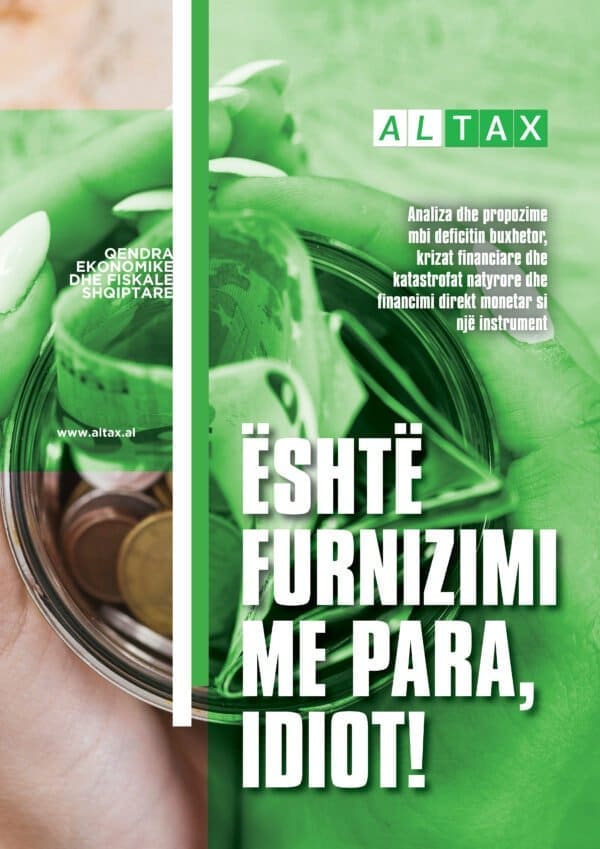
It’s the money supply, idiot!
Original price was: 35 €.32 €Current price is: 32 €.
Of the two main types of monetary policy: restrictive and expansionary, in the summary of our analyzes that have been divided into three parts, we are in the approach of expansionary policy. Meanwhile, restrictive monetary policy is one that is used to reduce the amount of money circulating throughout the economy, usually by selling government bonds, raising interest rates, and increasing monetary reserve requirements for banks.
In most countries during the last three decades there has been a division of responsibilities in macroeconomic policy. Politicians in government have controlled public spending and decision-making on taxes, duties, and fees (fiscal policy). Meanwhile, central banks have had independent control of interest rates (monetary policy) with the objective of keeping inflation under control.
Independence allows monetary policymakers to make whatever choices are necessary to achieve their objective, even when, for example, those decisions increase the government’s borrowing costs. This independence also allows the central bank to stick to a medium-term objective, above and beyond the political election cycle.
But the degree of economic slowdown in almost the entire last decade and especially the increase in financial risk and a general collapse of confidence in the domestic market and economy require the Bank of Albania to look for new options beyond the conventional stimulus.
Therefore, this difficult global financial moment limits the ability of the Bank of Albania to influence the increase in interest rates to control inflation. To address this, and still with the aim of controlling inflation, the Bank must start a bold program due to the unsustainable and complete conditions for the implementation of Quantitative Easing (alb. Lehtësimi Sasior).
Monetary financing is the direct transfer of money spent by the government. This can be done through the direct purchase of debt by the central bank, where the Bank of Albania expands its balance sheet through purchases of government debt.
If we mention Quantitative Easing (QE), it does not constitute direct monetary financing/money printing. QE is like open market operations, where purchases are made in the secondary market, meaning that, at least directly, the government receives no additional revenue from the transactions.
- Description
Description
Money printing is different from QE. Printing money is an inflationary approach. Unlike money printing, which involves distributing printed money to the public, central banks use quantitative easing to create money and then buy assets using the printed money.
If the central bank rapidly prints a lot more money and immediately puts it into circulation, then more money will be used to buy the same amount of goods and services.
But if this money is to be used to pay the budget bills for the old owners, for the persecuted of the communist regime, as well as many other overdue bills, then the printing of money takes on a different and much more stimulating meaning.
However, given the fact that Quantitative Easing pushes interest rates down, it may be more effective and may serve as a valuable countermeasure at this time to influence the effects that interest rate hike policy may have.
Although QE aims to stabilize an economic contraction when inflation is extremely low or negative and when the standard instruments of monetary policy have become ineffective, under the conditions of the existence of rising inflation a supply of the economy through consumer spending would be the cheapest substitute of money laundering and the Fiscal Amnesty initiative launched recently again by Government.
All this financial logic becomes functional in the current conditions of government-individual relations, but also of banks with individuals and especially large businesses. When banks seek to increase their capital and borrowers will try to pay their debts, QE cannot increase the money supply and therefore cannot cause another impact on inflation.
The impact of QE through the purchase of assets (money) can affect a period when inflation will normalize with lower interest rates, but for a longer time than the impact of inflation itself, which reduces the cost of borrowing for loans with longer maturity helping to increase demand. In this sense, QE and BSH’s policy for normalizing inflation reinforce each other, but without QE prevailing.
This conclusion is based on the argument that asset purchases reduce the supply of purchased assets in the market by increasing their (money) price and reduce the implied cost of borrowing for the issuer (yield). By changing the relative offers of specific assets of different maturities and liquidity, the central bank can lower the yield of some long-term nominal assets, except for treasury bonds because of the substitutability of these assets.
From the perspective of a fiscal authority, the idea of paying for government spending with added money, as opposed to government debt, is understandable and attractive. Also, considering the debates about austerity measures in the last year and the historically high government debt, there is room for a policy of QE and even direct monetary financing to ease the government’s budget constraints. Especially in a fiscal crisis, this appeal is even stronger.
Milton Friedman’s idea of direct money supply considering also the economic effects derived from deviations from those determined by the Ricardian criteria, given the scarce use of money in the conditions of shrinking domestic consumption, the case seems stronger to use. By printing money, a channel is found to redistribute the active agents in the economy with a more powerful effect.
NOTE! The Summary is downloadable only in Albanian version and could be translated by private requests.
Related products
-
ALTAX PRODUCTS
Taxation trends in Western Balkans, 2020
Original price was: 18 €.15 €Current price is: 15 €. -
ALTAX PRODUCTS
Albanian partnership taxation regime
Original price was: 18 €.15 €Current price is: 15 €. -
ALTAX PRODUCTS
Economic growth in Albania: Influencing factors yesterday, today and tomorrow
Original price was: 22 €.20 €Current price is: 20 €. -
-
ALTAX PRODUCTS
Tax system and investment climate in Albania, 2016
Original price was: 12 €.9 €Current price is: 9 €. -
ALTAX PRODUCTS
Investment climate and tax system in Albania 2013
Original price was: 11 €.10 €Current price is: 10 €. -
ALTAX PRODUCTS
Tax gap in Kosovo and Albania, 2014
Original price was: 35 €.33 €Current price is: 33 €. -
ALTAX PRODUCTS
Tax notes for construction industry in Albania
Original price was: 15 €.14 €Current price is: 14 €. -
ALTAX PRODUCTS
Tax system incentives in Macedonia
Original price was: 16 €.11 €Current price is: 11 €.