Bashkohuni me ekipin tonë. A jeni gati të rrisni biznesin tuaj? Mëso më shumë


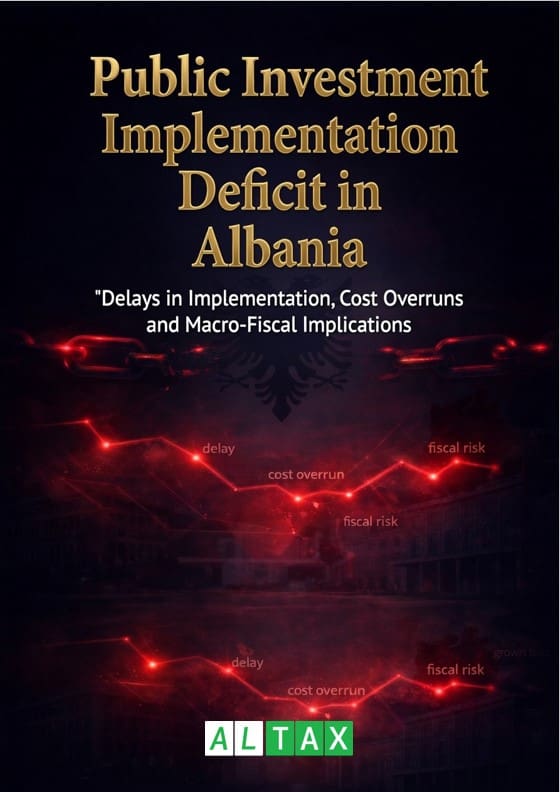
Public Investment Implementation Deficit in Albania
20 €
Public investments in infrastructure are one of the most important levers for economic growth in a developing country like Albania. However, when these investments suffer from systemic delays, they not only generate additional costs — they become a long-term fiscal burden and real losses for citizens and the economy.
This section places the problem in its macroeconomic and institutional dimension, showing why delays are not merely a technical issue but a structural challenge affecting the whole country.
Public investments in infrastructure (roads, water supply, sewerage, drainage, irrigation and urban/rural development) have a multiplier effect (fiscal multiplier) that, according to World Bank and IMF estimates, typically ranges between 1.2 and 1.5. This means that every 1 ALL spent on infrastructure generates 1.2–1.5 ALL in additional economic activity over the next 3–5 years, primarily through increased productivity, reduced transport and logistics costs, and improved competitiveness for businesses and tourism.
In theory, public investments are a powerful ‘engine’ for development. But in practice, in Albania this multiplier effect has been significantly reduced due to systemic delays. When a project is delayed by 3–5 years, the economic benefits (time savings, better market access, tourism growth, higher agricultural output) are pushed into the future, while costs (budget payments, material inflation, penalties) continue to rise. Our expertise confirms that over-programming (planning 2.25 times above real fiscal capacity) and low maturity (only 36% of projects fully ready) have reduced the fiscal multiplier below 1.0. In other words, today public investments in Albania produce less than they cost and have become expenditure without full economic return.
Albania has a relatively high level of public investment at around 5–7% of GDP in recent years, above the average for many countries in the region. But this high level does not translate into concrete results due to several structural problems:
- Chronic under-execution of the capital budget: Most projects pass to ‘continuation’ status for 3–5 years or more, leaving a large portion of planned funds unspent or redirected.
- Systemic over-programming: The investment portfolio for 2027–2029 reaches €14.83 billion, while the real fiscal capacity of sectoral strategies is only €7.38 billion — a mismatch of 2.25 times. This means two and a half times more is planned than can realistically be financed and implemented.
- Institutional stagnation: 73% of projects compared between the two Priority Policy Documents (PPD 2026–2028 and 2027–2029) have not changed status — a clear sign of lack of capacity to advance projects from idea to implementation.
- Dangerous sectoral concentration: Transport and energy account for 58% of the total portfolio, while social, health and education sectors remain below 5% — an imbalance that undermines sustainable development and achievement of SDGs.
- High risk from PPPs and energy projects: Road concessions (such as Arberi Road, Milot–Morina, Orikum–Dukat) create fixed annual payments of approximately 5–6 billion ALL (2025–2028), while energy projects like Vlora TPP and HVDC have been downgraded to ‘immature’ status, increasing the risk of fiscal contingencies.
These problems are not coincidental. They stem from a planning system that favours the quantity of projects over their quality and readiness — a system that produces long lists, but not a pipeline of implementable investments.
To deeply understand the problem and propose concrete solutions, this report focuses on three fundamental questions:
- How long do public projects actually take? How much time elapses between a project’s approval and the moment it becomes fully functional for citizens?
- How much does each year of delay cost? What is the direct (budget increase) and indirect (productivity loss, delayed tourism, lost agriculture) cost of each additional year?
- What is the cumulative impact on GDP, deficit, debt and investor confidence? How do delays affect long-term economic growth, fiscal balance and the country’s ability to attract private investment?
These questions are those that touch the daily lives of citizens, jobs, municipal revenues and the perspective of Albania’s regional development.
This report offers not only the diagnosis, but also a ready-to-implement reform package that can save 120–170 billion ALL by 2030.
- Description
Description
This study analyses the systemic public investment implementation deficit in Albania, focusing on chronic delays (averaging 2.5–5 years), cost overruns (25–40%) and macro-fiscal losses reaching 0.8–1.4% of GDP annually.
Based on a dataset of 350–400 projects from the road, water & sewerage, drainage-irrigation and urban/tourist development (AADA) sectors, as well as the Priority Policy Documents (PPD 2026–2028 and 2027–2029), the report reveals an over-programming of 2.25 times above real fiscal capacity, with only 36% of projects fully mature.
The Finish Rate Index is only 5–8%, while the fiscal multiplier has fallen below 1.0 due to delays. Using a CGE-lite model, sensitivity analysis and regional comparisons (Georgia, North Macedonia, Croatia), the study estimates cumulative losses for 2020–2028 at 159–260 billion ALL and proposes a concrete reform package for creating a digital Single Project Pipeline, an independent PIM Unit, a statutory fiscal ceiling and performance contracts.
Their implementation could save 120–170 billion ALL by 2030, raise the Finish Rate to 25–30% and improve access to IPA III funds and the Growth Plan. Albania does not suffer from a lack of investment, but from the systemic inefficiency of its execution.
Related products
-
ALTAX PRODUCTS
Investment climate and tax system in Albania 2013
Original price was: 11 €.10 €Current price is: 10 €. -
ALTAX PRODUCTS
Albanian partnership taxation regime
Original price was: 18 €.15 €Current price is: 15 €. -
ALTAX PRODUCTS
Investment climate and tax system in Albania 2015
Original price was: 12 €.10 €Current price is: 10 €. -
ALTAX PRODUCTS
Tax gap in Kosovo and Albania, 2014
Original price was: 35 €.33 €Current price is: 33 €. -
ALTAX PRODUCTS
Minimum wage increase and consume prices in Albania
Original price was: 15 €.13 €Current price is: 13 €. -
ALTAX PRODUCTS
Tax notes for construction industry in Albania
Original price was: 15 €.14 €Current price is: 14 €. -

-
ALTAX PRODUCTS
Economic growth in Albania: Influencing factors yesterday, today and tomorrow
Original price was: 22 €.20 €Current price is: 20 €.